第 12 节 · SECTION 12
11 Engaging in a Healthy Lifestyle

Chapter Outline
Introduction
Student Survey
How do you feel about health and wellness? These questions will help you determine how the chapter concepts relate to you right now. As we are introduced to new concepts and practices, it can be informative to reflect on how your understanding changes over time. We’ll revisit these questions at the end of the chapter to help you identify opportunities for improved health. Take this quick survey to figure it out, ranking questions on a scale of 1–4, 1 meaning “least like me” and 4 meaning “most like me.”
- I eat enough fruits and vegetables every day.
- I get enough sleep.
- I have, for the most part, healthy relationships with friends and family.
- I feel like I know how to manage stress.
You can also take the Chapter 11 survey anonymously online.
Student Profile
“My freshman year of college, I started at a pretty big university. I had what some call “social anxiety” and even cried before getting out the car on my first day. That year was a struggle for me, and I constantly had to fight with myself to step out of my comfort zone in order to succeed. I knew that if I made positive changes to my life then I would easily succeed in school. I joined a group of students who were a support system for me during my first year of college. Together we studied together and even worked out together. It helped me be more involved on my campus and less worried. Being connected with other students has taught me a lot of ways to cope with common problems many students face.
My first advice would be first and foremost, always make sure you are being kind to yourself. It’s not advisable to work 40 hours a week and also try to be a full time student. You need to set up a realistic home and school life so that way you are balanced with your assignments and other responsibilities. You need to give your body and your brain time to rest so you can absorb as much as you want to without restrictions. I found it useful to start working out to make sure that I’m dedicating the time I should be to myself and not working myself until exhaustion. Little things like exercise, yoga and meditation can do amazing things for your body as well as your mind. If you take care of your body, your body will take care of you.”
–Felicia Santiago, Delgado Community College
About this Chapter
This chapter explores the many ways your health is impacted by your lifestyle choices. The goal of this material is to help you do the following:
- Describe actions you can take to improve your physical health.
- Identify ways to maintain and enhance your emotional health.
- Understand mental health risks and warning signs.
- Articulate reasons and ways to maintain healthy relationships.
- Outline steps you can take to be more safety conscious.
Recent headlines were buzzing with news about a 17-year-old boy who lost his eyesight because of a poor diet. While the boy ate enough food and his weight was considered normal, when doctors investigated, they discovered he didn’t eat enough nutrient-rich food. A self-described picky eater, the teen’s daily diet consisted of sausage, deli ham, white bread, Pringles, and french fries. His food choices led to numerous nutritional deficiencies of several essential vitamins and minerals, causing nutritional optic neuropathy.1
Have you heard the saying “you are what you eat”? If so, likely a parent or someone who loves you said it while coaxing you to eat your vegetables. Are we really what we eat, and what does this phrase actually mean? While the example of the boy who lost his vision may be extreme, the food we eat does impact our physical and mental health. What’s at the end of our fork can keep us healthy or eventually make us sick. Every 27 days, our skin replaces itself and our body makes new cells from the food we eat.2 And according to Dr. Libby Weaver, every three months we completely rebuild and replace our blood supply. What you eat becomes you.
It’s not only what you eat that impacts your health but also how much you exercise, how effectively you deal with stress, how well you sleep, your work habits, and even your relationships—these things all have an impact on your well-being.
There are two primary reasons we become unhealthy. First, we do not deliver enough nutrients for our cells to operate properly, and second, our cells are bombarded with too many toxins. Keeping it simple, good health is proper nutrients in, toxins out. Toxins come from a host of sources—certain foods, the environment, stressful relationships, smoking, vaping, and alcohol and drug use. And if we don’t sleep and exercise enough, toxins can hang around long enough to cause us harm.
As a first-year college student you will make many choices without parental oversight, including the food you eat and the way you take care of your body and brain. Some choices put you on a path to health, and other choices can lead you down a path toward illness. There is a strong connection between success in college and your ability to stay healthy.
Health is more than a strong body that doesn’t get sick. Health also includes your overall sense of well-being (mental, emotional) and healthy relationships. Good health is about making positive choices in all of these areas, and avoiding destructive choices. It’s about learning to be smart, to set boundaries, to watch out for your safety, and to take care of the one body that will carry you through life.
While health and wellness are often interchanged, it is important to differentiate the two concepts. Health is a state of physical, mental, and social well-being, while wellness is a process through which people become aware of and make choices toward a healthy and fulfilling life.
11.1 Taking Care of Your Physical Health
| Estimated completion time: 26 minutes. |
Questions to Consider:
- What is healthy eating?
- Why is it important to stay hydrated?
- How important is exercise to a healthy body?
- Are you getting enough sleep to be healthy?
- What are toxins, and how can they affect your health?
You have one body. Treat it well so as to maximize its ability to serve you throughout your life. Often physical health gets moved to the bottom of the priority list when we are busy. Taking care of your physical health doesn’t mean six-pack abs or training for a marathon. It means honoring your physical needs so your body can function properly, feeding your cells the nutrients that will keep your body working well your entire life, and minimizing exposure to toxins to reduce your risk of disease.
Healthy Eating
While it’s not the only thing that contributes to great health, what you eat makes a huge difference. We have 37 trillion cells in our body. The only way they function optimally is with good nutrition. As a college student, you will be surrounded by temptations to eat poorly or even to overeat. It’s now up to you to make wise choices in the face of these temptations. Your dining hall is likely full of many healthy foods and just as many unhealthy foods. You may grab food on the run while racing to class or order a pizza at midnight while studying for a test. Lobby vending machines or a stash of snacks in your room should not turn into a substitute for real meals. The downside of fast food and easy access treats is that many are loaded with sugar, salt, or both.
The United States Department of Agriculture (USDA) updated their Healthy Plate Guidelines in 2011. MyPlate illustrates five different food groups considered the building blocks for a healthy diet—vegetables, fruits, protein, grains, and dairy.
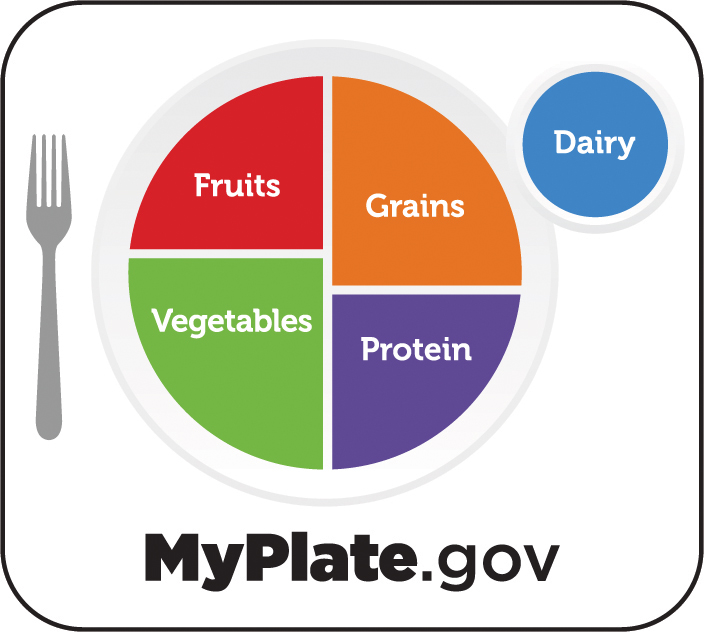
It’s also important to know what is not a healthy plate. A healthy plate is low in refined carbohydrates (donuts, pastries, pasta, cookies), low in sugar, and low in saturated fat (although we need healthy fats like avocado and nuts). You can learn more at https://www.myplate.gov/.
While the USDA’s MyPlate was revised to reflect some key findings at that time, nutritionists at Harvard felt it didn’t offer the most complete picture when it comes to basic nutrition guidelines. They created The Healthy Eating Plate, which is based on what they consider to be the best available science. Similar to MyPlate, half the plate is vegetables and fruit. Aim for eight servings of veggies or fruits a day, more veggies than fruits. It’s important to note that the Harvard version was created without the political pressure from food industry lobbyists (for example, the dairy industry). Note that grains are further defined as whole grains, protein is now healthy protein, and water is emphasized over dairy/milk. What other differences do you see?
This table provides more detail on how The Healthy Eating plate compares to USDA’s MyPlate.
Healthy eating also includes choosing organic fruits and vegetables when possible. By choosing organic, you help lower the amount of toxins your body encounters (since conventional fruits and vegetables are often sprayed with pesticides). Organic foods may not be readily available on your campus or in your local grocery store, so strive to choose the best options possible given availability and your budget. Many college and universities are adding organic food as a result of student demand. If healthy eating is something you are passionate about, consider organizing an effort to influence the dining options on your campus. When shopping on your own, the Dirty Dozen list provided by the Environmental Working Group (EWG) is a good guide of which produce is most important to eat organic, as these are the fruits and vegetables with the most pesticide residue. The EWG also compiles a Clean 15 list of the vegetables and fruits with the least amount of pesticides.
Whole Foods vs. Processed Foods
Choose whole foods. Whole foods are any foods that have not been processed, packaged, or altered in any way. Whole foods are an essential part of a healthy diet because they contain the vitamins and minerals our bodies need.
Examples of whole foods include the following:
- Vegetables: Carrots, broccoli, kale, avocados, cauliflower, spinach, peppers
- Fruits: Apples, bananas, blueberries, strawberries, grapes, melons, peaches
- Grains: Brown rice, oatmeal, barley, buckwheat, quinoa, millet
- Beans: Black, pinto, kidney, black-eyed peas, chickpeas
Minimize non-whole foods. These are foods that have been processed, such as cookies, hot dogs, chips, pasta, deli meat, and ice cream. Even seemingly healthy foods like yogurt, granola, and protein bars are processed and should be checked for added sugar and other unhealthy ingredients.
The average American eats 62 percent of their daily calories from processed foods.3 In order for your body to be as healthy as possible, it’s extremely important to include lots of whole foods in your diet.
“When you eat junk food you think junk thoughts.”
— Michael Bernard Beckwith
How to Read a Food Label
The U.S. government requires food manufacturers to put a label on every processed food product. This is so we, as consumers, know what we are putting into our bodies and can make good dietary choices. A quick review of the label will provide a lot of important information about what you are eating, yet most people don’t take the time to read the label. This is a big mistake.
Think of the front of the package as a marketing billboard. Don’t be fooled by the marketing. Every day millions of dollars are spent to persuade us to eat foods that are not healthy for us. Through visuals (like the strawberry on the bottle of dressing below) and words (like natural, healthy, or gluten free), the food industry wants us to make assumptions about the nature of a food product without looking at the facts. For example, many people eat protein bars thinking they are a healthy choice, but protein bars can have up to 30 grams of sugar! Understanding the nutrition information and ingredients will help you make healthier choices. When you take the time to read the labeled ingredients, you are no longer being marketed to—you are staring at the facts.
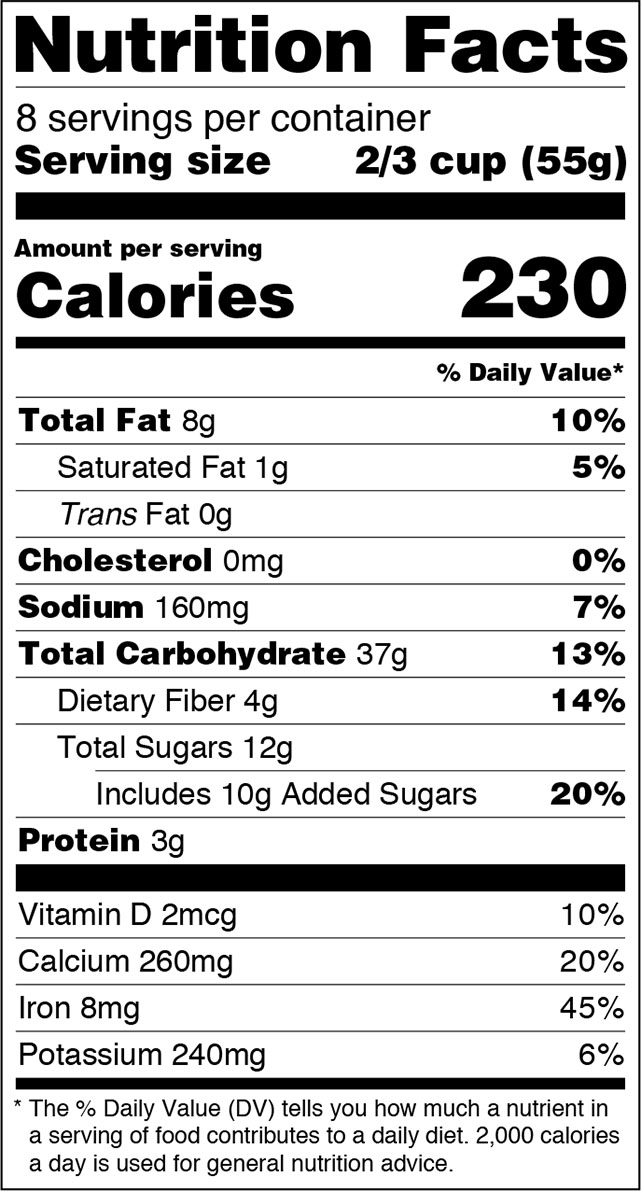
Look at the label on the back of what appears to be a healthy item: fruit salad or fruit cocktail. One of the first things to look for is the amount of sugar. 12 grams equals just under 2.5 teaspoons. The serving size indicated is 2/3 cups, so if you have double that amount, it’s the equivalent of spooning out 5 teaspoons of sugar. The lower the sugar the better.
It’s also important to avoid high amounts of sodium, to minimize saturated fats, and to avoid all trans fats. Trans fats are unhealthy substances made through the process of solidifying liquid oils to increase the shelf life of foods. Also called partially hydrogenated oil, trans fats are often found in margarine, microwave popcorn, crackers, cookies, and frozen pizza. Saturated fat usually comes from animal products like butter and meat fat. Saturated fat tends to raise the level of cholesterol in the blood, and while some is OK, moderation is best.
Dietary fiber is a good thing; the higher the number the better. Fiber has virtually no calories, but it holds water in your stomach, makes you feel full, and helps with digestion. Vitamins are very important. Aim to get to 100 percent of your recommended daily value through the food you eat throughout the day.
Next, look at the ingredient list that can be found at the bottom of the nutrition label. A long list of ingredients likely contains fillers and preservatives you should avoid. If you can’t pronounce an ingredient, you can generally assume it is not a healthy option. And it’s not only what you eat, it’s what you don’t eat. As a rule, the fewer the ingredients, the better.
This video on how to read a food label is a helpful overview on what else to look for.
You can also download the Fooducate app, which allows you to scan the bar code of any food item and quickly see a report card and suggestions for healthier alternatives.
Analysis Question
Take a few minutes to write down everything you ate in the last two days. Now review your list and estimate what percent of your food intake came from whole foods. How did your meals compare to The Healthy Plate? Where is there opportunity for healthier choices? How can these changes benefit you?
What You Drink
What is your go-to drink when you are thirsty? Soda? Juice? Coffee? How about water? Most of your blood and every cell in your body is composed of water. In fact, water makes up 60 to 80 percent of our entire body mass, so when we don’t consume enough water, all kinds of complications can occur. To function properly, all the cells and organs in our body need water. Proper hydration is key to overall health and well-being. By the time you feel thirsty, you are already dehydrated. Dehydration is when your body does not have as much water and fluids as it needs. Researchers at Virginia Polytechnic discovered that mild dehydration (as little as losing 1 to 2 percent of body water) can impair cognitive performance.4 Water increases energy and relieves fatigue, helps maintain weight, flushes toxins, improves skin complexion, improves digestion, and is a natural headache remedy (your brain is 76 percent water). Headaches, migraines, and back pains are commonly caused by dehydration. Your body will also let you know it needs water by messaging through muscle cramps, achy joints, constipation, dry skin, and of course a dry mouth.
Aside from feeling thirsty, the easiest way to tell if you are dehydrated is to check your urine. If it is a dark shade of yellow, your urine is over-concentrated with waste. This happens because water helps flush out waste and when you’re hydrated there’s a higher ratio of water to waste, turning your urine a lighter color.
One of the best habits you can develop is to drink a large glass of water first thing in the morning. Your body becomes a little dehydrated as you sleep. Drinking water first thing in the morning allows your body to rehydrate, which helps with digestion and helps move the bowels for regularity in the morning. It also helps to eliminate the toxins your liver processed while you slept.
Check out this video for more benefits of drinking water.
Staying hydrated is important to keep your body healthy, energized, and running properly. As a general guideline, aim to drink eight glasses of water a day, although a more helpful guide is to drink half your body weight in ounces (for example, if you weigh 150 lb, try to drink 75 oz of water a day). One of the best ways to remind yourself to drink throughout the day is to buy a reusable bottle and bring it everywhere you go. There are two reasons to use a refillable water bottle instead of a plastic bottle:
- Your own health. Most plastic water bottles have a chemical called bisphenol A (BPA), which is added to plastics to make them more durable and pliable. BPA is known to disrupt hormones and has been linked to sperm dysfunction.
- The health of the planet. Do you know that every time you drink from a plastic water bottle and casually toss it in the trash, it can stay on the planet approximately 450 years?5 Even when you recycle, the complex nature of recycling doesn’t guarantee your plastic bottle will make it through the process. Americans purchase about 50 billion water bottles per year, averaging 13 bottles a month for each of us. By using a reusable water bottle, you can save an average of 156 plastic bottles annually.65https://www.telegraph.co.uk/news/2018/01/10/stark-truth-long-plastic-footprint-will-last-planet/6https://www.earthday.org/2018/03/29/fact-sheet-single-use-plastics/#_ftn5
“But I don’t like the taste of water!” It may take time, but eventually you will. Add a little more each day, and eventually your body will feel so fantastic fully hydrated that you will have water cravings. In the meantime, you can visit the dining hall in the morning and add lemon, lime, berries, watermelon, cucumbers, or whatever taste you enjoy that will add a little healthy flavor to the water.
While water is undeniably the healthiest beverage you can drink, it is unrealistic to assume that is all you will drink. Be careful to minimize your soda intake, as most sodas are loaded with sugar or artificial sweeteners (which can be even worse than sugar). And unless you are squeezing your own fruit juice, you are also likely drinking a lot of sugar. Many fruit juices sold in supermarkets contain only a small percentage of real fruit juice, and have added sugar and other unhealthy sweeteners like high-fructose corn syrup. A 12-oz glass of orange juice can contain up to 9 teaspoons of sugar, about the same as a 12-oz can of Coke! Hot or cold herbal teas are a wonderful addition to your diet.
Exercise
Many people exercise to maintain or lose weight, or increase cardiovascular health, but physical outcomes are only one potential benefit of exercise. Regular exercise can improve the quality of your sleep, strengthen your bones, increase your energy levels, and reduce your risk of high blood pressure, diabetes, and even some forms of cancer.7 Regular exercise is key to living a long, healthy life.
There are three basic types of exercise—flexibility, strength training, and cardiovascular.
- Flexibility is the range in motion of the joints in your body, or the ability for your muscles to move freely. Without adequate flexibility, daily activities can become difficult to do. Stretching increases your body’s flexibility, improves circulation, and sends more blood to your muscles. Just a few minutes a day of deep stretching can have a powerfully positive impact on your health. Yoga and Tai Chi are other wonderful ways to improve your flexibility.
- Strength is the body’s ability to produce force. Strength training helps improve muscle strength and muscle mass, which will become increasingly important as you age. Increased muscle helps your body burn calories more efficiently. Strength training also helps maintain bone strength. In addition to lifting weights, other ways to build strength include push-ups, pull-ups, squats, lunges, and yoga.
- Cardiovascular is the body’s ability to use oxygen efficiently during exercise. As one’s ability to use oxygen improves, daily activities can be performed with less fatigue. Great cardiovascular modes of exercise include jogging, swimming, biking, and HIIT (high intensity interval training). HIIT is short bursts of intense activity followed by a rest period. With HIIT, you can squeeze a lot of benefit into a short period of time. Click here for an example of HITT workouts.

Research indicates that regular aerobic exercise can support memory and cognition. In these studies, aerobic exercise generally increases the number of new neurons created in the brain’s memory center and also reduces inflammation.8 Inflammation in the brain may contribute to the development of dementia and other neurodegenerative conditions. It might be good timing to take a jog before you sit down to study for a test!
It’s important to move throughout the day, and every day. Aim to exercise for 150 minutes a week. You don’t have to be the king or queen of CrossFit; it’s the daily movement that is most important. While it is best to integrate all three types of exercise, the best exercise is the one you will actually do. Find and commit to a form of exercise you will enjoy.
Toxins
We live in an increasingly toxic world. Since the Industrial Revolution, we have released thousands of man-made chemicals into the environment. These chemical toxins are in our food (pesticides, conventional fertilizers), in food packaging, in household products, and in our personal care products. Many of these chemicals have been linked to infertility, asthma, migraines, ADHD, and cancer.
The complicated thing about these chemicals is that their effects can take years or even decades to appear. The chemicals build up over time and they interact with each other, which can result in problems that are not considered by “single chemical” testing (which is the majority of the limited testing that is done).
Now the good news—there are simple things you can do right now to limit the amount of toxins in your environment. First, it is best to avoid any products with “artificial colors” or “fragrance.”
- Artificial colors: Synthetic dyes like Yellow 10, Blue 1, and Red 28 may contain carcinogens and neurotoxins and can be absorbed by your skin and go directly into your bloodstream.
- Fragrance: Have you ever walked down the cleaning and laundry soap aisle and been assaulted by so many fragrances you couldn’t get to the next aisle fast enough? Claiming trade secrets, companies don’t have to tell us what’s in “fragrance,” which can include highly toxic ingredients, hormone disruptors, and carcinogens. Fragranced products come in the form of soaps, cleaners, air fresheners, hand sanitizers, laundry detergents, and personal care products. Studies have repeatedly shown that the synthetic fragrances and other toxic chemicals included in these products are causing a range of health problems.99https://www.ewg.org/
There is a long and ever-growing list of common chemicals to avoid, but it’s hard to remember the names when you are shopping. That’s where a handy app like Healthy Living from the EWG comes in.
Simply scan the bar code of any products you use and learn about any potential health hazards.
“Many Americans are surprised to learn that the ingredients in their makeup, shampoo and body lotion are largely unregulated and, in some cases, harmful to their health. The fact is that companies can put potentially dangerous ingredients into the products they sell without ever having to prove they are safe.”
— Heather White, Environmental Working Group Executive Director
Your skin is your largest organ, and in seconds will absorb what you put on it. It’s important to be wary of conventional skin care products that could potentially leak toxins into your body. Think of your skin as one giant mouth. If you wouldn’t eat the ingredients in your products, think twice before applying them to your skin.
Analysis Question
Are your eating and sleeping habits currently affecting your ability to have a super-successful college experience? Describe the health and wellness changes a commitment to eating clean and sleeping well will bring about, and how you will benefit in the short and long term.
11.2 Sleep
| Estimated completion time: 19 minutes. |
Questions to Consider:
- How much sleep is enough?
- What are the impacts of sleep deprivation?
- Which strategies and support can enhance sleep?
How often do you wake up filled with energy, eager to embrace the day? How often do you wake up still tired, with heavy eyes that just don’t want to open? Your answer to these questions has a direct bearing on the quality of your decisions, your ability to use good judgement, the extent to which you can focus in the classroom, and ultimately your long-term health.
A great night’s sleep begins the minute you wake up. The choices you make throughout the day impact how quickly you fall asleep, whether you sleep soundly, and whether your body is able to successfully complete the cycle of critical functions that only happen while you sleep.
Sleep is the foundation of amazing health, yet almost 40 percent of adults struggle to get enough sleep.10 Lack of sleep affects mental and physical performance and can make you more irritable. The diminished energy that results from too little sleep often leads us to make poor decisions about most things, including food. Think about the last time you were really tired. Did you crave pizza, donuts, and fries—or a healthy salad? Studies have shown that people who sleep less are more likely to eat fewer vegetables and eat more fats and refined carbohydrates, like donuts.11
With sufficient sleep it is easier to learn, to remember what you learned, and to have the necessary energy to make the most of your college experience. Without sufficient sleep it is harder to learn, to remember what you learned, and to have the energy to make the most of your college experience. It’s that simple.
What Happens When We Sleep?
Sleep is a time when our bodies are quite busy repairing and detoxifying. While we sleep we fix damaged tissue, toxins are processed and eliminated, hormones essential for growth and appetite control are released and restocked, and energy is restored. Sleep is essential for a healthy immune system. How many colds do you catch a year? How often do you get the flu? If you are often sick, you do not have a healthy immune system, and sleep deprivation may be a key culprit.
A review of hundreds of sleep studies concluded that most adults need around eight hours of sleep to maintain good health. Some people may be able to function quite well on seven and others may need closer to nine, but as a general rule, most people need a solid eight hours of sleep each night. And when it comes to sleep, both quantity and quality are important.
When sleep is cut short, the body doesn’t have time to complete all the phases needed for the repair and detoxification.
A tiny lobe called the pineal gland helps us fall asleep. The pineal gland secretes melatonin to calm the brain. The pineal gland responds to darkness. If you are watching TV until the minute you go to bed and then sleep with the artificial light from smartphones and other devices, your brain is tricked into thinking it is still daylight; this makes it difficult for the pineal gland to do its job. In addition, if the TV shows you watch before bed are violent or action-packed, your body will release cortisol (the stress hormone). Anything that creates stress close to bedtime will make it more difficult to fall asleep. A bedtime practice of quiet activities like reading, journaling, listening to music, or meditation will make it much easier to fall asleep.
What Happens If You Don’t Get Enough Sleep?
Lack of sleep has a big impact on your overall state of health and well-being. Studies have linked poor sleep to a variety of health problems. The U.S. Centers for Disease Control and Prevention have identified sleep deprivation as a public health epidemic.
A lack of sleep can change the way your genes express themselves. One notable study involved a group of healthy adults limited to six hours of sleep for one week. Researchers then measured the change in gene activity compared to the prior week when these same people were getting a full eight hours of sleep a night. The lack of sleep caused the activity of 711 genes to become distorted. About half of the genes were switched off by a lack of sleep, and these genes were associated with the immune system. The other half of the genes experienced increased activity from a lack of sleep, and these were genes associated with the promotion of tumors, genes associated with long-term chronic inflammation, and stress genes.12
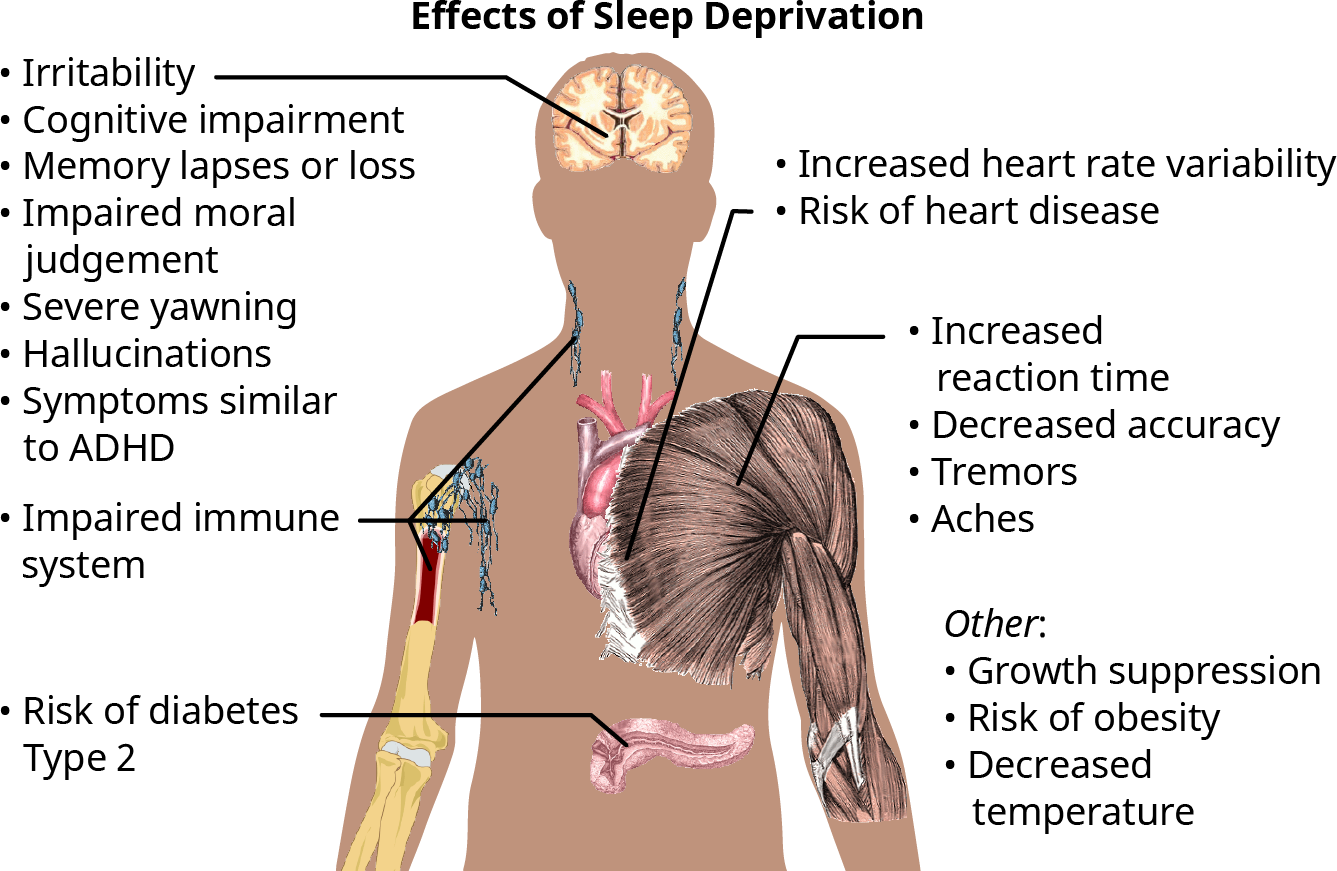
Some of the health risks of insufficient sleep include the following:
Increased risk of heart attack and stroke: In his book Why We Sleep, Matthew Walker, PhD, shares Japanese research showing that male workers who average six hours of sleep or less are 400 to 500 percent more likely to suffer one or more cardiac arrests than those getting more than six hours of sleep each night. Another study of women between the ages of 20 and 79 found that those who had mild sleep disturbance such as taking longer to fall asleep or waking up one or more times during the night were significantly more likely to have high blood pressure than those who fell asleep quickly and slept soundly.13
Impaired cognitive function: Even one night of sleeping less than six hours can impact your ability to think clearly the next day.
Increased risk of accidents: Sleep deprivation slows your reaction time, which increases your risk of accidents. You are three times more likely to be in a car crash if you are tired. According to the American Sleep Foundation, 40 percent of people admitted to falling asleep behind the wheel at least once. A Governor’s Highway Safety Association report estimates there are 6,400 fatal drowsy driving crashes each year. Fifty percent of these crashes involve drivers under the age of 25.14
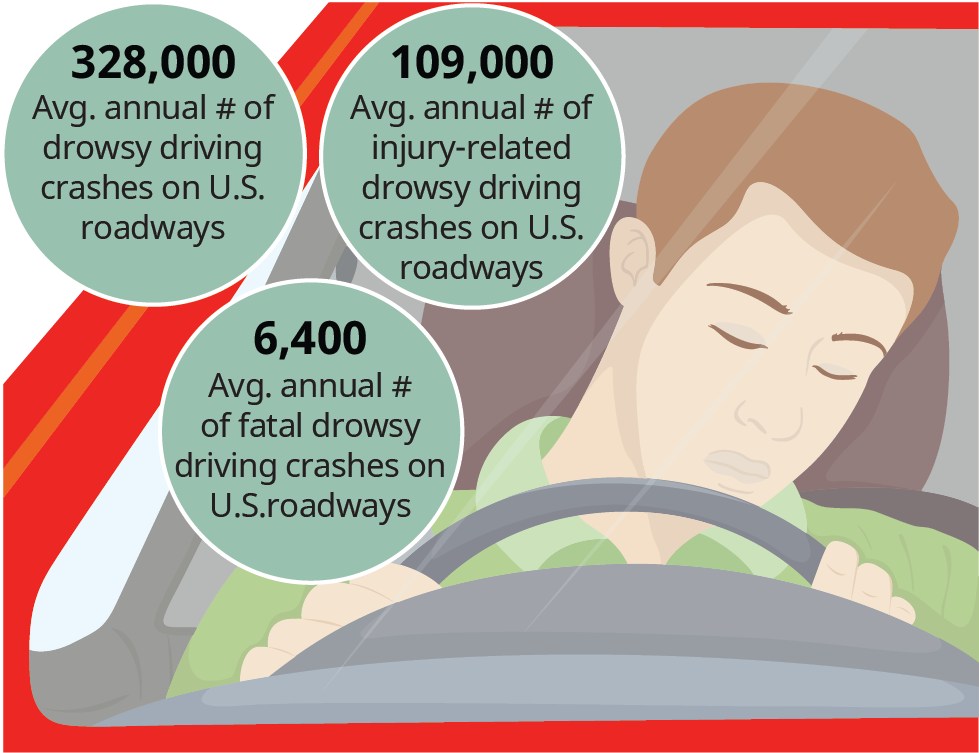
Driving after 20 hours without sleep is the equivalent of driving with a blood-alcohol concentration of 0.08 percent—the U.S. legal limit for drunk driving.
Weight gain/increased risk for obesity: Sleep helps balance your appetite by regulating hormones that play a role in helping you feel full after a meal. Also, cortisol is released during times of anxiety, and exhaustion causes your body to produce more cortisol. This can stimulate your appetite.
Increased risk of cancer: Tumors grow up to three times faster in laboratory animals with severe sleep dysfunctions. Researchers believe this is because of disrupted melatonin production, as melatonin has both antioxidant and anticancer activity.
Increased emotional intensity: The part of the brain responsible for emotional reactions, your amygdala, can be 60 percent more reactive when you've slept poorly, resulting in increased emotional intensity.
For more information on the advantages and health risks of sleep watch this TED Talk by Matt Walker, PhD, Director of the Sleep Center at U California Berkeley.
Tips to Improve the Quality of Your Sleep
Now that you are more aware of the ways insufficient sleep harms your body, let’s review some of the things you can do to enhance your sleep.
Make sleep a priority.
It can be challenging in college, but try to get on a schedule where you sleep and wake at the same time every day to get your body accustomed to a routine. This will help your body get into a sleep rhythm and make it easier to fall asleep and get up in the morning.
Sleep in a cool, quiet, dark room.
Create a sleeping environment that is comfortable and conducive to sleep. If you can control the temperature in your room, keep it cool in the evening. Scientists believe a cool bedroom (around 65 degrees) may be best for sleep, since it mimics our body's natural temperature drop. Exposure to bright light suppresses our body’s ability to make melatonin, so keep the room as dark as possible. A 2010 study in The Journal of Clinical Endocrinology & Metabolism found that individuals exposed to room light “during the usual hours of sleep suppressed melatonin by greater than 50%.”15 Even the tiniest bit of light in the room (like from a clock radio LCD screen) can disrupt your internal clock and your production of melatonin, which will interfere with your sleep. A sleep mask may help eliminate light, and earplugs can help reduce noise.
Avoid eating late or drinking alcohol or caffeine close to bedtime.
It is best to finish eating at least two hours before bedtime and avoid caffeine after lunch. While not everyone is affected in the same way, caffeine hangs around a long time in most bodies. Although alcohol will make you drowsy, the effect is short-lived and you will often wake up several hours later, unable to fall back to sleep. Alcohol can also keep you from entering the deeper stages of sleep, where your body does most of the repair and healing. A 2013 Scientific Research study concluded that “energy drinks, other caffeinated beverages and alcoholic beverages are risk factors of poor sleep quality.” It’s important to finish eating hours before bedtime so your body is able to heal and detoxify and it is not spending the first few hours of sleep digesting a heavy meal.
Start to wind down an hour before bed.
There are great apps to help with relaxation, stress release, and falling asleep. Or you can simply practice 4-7-8 breathing to calm your nervous system—breathe in to the count of 4, hold your breath for a count of 7, and release your breath slowly to the count of 8.
Consider the Insight Timer app, or any of the free apps listed by the American Sleep Association.
Exercise for 30 minutes a day.
One of the biggest benefits of exercise is its effect on sleep. A study from Stanford University found that 16 weeks in a moderate-intensity exercise program allowed people to fall asleep about 15 minutes faster and sleep about 45 minutes longer. Walking, yoga, swimming, strength training, jumping rope—whatever it is, find an exercise you like and make sure to move your body every day.
Improve your diet.
Low fiber and high saturated fat and sugar intake is associated with lighter, less restorative sleep with more wake time during the night. Processed food full of chemicals will make your body work extra hard during the night to remove the toxins and leave less time for healing and repair.
Sleep affects how we look, feel, and function on a daily basis and is vital to our health and quality of life. When you get the sleep your body needs, you look more vibrant, you feel more vibrant, and you have the energy to live your best life.
Now, with a better understanding of the benefits of getting the recommended hours of nightly sleep and the health risks of not getting enough sleep, what changes can you make to improve the quality and quantity of your sleep?
What If I’m Doing All These Things and I Still Have Trouble Sleeping?
People that have trouble falling asleep also often have low magnesium levels (sources suggest that over half of the adults in the United States are magnesium deficient). You can ask your doctor to check your magnesium levels, but you can also focus on eating magnesium-rich foods to help. One of the best magnesium-rich snacks is pumpkin seeds. Other great sources are almonds, sesame seeds, and walnuts.
Difficulty sleeping may be a sign that you have a clinical sleep problem, such as insomnia or sleep apnea. If you are doing all the right things and still have trouble falling or staying asleep, talk to your doctor.
These are some resources for insomnia:
- Healthy Sleep, Harvard Medical School Division of Sleep Medicine
- Insomnia Treatment, American Association of Sleep Medicine
- Sleep Medicine, Society of Behavioral Sleep Medicine
Analysis Question
Do you have a ritual to shut down your day and calm your mind? If yes, can you identify two ways to improve upon your current ritual? If no, what three things can you put in place to prepare your body and mind for a restorative night’s sleep?
11.3 Taking Care of Your Emotional Health
| Estimated completion time: 16 minutes. |
Questions to Consider:
- What are some of the ways to tell if you are holding onto stress?
- How do mindfulness and gratitude encourage emotional health?
Identifying and Managing Stress
According to a 2018 report from the American College Health Association, in a 12-month period 42 percent of college students reported that they have felt so depressed it was difficult to function, and 63 percent reported feeling overwhelming anxiety.16 Your ability to manage stress, maintain loving relationships, and rise to the demands of school and work all impact your emotional health.
Stress is not always bad. In fact, some stress is helpful. Good stress is stress in amounts small enough to help you meet daily challenges. It’s also a warning system that produces the fight-or-flight response, which increases blood pressure and your heart rate so you can avoid a potentially life-threatening situation. Feeling stressed can be perfectly normal, especially during exam time. It can motivate you to focus on your work, but it can also become so overwhelming you can’t concentrate. It’s when stress is chronic (meaning you always feel stressed) that it starts to damage your body.
What Chronic Stress Does to Your Body
Do you find it difficult to concentrate or complete your work? Are you frequently sick? Do you have regular headaches? Are you more anxious, angry, or irritable than usual? Do you have trouble falling asleep or staying awake? If you answered yes to any or all of these questions, you may be holding on to too much stress.
Stress that hangs around for weeks or months affects your ability to concentrate, makes you more accident-prone, increases your risk for heart disease, can weaken your immune system, disrupts your sleep, and can cause fatigue, depression, and anxiety.17 To learn more about what stress does to your body, click here: apa.org/helpcenter/stress.
Some people refer to the time we are living in as the age of overload. It’s easy to get worn down by social media and the constant news cycle, and to be overwhelmed by too many choices. We live in a fast-paced, always-on world with a lot of pressures. The military created the VUCA acronym for the world we currently live in. VUCA stands for volatile, uncertain, complex, and ambiguous, and as a result of living in this VUCA world, many of us are in a constant state of overdrive.
You will have stress. Stress is inevitable. It’s how you deal with it that can make all the difference. One of the most important things you can do is to keep perspective on your stressors. When feeling stressed, ask yourself, on a scale of 1 to 100, how stressful a situation is this? Will I even remember this three years from now? When facing potential stressors, the way you view what you're experiencing can intensify your stress or minimize it.
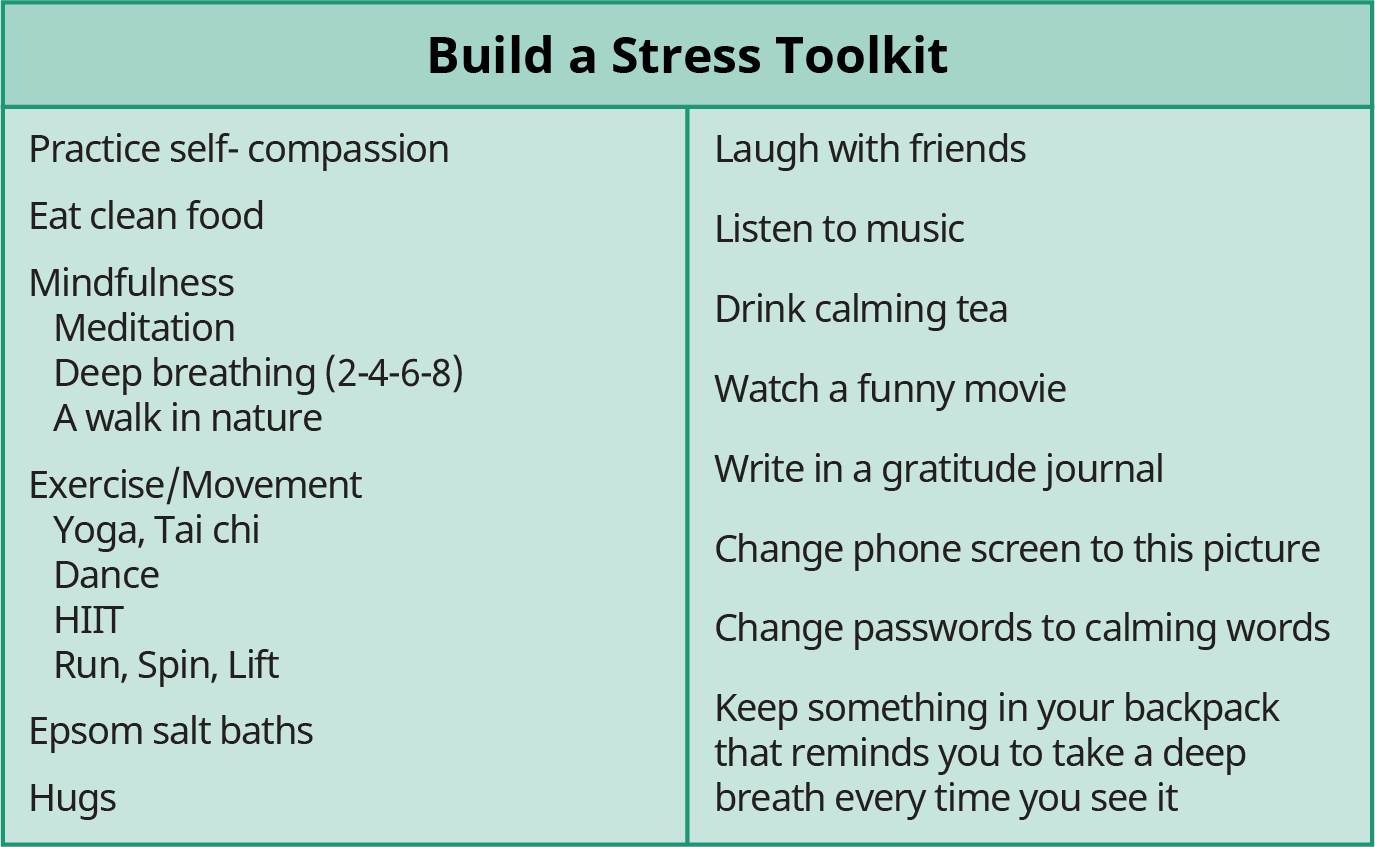
There are many ways to manage stress. Take a look at some of the ideas in the stress toolkit below. Which ones have you tried? Which ones do you want to try? It’s helpful to have different tools for different situations—for example, a calming yoga pose in your dorm room and deep breathing in the classroom.
Mindfulness and Gratitude
Deep breathing, mindfulness, and a practice of gratitude are some of the most effective ways to manage stress and take care of your emotional health.
Mindfulness
Mindfulness means being present with your thoughts, feelings, bodily sensations, and surrounding environment. Mindfulness is also without judgement—meaning there is no right or wrong way to think or feel in a given moment. When we practice mindfulness, our thoughts tune into what we’re sensing in the present moment rather than rehashing the past or imagining the future.18
Anything that keeps you present in the moment and gives your prefrontal cortex (the reasoning and thinking part of your brain) a break is practicing mindfulness. Mindfulness can be a slow walk; looking intently at the grass, trees, flowers, or buildings; and being aware of what you are sensing and feeling. Mindfulness can be sitting quietly—even sitting still in a quiet place for as little as a few minutes can reduce heart rate and blood pressure.19
Developing a practice of mindfulness is easier than you may think:
- Slow down. From brushing your teeth, to washing your face, to shampooing your hair—can you take the speed out of getting ready in the morning? Focus on the activity, pay attention to what you are doing, stay present (this means don’t think about what happened last night or what’s in store for the day, just stay focused on the activity), and take your time.
- Focus on your breath. How fast are you breathing? Is your breath coming from your chest or your belly? Can you feel the air come through your nose on the inhale? Can you slow down the exhale? Can you feel your body relax when you slow the exhale?
- Connect to your environment. Walk for a few minutes, focused on the world around you—look at the leaves on the trees or the light at the corner, listen to the sounds around you, stay with your surroundings, and observe what you see and hear around you.
“We can’t change the world, at least not quickly, but we can change our brains. By practicing mindfulness all of us have the capacity to develop a deeper sense of calm.”
— Rick Hanson, author, Resilient
Deep Breathing
When people hear mindfulness they often think meditation. While meditation is one method of mindfulness, there are many others that may be simpler and easier for you to practice. Deep breathing helps lower stress and reduce anxiety, and it is simple yet very powerful. A daily mindful breathing practice has been shown to reduce test anxiety in college students.20 A 2-4-6-8 breathing pattern is a very useful tool that can be used to help bring a sense of calm and to help mild to moderate anxiety. It takes almost no time, requires no equipment, and can be done anywhere:
- Start by quickly exhaling any air in your lungs (to the count of 2).
- Breathing in through your nose, inhale to the count of 4.
- Hold your breath for a count of 6.
- Slowly exhale through your mouth to the count of 8.
This is one round. Do not repeat the quick exhale again. Instead start round two with an inhale through your nose to the count of 4, hold for 6, and exhale to 8. Repeat for three more rounds to relax your body and mind.
With practice, 2-4-6-8 breathing will become a useful tool for times when you experience tension or stress.
Meditation
Dan Harris, a news reporter at ABC, fell into drug use and suffered a major panic attack on national television. Following this embarrassing period in his life, he learned to meditate and found that it made him calmer and more resilient. He’s now on a mission to make meditation approachable to everyone. Dan used to be a skeptic about meditation but now says that if he learned to meditate, anyone can learn to meditate! Dan reminds us that we ARE going to get lost, and our mind IS going to stray, and that’s ok. Simply notice when you’re lost and start over. Every time your mind strays and your start over, it is like a bicep curl for your brain. Start with 3 minutes and slowly work your way up to 15 or 20. To hear more about Dan’s journey, watch this video, and for a simple meditation to get started, you can try one of the videos on the meditation Youtube channel.
Some great meditation apps include Insight Timer, CALM, and Headspace.
Gratitude
Too often people think it is the external factors that bring us joy and happiness, when really it’s all related to internal work. According to UCLA’s Mindfulness Awareness Research Center, “Having an attitude of gratitude changes the molecular structure of the brain, and makes us healthier and happier. When you feel happiness, the central nervous system is affected. You are more peaceful, less reactive and less resistant.”21
Numerous studies show that people who count their blessings tend to be happier and less depressed. In a UC Berkeley study, researchers recruited 300 people who were experiencing emotional or mental health challenges and randomly divided them into three groups. All three groups received counseling services. The first group also wrote a letter of gratitude every week for three weeks. The second group wrote about their thoughts and feelings with negative experiences. The third group received only counseling. The people in the group who wrote gratitude letters reported significantly better mental health for up to 12 weeks after the writing exercise ended.
This would suggest that a healthy emotional self-care practice is to take note of good experiences or when you see something that makes you smile. Think about why the experience feels so good. According to Rick Hanson, author of Resilient, “Each day is strewn with little jewels. The idea is to see them and pick them up. When you notice something positive, stay with the feeling for 30 seconds. Feel the emotions in your whole body. Maybe your heart feels lighter or you’re smiling. The more you can deepen and lengthen positive experiences the longer those positivity neurons in your brain are firing—and the longer they fire the stronger the underlying neural networks become. Repeat that process a half dozen times a day and you’ll feel stronger, more stable and calmer within a few weeks.”
Activity
Take a look at some of the suggested tools for your stress toolkit. Which ones have you tried? Have they been effective in helping you manage stress? Ask two friends or family members about their favorite stress-management strategies. What has worked for you and others that is not on this list? Identify two new tools you would like to explore and articulate how you will determine if they work for you, and then you can confidently add them to your stress toolkit.
11.4 Taking Care of Your Mental Health
| Estimated completion time: 16 minutes. |
Question to consider:
- What is mental health?
- How can I take care of it?
The World Health Organization ranks mental health conditions as the leading cause of disability in the United States. One in four adults experience a diagnosable mental health disorder in any given year, yet more than half will not seek treatment. The primary reason people don’t seek the help they need is shame and fear of judgment from friends, family, and coworkers. It is important to remove any stigma associated with mental health and encourage those who need help to seek support.
What Students Say
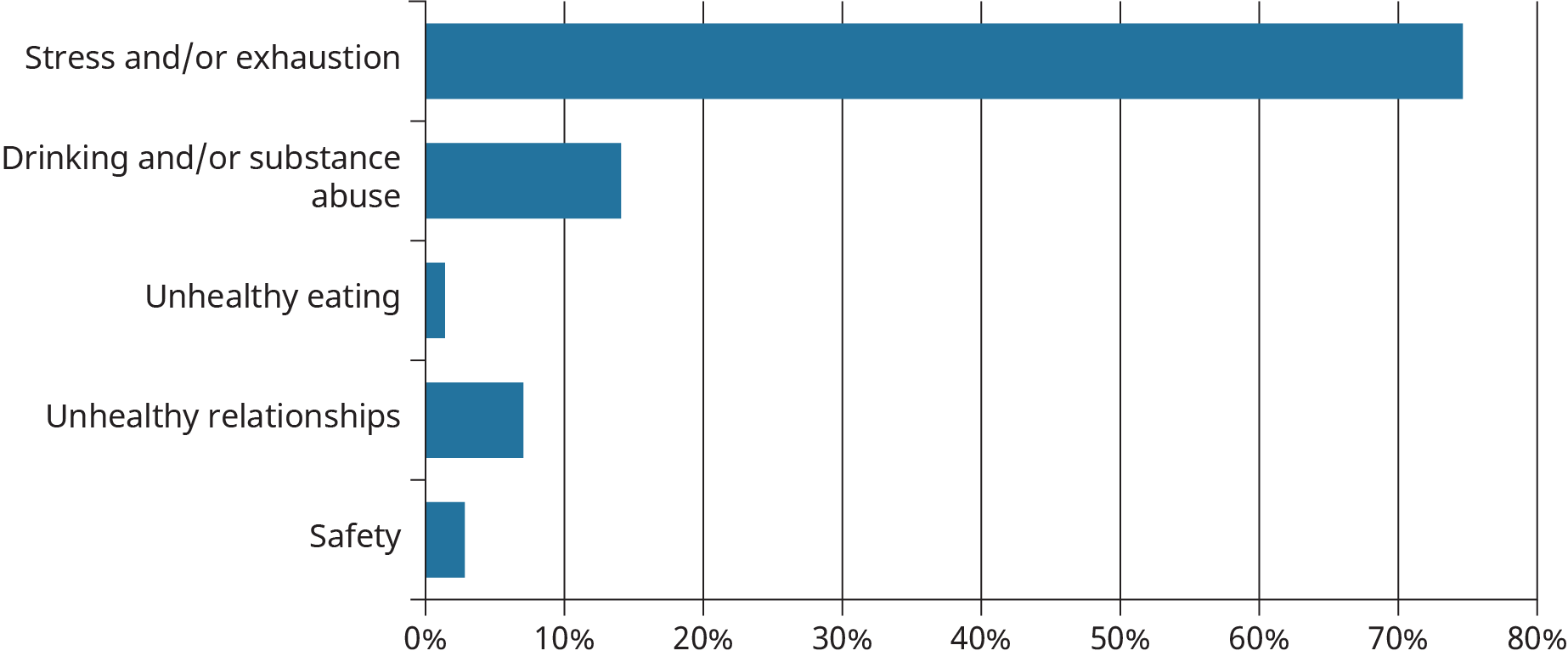
- In your opinion, which of the following is the most significant health issue facing college students?
- stress and/or exhaustion
- drinking and/or substance abuse
- unhealthy eating
- unhealthy relationships
- safety
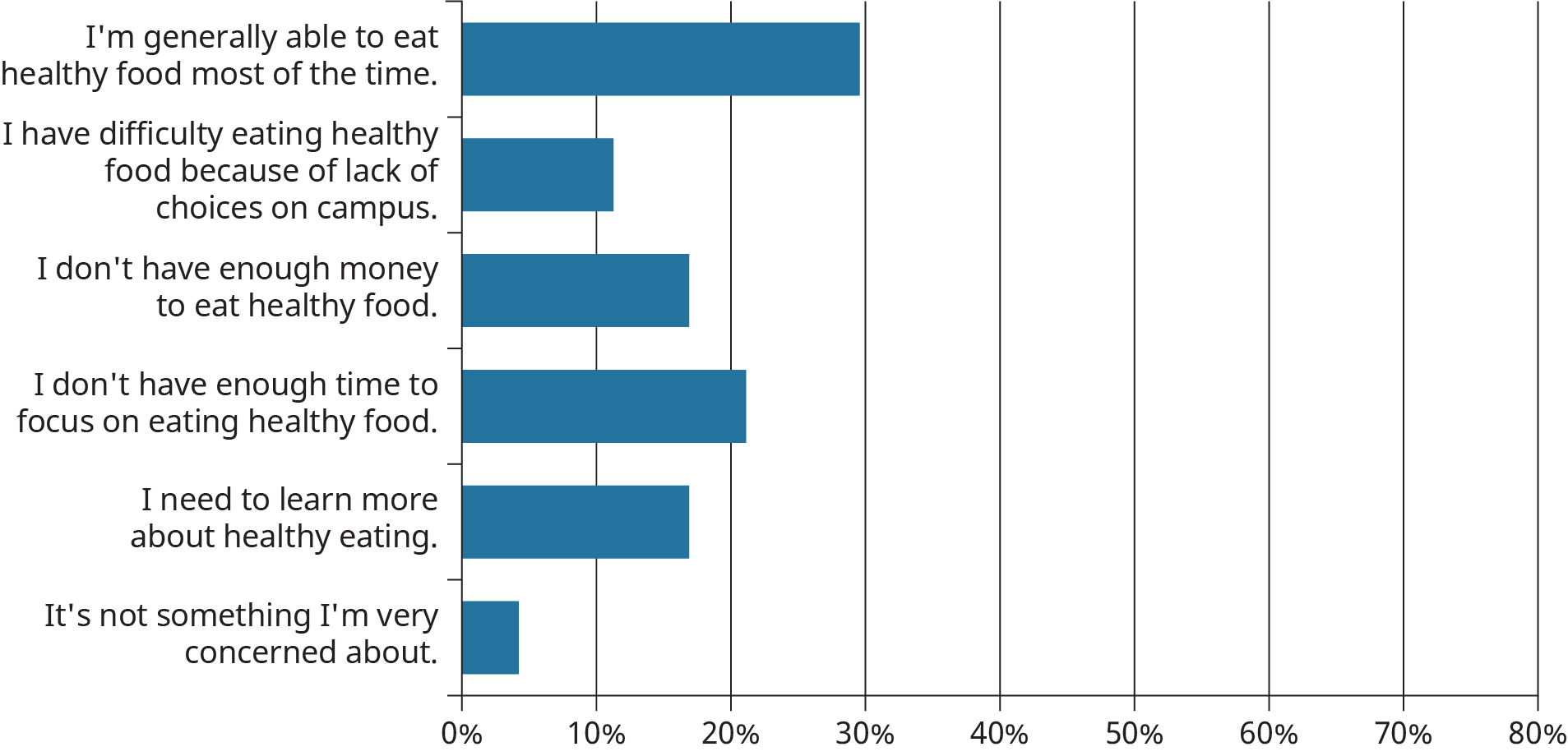
- Which of the following best describes your experience or outlook regarding healthy eating while in college?
- I'm generally able to eat healthy food most of the time.
- I have difficulty eating healthy food because of lack of choices on campus.
- I don't have enough money to eat healthy food.
- I don't have enough time to focus on eating healthy food.
- I need to learn more about healthy eating.
- It's not something I'm very concerned about.
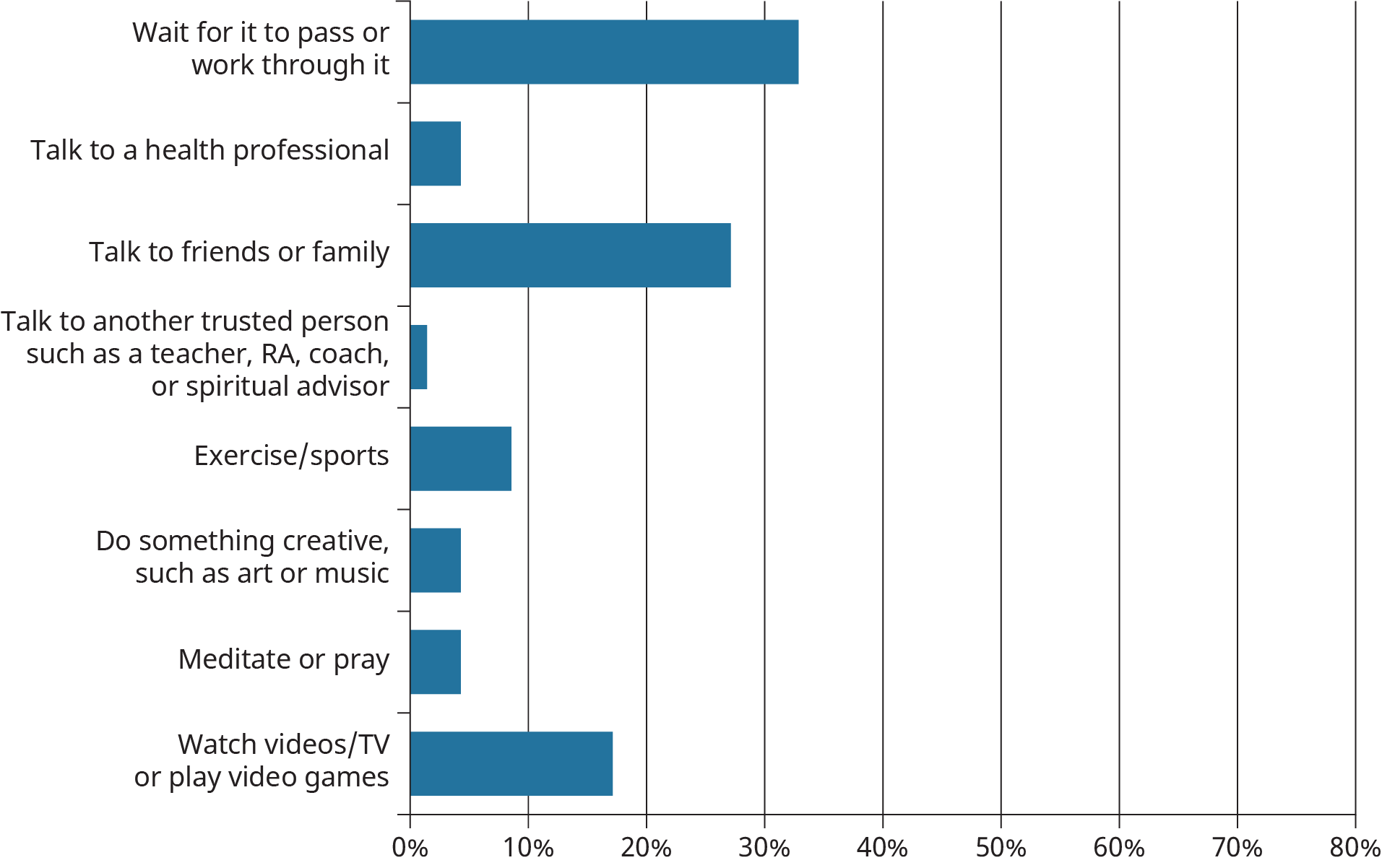
- When you are facing an issue regarding your emotions, stress, mental health, or relationships, what do you typically do?
- Wait for it to pass or work through it.
- Talk to a health professional.
- Talk to friends or family.
- Talk to another trusted person such as a teacher, RA, or religious person.
- Use a method such as meditation, exercise, or something similar.
You can also take the anonymous What Students Say surveys to add your voice to this textbook. Your responses will be included in updates.
Students offered their views on these questions, and the results are displayed in the graphs below.
In your opinion, which of the following is the most significant health issue facing college students?
Which of the following best describes your experience or outlook regarding healthy eating while in college?
When you are facing an issue regarding your emotions, stress, mental health, or relationships, what do you typically do?
What Is Mental Health?
Mental health is “the level of psychological well-being or an absence of mental illness. It is the state of someone who is functioning at a satisfactory level of emotional and behavioral adjustment.”22
According to NAMI (National Alliance on Mental Illness), a mental illness is a condition that affects a person's thinking, feeling, or mood. The condition may affect a person’s ability to relate to others and function throughout the day.
A mental health condition isn’t the result of one event; it is most often the result of multiple overlapping causes. Environment, lifestyle, and genetic predisposition can all be factors in whether someone develops a mental health condition. Traumatic life events or stressful experiences may make some people more susceptible, and brain biochemistry may play a role as well. Mental health conditions show up in many ways. Anxiety, depression, and eating disorders are some of the most common.
Anxiety Disorders
We all experience the occasional feeling of anxiety, which is quite normal. New situations, meeting new people, driving in traffic, and public speaking are just a few of the common activities that can cause people to feel anxious. It is important to seek help when these feelings become overwhelming, cause fear, or keep us from doing everyday activities. Anxiety disorders are the most common mental health concern in the United States, and while there are many types of anxiety disorders, they all have one thing in common: “persistent, excessive fear or worry in situations that are not threatening.”23 Physically, your heart may race, and you may experience shortness of breath, nausea, or intense fatigue. Talk with a mental health care professional if you experience a level of anxiety that keeps you from your regular daily activities.
Eating Disorders
Eating disorders are not uncommon among students. Stress or anxiety may create a desire for some students to overeat, while others may develop a concern about body shape or weight and significantly reduce their food intake.
Anorexia nervosa is a potentially fatal illness marked by self-starvation. People with anorexia usually have an irrational concern about body shape or weight and eat a very restricted diet. They may also feel the need to exercise all the time, even when they are sick or exhausted.
Binge eating is frequent consumption of large amounts of food in a short period of time. People who binge regularly (more than once a week) and feel a lack of control over their eating may have binge eating disorder (BED). It is important to seek treatment if you suspect there is an issue with binge eating. Treatment can address any underlying psychological issues that will help control urges to binge eat.
Bulimia involves cycles of excessive eating followed by eliminating food through vomiting or with laxatives. Eating disorders can lead to many complications, some of them very serious, like heart conditions and kidney failure. It is crucial for anyone with an eating disorder to stabilize their health, then continuing medical care and counseling to reach full recovery. Eating disorders can be treated successfully with medical care, psychotherapy, counseling, or coaching.
If you think you might have an eating disorder, visit a doctor or your campus health center. The National Eating Disorders Association also offers information, help, and support.
Depression
Most people feel sad at times. This is a normal reaction to loss or struggles we face. Being sad is not the same as having depression. When intense sadness lasts for several days or even weeks and you are no longer interested in activities you once enjoyed, it may be depression. Depression can lead to a variety of emotional and physical problems and can decrease a person’s ability to function at work and at home.
Depression does not have a single cause. It can follow a life crisis or physical illness, but it can also occur spontaneously. Several factors including trauma, a significant life change, brain injury, and drug and alcohol misuse may contribute to depression. Depression is a treatable medical condition. Talk with a mental health care professional if you experience an ongoing level of sadness that keeps you from your regular daily activities.
Suicidal Behavior
Suicide is when people direct violence at themselves with the intent to end their lives, and they die because of their actions.24
People who contemplate suicide often experience a deep feeling of hopelessness. They often don’t feel they can cope with challenging life events and are not able to see solutions to problems. In the moment, they are unable to see that the challenges are really only temporary. Most survivors of suicide attempts go on to live wonderful, full lives.
Help is available all day, every day, for anyone who might be in crisis. By offering immediate counseling to everyone that may need it, crisis centers provide invaluable support at the most critical times. If you or someone you know has warning signs of suicide, get help as soon as possible. Family and friends are often the first to recognize any warning signs and can help take the first step in finding treatment.
If someone is telling you that they are going to kill themselves, do not leave them alone. The National Suicide Prevention Lifeline at 1-800-273-TALK (8255) is available 24 hours a day, 7 days a week. A Crisis Text Line is also available 24/7 by texting HOME to 741741, 85258, or 686868. There are also near-term plans to implement a 988 suicide hotline number that will work similarly to 911.
Depression is a key risk factor for suicide, along with substance abuse, chronic debilitating pain, mental health disorders, and a family history of suicide.
These are some of the warning signs to help you determine if a friend or loved one is at risk for suicide, especially if the behavior is new, has increased, or seems related to a painful event:
- talking about wanting to die or to kill themselves
- looking for a way to kill themselves, like searching online or buying a gun
- talking about feeling hopeless or having no reason to live
- talking about feeling trapped or in unbearable pain
- talking about being a burden to others
- increasing the use of alcohol or drugs
- acting anxious or agitated; behaving recklessly
- sleeping too little or too much
- withdrawing or isolating themselves
- showing rage or talking about seeking revenge
- extreme mood swings2525https://suicidepreventionlifeline.org/how-we-can-all-prevent-suicide/; https://www.nimh.nih.gov/health/publications/suicide-faq/index.shtml
Additional Resources
Because entering college is such a big transition, it is important to know what health services are available on your campus. Some help may be beyond the scope of a college counseling program, and if this is the case, your college health center can refer you to off-campus resources to support you.
Regardless of where you attend college, OK2TALK and NAMI offer online, text, and phone support.
- OK2TALK is a community for young adults struggling with mental health problems. It offers a safe place to talk.
- Call the NAMI helpline at 800-950-6264, or txt NAMI to 741741.
11.5 Maintaining Healthy Relationships
| Estimated completion time: 18 minutes. |
Questions to Consider:
- How does self-care benefit relationships?
- Why is community so important to healthy relationships?
- What is sexual health?
Relationships are key to happy and healthy lives. According to Dr. Robert Waldinger, director of the Harvard Study of Adult Development, people with the best health outcomes were people who “leaned into relationships, with family, with friends, with community.”

The quality of our relationships is important, however. What makes a relationship healthy? Relationships come in many forms: lovers, family, friends, coworkers, team members, and neighbors. Think of a relationship where you have mutual respect and trust, supporting each other in tough times, celebrating the good times, and communicating with ease and honesty. This is a healthy relationship. Do you have someone in mind? On the other hand, if communication is often tense or strained, confidences are broken, or you don’t feel listened to, appreciated, or valued, these are signs of an unhealthy relationship. Unhealthy relationships can have both immediate and longer-term health impacts. If you are unhappy in a relationship, try to improve the relationship, or end it. Do not stay in a relationship for the wrong reasons, such as fear of being alone or guilt.
If a partner tries to force you to do something sexually, harms you physically, or is verbally abusive, you are in an unhealthy relationship. Even if you believe the person loves you, it does not make up for the harm they are doing to you. End the relationship.
Take a moment to assess the health of your relationships. Who are the people who make you smile, who boost your confidence, who truly listen when you need to talk, and who want only the best for you? Investing in these relationships is likely to make you happier and healthier. Relationships are two-way streets. How committed are you to your relationships? How much effort do you put into nurturing your relationships?
Self-Care
Healthy relationships start with healthy individuals. Self-care is learning to take good care of yourself and to prioritize your own needs. Self-care involves any activity that nurtures and refuels you, such as taking a walk in the woods, going to a yoga class, attending a sporting event, reading a good book, or spending time with friends. When you are feeling calm and nourished, you are going to look forward to your day, and despite how busy it is, you will prioritize time with friends and family. If you don’t take care of and learn to love yourself, you will never be able to bring your best self to any relationship.
An important dynamic you bring to any relationship is how you feel about yourself. Self-esteem is about loving yourself and being happy for who you are. Building healthy self-esteem impacts how you see yourself, which can drastically improve your relationships. While low self-esteem won’t keep us from romantic love, it can act as a barrier to a healthy relationship. If you do not believe you are good enough, how can you expect your partner to think so?
When you feel secure in yourself, this allows you and your partner to feel more secure about the relationship. If you have insecurities, it may show in your relationship as jealousy, defensiveness, or tension that leads to unnecessary arguments. Healthy self-esteem goes hand in hand with self-confidence, and feeling confident about yourself will translate into a stronger and more satisfying relationship. If you are experiencing low self-esteem, you may give your partner too much credit or stay in a relationship that is not healthy for you. If you find yourself changing your personality for someone else, that is never a sign of a healthy relationship.
You can reverse negative self-talk and build your self-esteem. If you catch yourself thinking you are unlovable, unattractive, or not good enough, it’s important to start talking to yourself in a positive way and to celebrate all that is uniquely you.
Self-care includes self-forgiveness. We all make mistakes. A misstep isn’t the end of the world. Pick yourself up, put things in perspective, acknowledge any lessons to be learned, focus on all that makes you special, and move forward. Be kind to yourself.
The Importance of Community
The Nicoya Peninsula in Costa Rica is home to some of the highest number of centenarians (people who are 100 years old or older) in the world. Costa Ricans in general report a high level of life satisfaction. Dan Buettner, author of the Blue Zones study of the longest living populations in the world, explains that Costa Rica “is a place where religion, family, and social interaction are the main values, unlike trying to get ahead, or financial security, or status. Their cities are set up so they’re bumping into each other all day long. They walk to the markets, where they have conversations with people.”26
In many families in Costa Rica, multiple generations live together under the same roof or nearby where they can be involved in each other’s lives. Neighbors are like extended family, and people often stop in for a visit and go out of their way to help one another.
While this isn’t the way many of us live in the United States, the lessons from the Blue Zone study underscore the importance of community and the health benefits of connecting to and staying close to a community. What communities do you belong to? Is your dorm a community? A sports team? A club or people you volunteer with? When you start seeing the social circles you connect to as communities and prioritize your time to develop more closeness with those communities, you will experience many physical, mental, and emotional health benefits.

According to an analysis of research on college students (Joe Cuseo, The Most Potent, Research-Based Principles of College Success), college students who have a higher sense of belonging and are more involved in their college community are more successful. Additionally, college students who are involved in extracurricular, volunteer, and part-time work experiences outside the classroom (less than 20 hours per week) earn higher grades than students who do not get involved in any out-of-class activities at all.
Application
Make a list of the communities you belong to. Your list should include formal communities—for example, sports teams, fraternities or sororities, and membership in clubs and other organizations. Your list should also include informal communities—for example, your neighbors or the people you always see at your favorite exercise class.
Next to each community, write how being a member of this community benefits you and how your involvement benefits the community. Now, make a new list of your personal interests and passions. How well do these align with the communities you already belong to? Are there new communities that would be a good fit for you?
If you are struggling to identify communities you already belong to, think about your passions, causes you care about, and ways you love to spend your time. Find a group or club that aligns with your interests. If you can’t find one that already exists, start a new club!
Research has shown that friends provide a sense of meaning or purpose in our lives, and that having a healthy social life is important to staying physically healthy. In a meta-analysis of the research results from 148 studies of over 300,000 participants, researchers found that social relationships are important in improving our lifespan. Social support has been linked to lower blood pressure and better immune system functioning. The meta-analysis also showed that social support operates on a continuum: the greater the extent of the relationships, the lower the health risks.27
According to a 2018 report from the American College Health Association, in a 12-month period, 63 percent of college students have felt very lonely. If you are feeling lonely or having a hard time making friends, know that the majority of people around you have also felt this way. Joining a group or a club of people who share your interests and passions is one of the best ways to make great friends and stay connected.
Sexual Health
Affection, love, and sexual intimacy all play an important role in healthy relationships, and a responsible approach to intimacy is essential for sexual health. Whether you are already sexually active or become sexually active in the future, your choices can affect your safety as well as the health and safety of your sexual partners. It’s important to understand what you can do to protect yourself from sexually transmitted infections (STIs).
| Infection | Symptoms | Diagnosis and Treatment |
|---|---|---|
| Human papillomavirus (HPV) |
|
|
| Chlamydia |
|
|
| Genital herpes |
|
|
| Gonorrhea |
|
|
| Human immunodeficiency virus (HIV) |
|
|
How You Can Protect Yourself against STIs
The surest way to protect yourself against STIs is to practice abstinence. This means not having any vaginal, anal, or oral sex. There are many things to consider before having sex, and it’s okay to say no if you are not ready. If you do decide to have sex, you and your partner should both get tested beforehand and make sure you always use a condom. It’s not safe to stop using condoms unless you’ve both been tested, know your status, have another form of birth control, and are in a mutually monogamous relationship. Mutual monogamy means that you and your partner both agree to only have sexual contact with each other. This can help protect against STIs as long as you’ve both been tested and know you’re STI-free. Visit this website to find a confidential STI testing location near you.
Before you have sex, talk with your partner about how you will prevent STIs and pregnancy. If you think you’re ready to have sex, you need to be ready to protect your body and your future. You should also talk to your partner ahead of time about what you will and will not do sexually. Your partner should always respect your right to say no to anything that doesn’t feel right. Sex should always be consensual and respectful.
It’s important to discuss treatment with your doctor and begin treatment as soon as possible if you find out you have an STI. If you are living with an STI, it’s important to tell your partner before you have sex. Although it may be uncomfortable to talk about your STI, open and honest conversation can help your partner make informed decisions to protect his or her health.
11.6 Your Safety
| Estimated completion time: 22 minutes. |
Questions to Consider:
- What makes a person safety conscious?
- How can you improve your personal safety?
Safety Consciousness
To be safety conscious means you have an awareness of potential hazards and an alertness to danger. Simply, you are conscious of being safe. This includes being smart about your physical surroundings and careful with drug and alcohol use.
A drug is a chemical substance that can change how your body and mind work and how you feel. Some drugs are illegal (like cocaine or heroin), and while others may be legal, they can still harm your body and brain. Even prescription medicines can be abused when taken to get high or to a point of dependency.
Why do people abuse drugs? The answer varies for different people, but most want to feel good and escape any bad feelings they are experiencing. Or they want to improve in an area of their life—for example, to get better grades. This may lead them to start taking drugs for more energy, to stay awake longer, or to stay focused while studying. This short-term boost is not worth the health risks and the potential for addiction.
Alcohol
The statistics are sobering. Thirty-two percent of college students who drank alcohol reported doing something they later regretted, 27 percent forgot where they were or what they did, and 11 percent physically hurt themselves.28 Many people consume alcohol to relax, socialize, or celebrate, but there are serious health effects attributed to too much alcohol consumption.
You do not need to be an alcoholic for alcohol to interfere with your health and life, and the potential to become addicted to alcohol is a serious problem that can affect anyone.
Alcohol is classified as a drug and is a known depressant, making it the most widely used drug in the world. Alcohol interferes with the brain’s communication pathways and can affect the way the brain looks and works. These disruptions can change your mood and behavior and make it harder to think clearly and move with coordination. This is why it is critical to never drive a vehicle if you have been drinking. Drinking can weaken your immune system and damage your heart, increasing your risk for stroke and high blood pressure. Heavy drinking also harms the liver and pancreas.
The National Institute on Alcohol Abuse and Alcoholism offers the following guidelines:
- Moderate alcohol consumption: up to one drink per day for women and up to two drinks per day for men
- Binge drinking: typically occurs after four drinks for women and five drinks for men in a two-hour period that brings blood alcohol concentration levels to 0.08 g/dL
- Heavy drinking: drinking five or more drinks on the same occasion on each of five or more days in the past 30 days
Alcohol is a part of the social scene on many college campuses. If you choose to drink, you can avoid the devastating consequences of alcohol addiction by drinking responsibly and in moderation. The quality of your schoolwork can suffer dramatically if you drink beyond moderation. Too much alcohol can result in missing classes, performing poorly on exams, and falling behind in assignments. Have you ever decided to drink instead of study even though you had a big test the next day? Have you missed a class because you were too hungover to get out of bed? Did you hand in a project or paper late or not at all due to a series of nights spent drinking? If you answered yes to any of these questions, you are at risk of negatively impacting your success in college because of alcohol.
Tobacco and Vaping
Cigarettes and other forms of tobacco are also drugs. Tobacco contains nicotine, which excites the parts of the brain that make you feel good. Nicotine gives you a mild rush of pleasure and energy but soon wears off, which makes you want more. The more frequently you smoke, the faster your body and brain get addicted.
Tobacco is not healthy. Cigarette smoke causes lung cancer and emphysema. If you live with someone who smokes, you are also susceptible to these diseases, even if you are a nonsmoker. This is called secondhand smoke. Smokers are more likely to suffer heart attacks. Chewing tobacco can lead to cancer of the mouth. If you currently smoke, there are medicines and various treatments, as well as hotlines, to help you quit.
Electronic cigarettes are marketed as a way to help people stop smoking. Unfortunately, while they do contain less nicotine, they have many health risks.
E-cigarettes are battery-operated devices that people use to inhale an aerosol containing nicotine, flavors, and other chemicals. When you smoke an e-cigarette (also called vaping), the nicotine is absorbed from the lungs into the bloodstream, where it stimulates the adrenal glands to release the hormone epinephrine. Epinephrine (also known as adrenaline) stimulates the central nervous system and increases blood pressure, breathing, and heart rate. Like other addictive substances, nicotine activates the brain’s reward circuits and increases dopamine. This pleasure causes some people to use nicotine with increased frequency, despite risks to their health and well-being.
The FDA (Food and Drug Administration) has alerted the public to reports of serious lung illnesses and several deaths associated with vaping. While the manufacturers of e-cigarettes would like us to believe they are less harmful than cigarettes, nicotine is a highly addictive drug. It is best to stay away from it in any form. E-cigarettes are not an FDA-approved smoking cessation aid, and there is no conclusive scientific evidence on the effectiveness of e-cigarettes to help stop smoking.
Smoking e-cigarettes also exposes the lungs to chemicals. A study of some e-cigarette products found that the vapor contains known carcinogens and toxic chemicals, and the device itself can contain toxic metals.
If you are still in your teens or early adulthood, these years are critical for brain development. If you use nicotine in any form, or for that matter any substances, you are putting yourself at risk for long-lasting effects.
Marijuana
Marijuana comes from the cannabis plant. It can be rolled up and smoked like a cigarette, called a joint. It can also be smoked in a pipe, and edibles are becoming increasingly common. Marijuana can make you feel relaxed, silly, or for some people, nervous.
Marijuana makes it harder to pay attention and to remember things that just happened a few minutes ago. If you smoke before class, it is going to make it more challenging to learn. A recent study showed that if you begin regular marijuana use as a teen, you can lose an average of eight IQ points, and you do not get them back, even if you stop using.29
Using marijuana makes the heart beat fast and raises your risk of having a heart attack. Marijuana smoke can hurt your lungs. One of the biggest risks is drugged driving, which is driving when you are high. Marijuana makes it harder to pay attention on the road, and your reactions to traffic signs and sounds are slowed. It is dangerous to smoke and drive.
Prescription Pain Medicine
Pain medicines help relieve pain from surgery or injuries. Prescription pain medicines are legal and helpful to use when ordered by a doctor to treat a specific medical problem within a specific time frame. It is vitally important to take any prescriptions according to your doctor’s instructions, and to carefully read all risks and food/medicine counteractions.
Unfortunately, people sometimes take pills without a doctor’s prescription to get high, believing they are safer than street drugs. Make no mistake, prescription pain pill abuse can be just as dangerous as heroin or cocaine. Drug dealers sell these pills just like they sell heroin or cocaine. The abuse of oxycodone has become well documented—sometimes it goes by the brand names OxyContin or Percocet. Hydrocodone is also often abused and is best known under the brand name Vicodin.
Prescription pain pill abuse can lead to many problems. Pain medicine abuse can slow down or even stop your breathing. Signs of a pain medicine overdose are cold and sweaty skin, confusion, shaking, extreme sleepiness, and trouble breathing. More people overdose from pain medicines every year than from heroin and cocaine combined. If your doctor prescribes any pain relief pills for you, it is important to ask a lot of questions and understand why your doctor is prescribing them. If after consideration you decide to take pain-relief pills, stop taking them as soon as you possibly can. The longer you take them, the higher the possibility of getting addicted.
Cocaine and Heroin
Cocaine and heroin are both powders, often snorted up the nose, smoked, or mixed with water and injected with a needle. It is easy to become addicted to both drugs, and many people who seek treatment find it hard to stay off the drug. It is not uncommon to feel strong cravings for heroin or cocaine years after seeking treatment. People who inject the drug using a shared needle put themselves at further risk of contracting blood-borne viruses, such as hepatitis or HIV.
Cocaine can make people feel full of energy for a period of time, but it can also bring about feelings of restlessness and anger. Cocaine raises blood pressure and makes the heart beat faster, which could lead to a heart attack or stroke.
Heroin brings a rush of good feelings after it’s taken. The feeling then wears off, and users often feel a strong urge to take more. The reason so many people overdose on heroin is because they can’t tell how strong it is until they take it. Heroin can slow or stop your breathing. It can kill you. Signs of a heroin overdose are slow breathing; blue lips and fingernails; cold, clammy skin; and shaking.
There are medicines that can help people recover from addiction, but the best course is to not start. Avoid any temptation to try heroin or cocaine. Experimentation can be deadly.
Methamphetamine (Meth)
Meth is a white powder that is sometimes made into a pill or rock. Meth powder can be eaten or snorted up the nose. Like cocaine and heroin, it can also be mixed with liquid and injected into your body with a needle. Crystal meth is smoked in a small glass pipe.
Meth at first causes a rush of good feelings, but then users feel edgy, overly excited, angry, or afraid. Meth causes many problems. It can make your body temperature so hot that you pass out and could die. If you look at pictures of meth users, you will notice how quickly the drug ages them. Teeth become stained, break, and rot. As the teeth go bad the mouth looks sunken. Meth users burn a lot of energy and don’t eat well, which leads to degeneration and a sickly appearance. The skin turns dull, and sores and pimples that won’t heal are common. Meth use can quickly lead to addiction and cause cognitive or emotional problems that don’t go away or that come back again even after you quit using. For instance, some users feel, hear, or see things that aren’t there and think that people are out to get them.
This is a dangerous drug that should be avoided at all costs.
Other Drugs
There are many other drugs of abuse, including Ecstasy, K2 (or Spice), LSD, PCP, and roofies. It’s best to avoid all of them.
If your use of drugs or alcohol is interfering with your life and negatively impacting your health, school, relationships, or finances—it’s time to quit and find help.
The first semester is an especially critical and vulnerable time for most first-year students. It is often a time of heavy drinking and partying. The transition to college is often difficult, and while partying may feel like it is helping to ease the transition, the health risks are real: about one-third of first-year students fail to enroll for their second year.
If you are concerned about your drug or alcohol use, or you need help quitting, visit the student health center or talk with your college counselor. If you need additional resources, the following can help:
- Drug Information Online
- Drug and Alcohol Treatment Hotline: 1-800-662-HELP
Personal Safety
For many students, their first year in college is also the first time they have lived away from home, or for commuting students, often the most time they have spent away from home. This new freedom can feel really exciting. College should be a time for fun, experimentation (in healthy ways), and growth. It’s important to be smart about your safety and conscious that you don’t put yourself in any high-risk situations. It’s also important to know what to do if any problems arise. Here are some ways to remain safe while enjoying your college experience:
Speak up. If you are worried about a friend’s well-being, ask them if they are OK. If you see inappropriate behavior, let someone know. Get an RA or other authority involved if someone looks like they are in trouble or an activity looks like it is leading to trouble. In general, speak up if you notice something going on that concerns you.
Learn your campus emergency system. Many colleges and universities have blue-light phones with direct access to campus security. If your campus has blue-light phones, take the time to find out where they are. If you are not familiar with the emergency system on your campus, visit your public safety department (or website) to understand how you can call for help in an emergency. Add campus security to your phone contacts.
 Figure 11.13 Emergency phones and related systems are present on many campuses. Learn your system and note the locations of these devices as you travel. If you commute via public transportation, such as a train or bus, learn the safety procedures and devices available for those systems. (Credit: KOMO News / Flickr / Attribution 2.0 Generic (CC-BY 2.0))
Protect your drink. A risk at bars and at college campus parties is the use of date-rape drugs to assist sexual assaults. Date-rape drugs often have no color, smell, or taste, so you can’t tell if you are being drugged. The drugs can make you weak and confused so you are unable to refuse sex or defend yourself.
It is easy for anyone to slip a date-rape drug in your drink. Never leave your drink unattended, and never accept a drink from someone you do not trust.
Be alert and stay charged. Always be aware of the people in your surrounding area. Notice anyone who looks out of place, and avoid dark and unpopulated areas. Make sure to charge your cell phone before you go out for the evening.
Avoid walking alone at night, and don’t accept rides from strangers. Going out with a group is the best way to make sure everyone gets home safely. In the event you find yourself alone at the end of the night, know ahead of time what escort services your school offers. Or use services like Uber and Lyft, and MAKE SURE you get in the car that matches the license plate on the app.
It’s also wise to install safety apps. These apps can automatically alert police and your emergency contacts in the event of an emergency. Always let your roommates and friends know your plans for the evening and when you expect to return.
Get Connected
Luckily, there are tech opportunities to keep yourself safe. Three good apps for the job are:
Noonlight is an app that connects all your devices to trigger an alarm with a live, 24/7 staff in case of any emergency: heart attack, car wreck, assault, or any other event that requires emergency attention.
Kitestring is an app you alert when you are headed out to a potentially risky situation, like a first date or meeting someone for the first time. The app texts you to check in, and if you don’t respond, it alerts your emergency contacts to the situation.
Circle of 6 makes it easy for you to alert the six people in your circle any time you need help.
If You Are a Victim of a Crime
Most college students report feeling safe on campus. College administrators are fully committed to making your campus experience as safe as possible. If you are attacked, it is important to know what to do:
- If possible, get to a safe place. Move to a well-lit area to call for help.
- Call 911 or have someone call 911 for you.
- Follow the operator's instructions. 911 operators will instruct you until police or paramedics arrive.
- Contact a trusted friend or family member. You will want emotional support and also somewhere to go after all the official procedures are complete.
- Take time to heal. If you are a victim of crime or assault, it can be traumatic. The healing process will take time. Check with your campus mental health services about how they can help in your recovery.
If You Are a Victim of Sexual Assault or Rape
Sexual assault is any type of sexual activity you don’t agree to. This can include inappropriate touching, sexual intercourse, attempted rape, and rape. Most people are surprised to learn that 80 percent of rapes are committed by someone the victim knows.
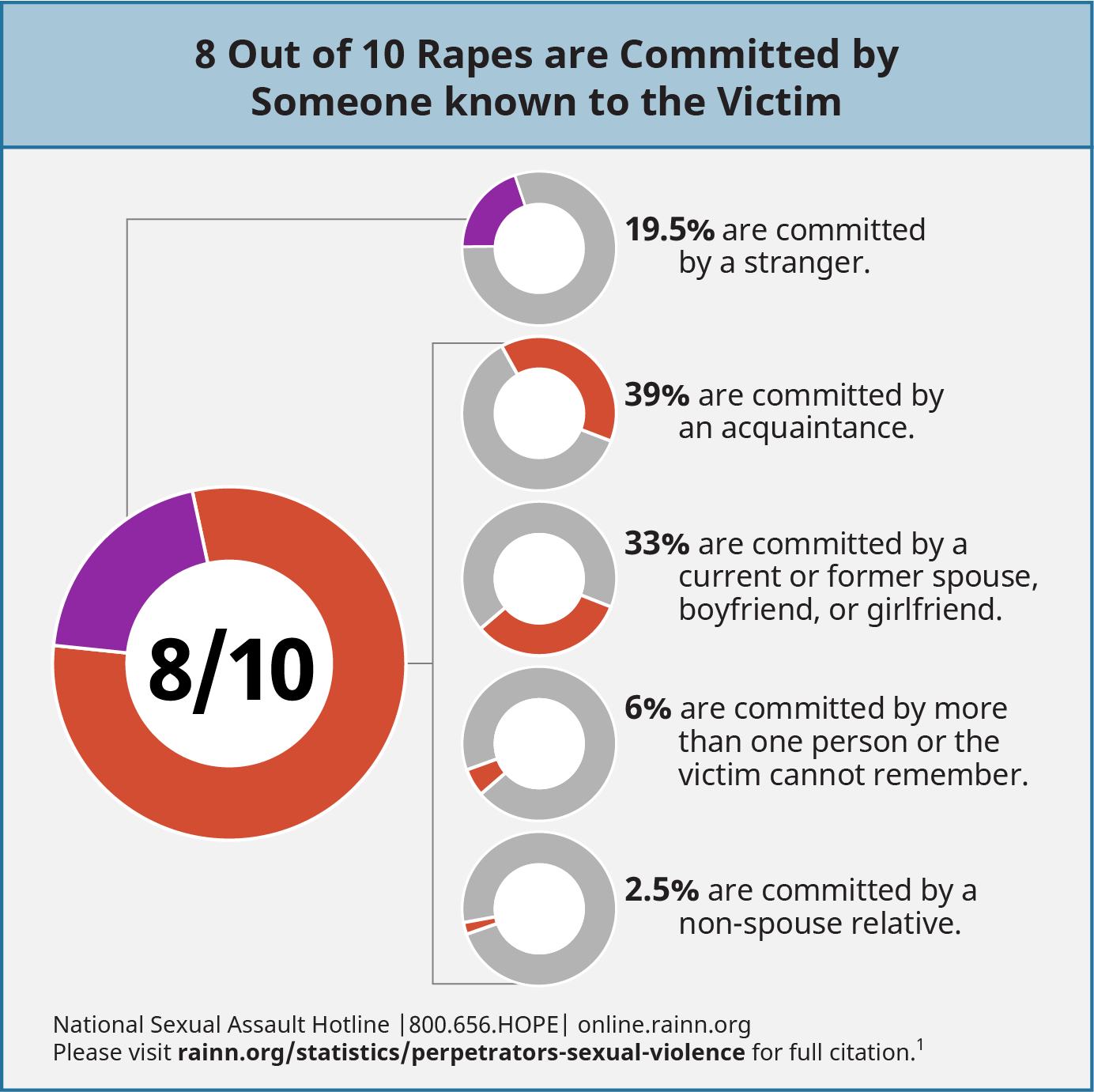
Take the following steps if you or someone you know has been raped:
- Get medical care. Go to the nearest rape crisis center, hospital, or student health service center. Do not go to the bathroom, shower, brush your teeth, wash your hands, or change clothes before you go. It’s important to preserve any evidence.
- Ask the hospital or center to take a urine sample to test for date-rape drugs.
- Call the police from the hospital. Tell the police exactly what you remember. File a report.
- Arrange for follow-up counseling. A counselor can help you work through the many emotions you may feel following a sexual assault, which is important to the healing process. You can get help from the National Sexual Assault Hotline at 800-656-HOPE.
Under Title IX legislation, sexual harassment and sexual violence are forms of gender discrimination and are prohibited. This includes off-campus incidents or incidents that involve people who are not students. If you experience a hostile environment, sexual harassment, or sexual assault, schools have a responsibility to stop the discrimination, prevent its recurrence, and address its effects. Schools also have a responsibility to protect people who report sexual harassment or assault from retaliation from other students, school administrators, or faculty.
The Clery Act, a federal law that intersects with Title IX, requires colleges and universities to do the following for survivors of campus sexual assault:
- Notify survivors of counseling resources.
- Notify survivors of the option to report a case to the school and law enforcement.
- Provide requested accommodations, such as changing dorms or classes.
- Notify survivors of the final outcome of a disciplinary proceeding.
Summary
In this chapter you have been introduced to the wide range of factors that impact your health. Health is much more than keeping your physical body in good shape. Good health also includes your mental and emotional health, quality relationships, and prioritizing your personal safety.
The contributors to physical health include eating clean, non-processed food; staying hydrated; moving your body daily; and getting sufficient sleep. You now understand why it is necessary to prioritize sleep, and that quality sleep is also dependent on the way you eat and exercise. You have identified ways to improve what you eat and how you sleep. With these changes you should be able to fall asleep with ease, stay asleep all night, and wake up feeling energized. Your mind will be clear and sharp. and you’ll get more done in less time, massively increasing your productivity and your success in college.
You now understand that a certain level of stress is to be expected. Chronic stress, however, is damaging to the body, so it’s important to have a variety of tools to manage stress. Practicing mindfulness, deep breathing, and gratitude can have a powerful impact on your emotional, mental, and physical health.
At the beginning of this chapter, you were introduced to a simple way of thinking about your health—nutrients in, toxins out. This means eating plenty of fruits and vegetables and avoiding junk food, soda, and other sugary beverages. If you move often throughout the day, drink plenty of clean water, and prioritize your sleep, you will help your body detoxify. Reduce your exposure to toxins by paying attention to what you put in and on your body. If you wouldn’t eat it, don’t put it on your skin or hair. A helpful way to remember to take care of your health is to follow the rule of eights: aim each day for eight hours of sleep, eight servings of fruits and vegetables, eight glasses of water, eight minutes of mindfulness, and eight meaningful connections, and incorporate any one of these eight ways to move—walking, aerobic exercise, strength training, yoga, Tai Chi, stretching, HIIT, or dancing.
Career Connection
Is putting in longer hours at work an effective strategy for meeting workplace demands? Read this article about managing your energy instead of your time.
Rethinking
Revisit the questions you answered at the beginning of the chapter, and consider one option you learned in this chapter that might make you rethink how you answered each one. Has this chapter prompted you to consider changing any of your habits?
Rank the following questions on a scale of 1–4. 1 = “least like me” and 4 = “most like me.”
- I eat enough fruits and vegetables every day.
- I get enough sleep.
- I have, for the most part, healthy relationships with friends and family.
- I feel like I know how to manage stress.
Where do you go from here?
It’s easy to lose focus on your own health and wellness during the tumultuous first year in college. But the benefits of developing strategies to improve and maintain your emotional, physical, and mental health will only increase as you age. What would you like to learn more about? Choose a topic from the list below, and create an annotated bibliography that would direct further research.
- simple strategies to improve physical health
- daily opportunities to maintain and improve emotional well-being
- mental health risks and warning signs
- steps to take to be more safety conscious