第 13 节 · SECTION 13
12 Planning for Your Future

Chapter Outline
Introduction
Student Survey
How ready are you to plan your career? Take this quick survey to figure it out, ranking questions on a scale of 1–4, 1 meaning “least like me” and 4 meaning “most like me.”
- I am feeling certain about my major (or my ability to choose a major soon).
- I know what kinds of jobs I can get with my major.
- I have a good idea of what I need to do in each year of college to achieve career success as I graduate.
- I am aware of what resources are on campus to help me create a career plan.
You can also take the Chapter 12 survey anonymously online.
Student Profile
“A lesson I have learned throughout my college career is that changing majors is okay. Fresh out of high school, I always wanted to be an FBI agent. I wanted to be in those forensic shows—like Criminal Minds—that we all see on TV. So I decided to go to college and major in criminal justice with an emphasis in forensic science. When I started to take criminal justice classes, I noticed that my passion and determination were focused on something else: helping others and changing people’s lives so they do not have to struggle as much as I did. I quickly decided to talk to a career counselor and let him know that I wanted to change majors. We discussed the long-term plans and where I would see myself in the future. I changed my major to a related one, sociology. And with that, I want to be a counselor, as I want to help others achieve their goals.”
—Carlos Espinosa
About This Chapter
In earlier chapters of this book (1, 3, 4), you learned more about setting the foundation for college and career success by gaining a deeper understanding of why you are attending college, how to set goals and priorities, and how to begin your academic and life planning. By the time you complete this chapter, you should be able to do the following:
- Learn what a career is and how it applies to you.
- Identify resources on campus that can help you explore careers and develop a plan.
- Increase your self-awareness relative to your career aspirations, and map productive steps forward.
12.1 Why Worry about a Career While I'm in College?
| Estimated completion time: 12 minutes. |
Questions to Consider:
- What should I consider when choosing a career?
- How do I separate career myths from reality?
CAREER (noun)
Definition of career (Entry 1 of 2)
1: a profession for which one trains and which is undertaken as a permanent calling
a career in medicine
—often used before another noun
a career diplomat
2: a field for or pursuit of consecutive progressive achievement especially in public, professional, or business life
Washington’s career as a soldier1
Throughout your life, you’ve probably heard about getting a “good job” after you graduate. Everyone might define that differently. Many people say a good job is one where you can make a lot of money, but is that true? And is that true for you?
Consider the definition of “career” above. Does it seem exciting? Are there parts that sound intimidating? How can you navigate both parts of the responsibility of having a career? Many people believe that just because they have had a job, they know how to have a career. Getting a job is a single transaction. Crafting a career takes more strategy and time.
What Is the Difference Between a Job and a Career?
A universal definition of a job is “work that you do in exchange for money.” It can also be a particular role or title. Going back to our definition of career above, a career is something for which we train, something that we intend to do permanently—which in actuality means long-term and over time, not necessarily for the rest of your life. It is a field or area in which we have achievement. It occurs progressively and usually consecutively. Here is how some current college students have defined “career”:
- “A career is long-term; you do it until you can’t anymore.”
- “Something you love . . . a dream job.”
- “What you plan and strive for while you work.”
- “When you are more invested in the activities of the job than just getting a paycheck.”22Canisius College Student Interviews, Buffalo, NY, September 2019
Shira
When Shira was in college, she had a job at a local ice-cream stand. She made very good money in the summertime, so she could work less during the school year. She also learned a lot about customer service and working with her coworkers as a team. Shira eventually took on more responsibility as a supervisor, creating work schedules and interviewing prospective new employees. She really enjoyed this part of her job because she liked tasks involving helping people do well at work. Her boss, customers, and coworkers told her she was good at it. Unbeknownst to her at the time, this was the beginning of Shira’s career in human resources.
How did this happen? As she took classes in psychology and business, Shira saw her courses in organizational psychology and management as applicable to her work. She enjoyed learning about how people interact in the workplace. She learned about human resources, which is typically defined as the department of a business or organization that deals with the hiring, administration, and training of people. She wanted to learn even more, so she got an internship in the human resources department of a bank before she graduated and loved it.
After getting her Bachelor of Science degree in psychology, Shira got her first career-oriented job, as a recruiting specialist at a health insurance company. After about two years of working diligently, Shira got promoted to a job as a human resource generalist, with responsibility for recruiting strategy and process; recruiting specialists now report to her. In addition to working full-time, Shira also is active in her local chapter of the Society for Human Resource Management and will begin studying to take the national certification exams offered through this organization, giving her a highly sought-after professional credential. Within 5 to 10 years, Shira hopes to become a human resources director.

Shira’s career path is a straightforward one. She learned a lot about herself early in her college career. She got some experience and studied academic subjects she was interested in. Shira was nervous and uncertain at times, but she remained positive and adjusted her course as needed. She worked hard and made plans to be sure she could get a “good job.”
What Students Say
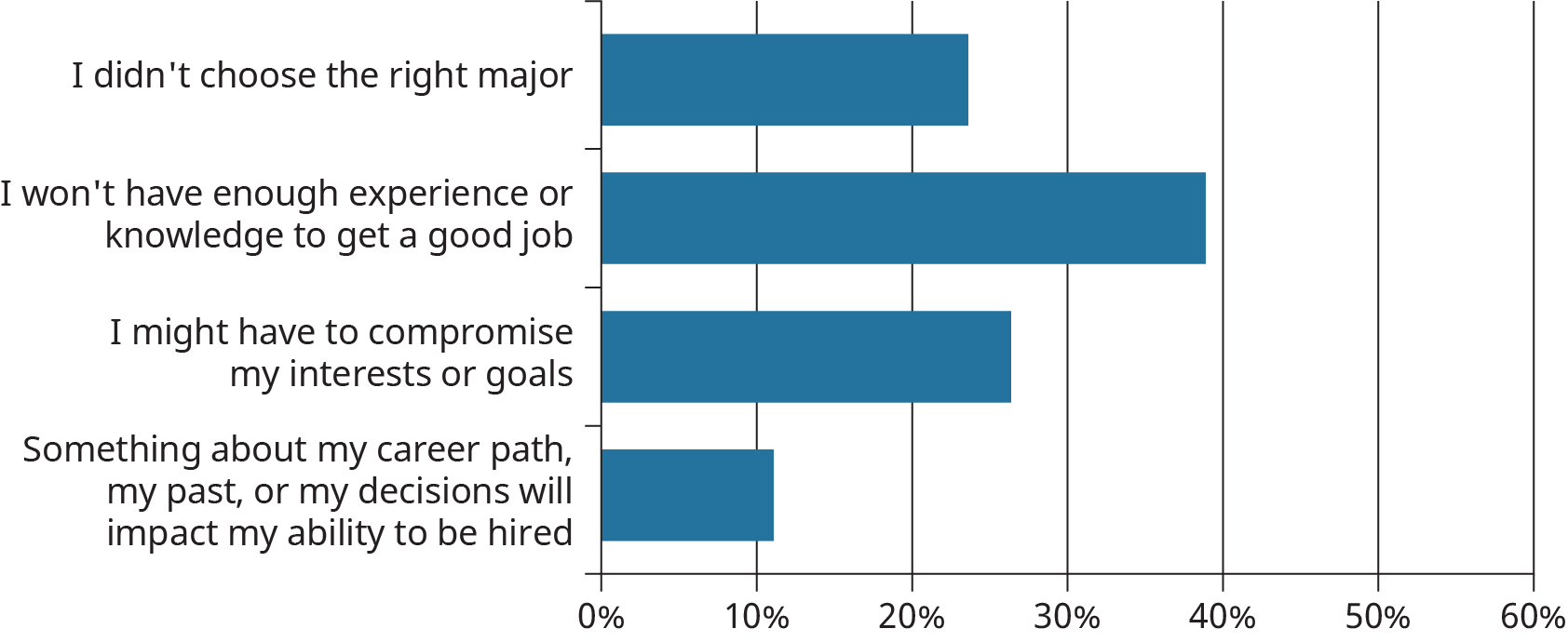
- What is your most significant concern about starting your career after college?
- I didn’t choose the right major
- I won’t have enough experience or knowledge to get a good job
- I might have to compromise my interests or goals
- Something about my career path, my past, or my decisions will impact my ability to be hired.
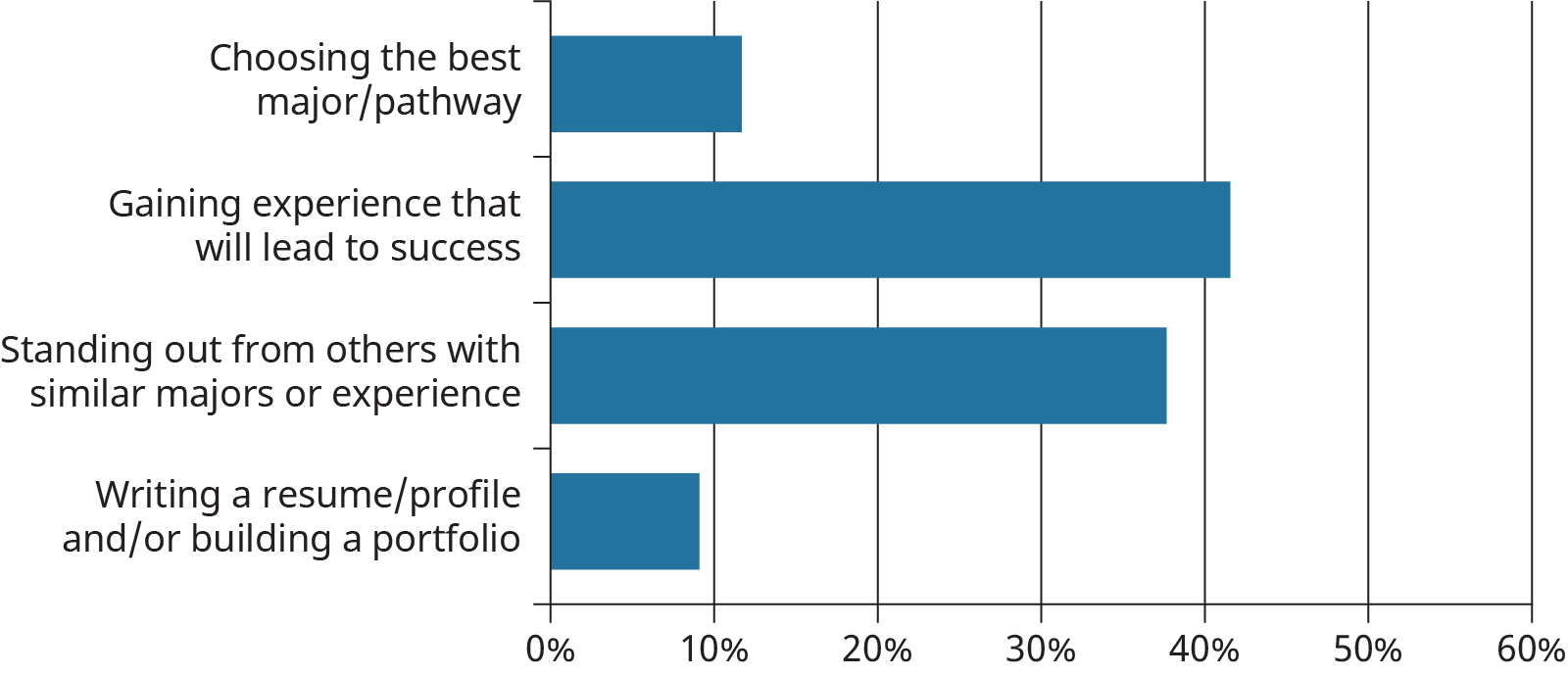
- With what do you feel you need the most help in preparing for your career?
- Choosing the best major/pathway
- Gaining experience that will lead to success
- Standing out from others with similar majors or experience
- Writing a resume/profile and/or building a portfolio
You can also take the anonymous What Students Say surveys to add your voice to this textbook. Your responses will be included in updates.
Students offered their views on these questions, and the results are displayed in the graphs below.
What is your most significant concern about starting your career after college?
With what do you feel you need the most help in preparing for your career?
Career Myths and Realities
Because you are a student, many people will want to give you advice as you make your way through college. Older family members like to talk about how things were when they were in and graduated from college. Your parents might have very definite ideas about what you should major in and the best way to get a job (or perhaps they don’t know at all, and you wish they did). Your friends, particularly those already in college, might tell you what their experience is, but maybe yours will be very different. Then there are all kinds of things you hear about in the news as to whether there are jobs out there. The economy can be very confusing at times. The stock market is up, then down. Government statistics tell us that the unemployment rate is lower than ever before, but many people say it is still very difficult to get a job. Students have seen their parents or grandparents get laid off, then hear that there is a new company in town that will hire thousands of people. Any and all of these things can be true, and all at the same time. So what does that mean for college students looking to begin their careers?
MYTH #1: “Because I am getting a college degree, I will have no problem getting hired and making a lot of money.”
REALITY: As you learned in chapters 1 and 10, your chances of making more money over the course of your lifetime are greater when you have a college degree. However, employers expect more than just a diploma. They also expect that you did well in your studies and engaged in activities and experiences that demonstrate you can put learning into context in a work setting. Internships, practicums, service learning, community-based research, part-time or summer jobs, and more prove to employers that you are capable and eager to begin your career.
MYTH #2: “There is one perfect job for me” or “I will be happy if I find the right career.”
REALITY: Finding the right career is not like waving a magic wand or a ticket to living your best Instagram life all of the time. There are jobs and careers for which you might be well-suited based on a combination of features and attributes. The better you know yourself, the better you can make a good match. Additionally, those features and attributes change over time, and by learning good career planning skills, you can adapt easily.
MYTH #3: “I can’t get a good job with (fill in the name of a major).”
REALITY: There are some majors that traditionally result in jobs that earn more than others do. These are usually because the education for these occupations is often rigorous, and both training for and working in the occupation require a high level of skill and knowledge, even over time (engineering, computer science, accounting). However, anybody can get a “good” job with their major. The key is to understand what knowledge, skills, and abilities are required for the jobs you would like and to take action to make sure you have them. People who have a problem getting employment in their field after college may not have fully understood the requirements for being hired, they may have been unable to make the sacrifices necessary for that to happen, or they may have had unrealistic expectations.
MYTH #4: “I should base my major on ‘hot’ careers that will pay well.”
REALITY: Just because a major or career field is “hot” doesn’t mean that you will enjoy it or even be any good at it. Better to choose a career based on your interests, abilities, values, and personality. Additionally, which careers and fields are popular and well-paying can change quickly based on supply of candidates and economic situations. Thus, those who choose a hot field must be eager to learn new skills to keep up with the evolution of such a career.
MYTH #5: “It is too late to change my career.”
REALITY: It is almost never “too late” to make a career change. There are millions of people who have made career changes, some by going to college in their 30s, 40s, 50s, or even older. In many cases, the best time to make a change is when you are older, because you have more to offer employers, have gained different experiences, and have become more settled in your personal life. Many college students find they are well-positioned to make the most of their college studies when they are more mature.
MYTH #6: “No one will hire me because I am ‘just a student’; I won’t be able to compete with people with more experience.”
REALITY: Employers often like to hire recent graduates or people who are early in their careers because their learning is fresh, and they know how to learn new material and adapt quickly. Additionally, many employers believe that hiring new graduates allows them to train people the way that they would like. New graduates of all ages show persistence and flexibility by having earned a college degree and shown willingness to start something new.
MYTH #7: “I should be passionate about my work. If not, I am doing something wrong. “
REALITY: “Do what you love and you’ll never work a day in your life” and “Do what you love and the money will follow” are terrible advice. No one loves their work every minute of every day, and passion is a very high standard to meet. There are many things about which we might be passionate that would make for jobs that are completely unsuitable for us. What most people who are happy with their work have in common are that they can do it well; it has some impact on people, organizations, information, or things; and they find satisfaction in it. It is often through discovering this that passion for one’s work follows.
MYTH #8: “My career path should follow a neat, straight line.”
REALITY: For almost everyone, a career path is more like a winding road than a straight highway. Recall the story of Shira building a career off of her summer job, and know that Shira’s experience is one path of many. Not everyone has a clear idea of how to find a job that fulfills an interest and then how to move from that job to a career. It is not always so straightforward. For example, there is great value in choosing a major in the natural sciences, social sciences, arts, or humanities, but sometimes these fields do not obviously transfer to a career. Yet with the right guidance, practice, and commitment, these majors provide many routes to a fulfilling career and life. Based on information, experiences, and skills you gather along the way, you will find that you need and want to adapt and adjust. There is no “right” or “wrong” way to get into a career.
MYTH #9: “There are not many jobs out there with good pay and benefits, so why bother looking?”
REALITY: The way in which we work has changed in the last twenty years. There are many more flexible work arrangements available. The “gig economy” refers to jobs that are independent of being an employee and are often time-limited. These positions give people multiple options for generating personal income and are good options for a “side hustle.” At the present time, the job market is also considered to be a “job seeker’s market,” meaning employers are having difficulty finding candidates for their openings. Every day, thousands of people get jobs that advance their status.
Activity
Consider the various events or conversations you’ve experienced in the past few years that have led you toward a career goal. Have any of the myths or their counterparts listed above impacted your choices? Are you called to reconsider any previous decisions? Why or why not? Are there additional preconceptions you might have that could potentially block you from moving forward with your ideal plans?
What Should I Be?
Have you ever heard statements like these?
- “You are so good at math . . . you should be an accountant.”
- “Your best grades have always been in art, but it isn’t really practical to become an artist.”
- “You like kids so much! You should be a teacher!”
Many people tend to first think of careers based on images they see in society or the media. Prestigious and high-visibility occupations are what many young people aspire to when they are young. How many of you first wanted to be a doctor, firefighter, entertainer, professional athlete, or teacher? As we grow up and get to know the world better, we are exposed to a greater universe of jobs. However, young people in middle and high school also tend to look at careers based on the subjects they are good at (or not good at) in school. These self-perceptions and interests can last long into adulthood. But education and the work world can be extremely different environments with different purposes and expectations. The realities of jobs and careers we choose are vastly more complex than the courses we like or don’t and whether we perform well in them in high school. Though we may have some images for “what we are” and “who we should be,” there are also many different options, and the choices can be overwhelming. How do we ensure that we make career decisions that are productive for us?
12.2 Your Map to Success: The Career Planning Cycle
| Estimated completion time: 42 minutes. |
Questions to Consider:
- What steps should I take to learn about my best opportunities?
- What can I do to prepare for my career while in college?
- What experiences and resources can help me in my search?
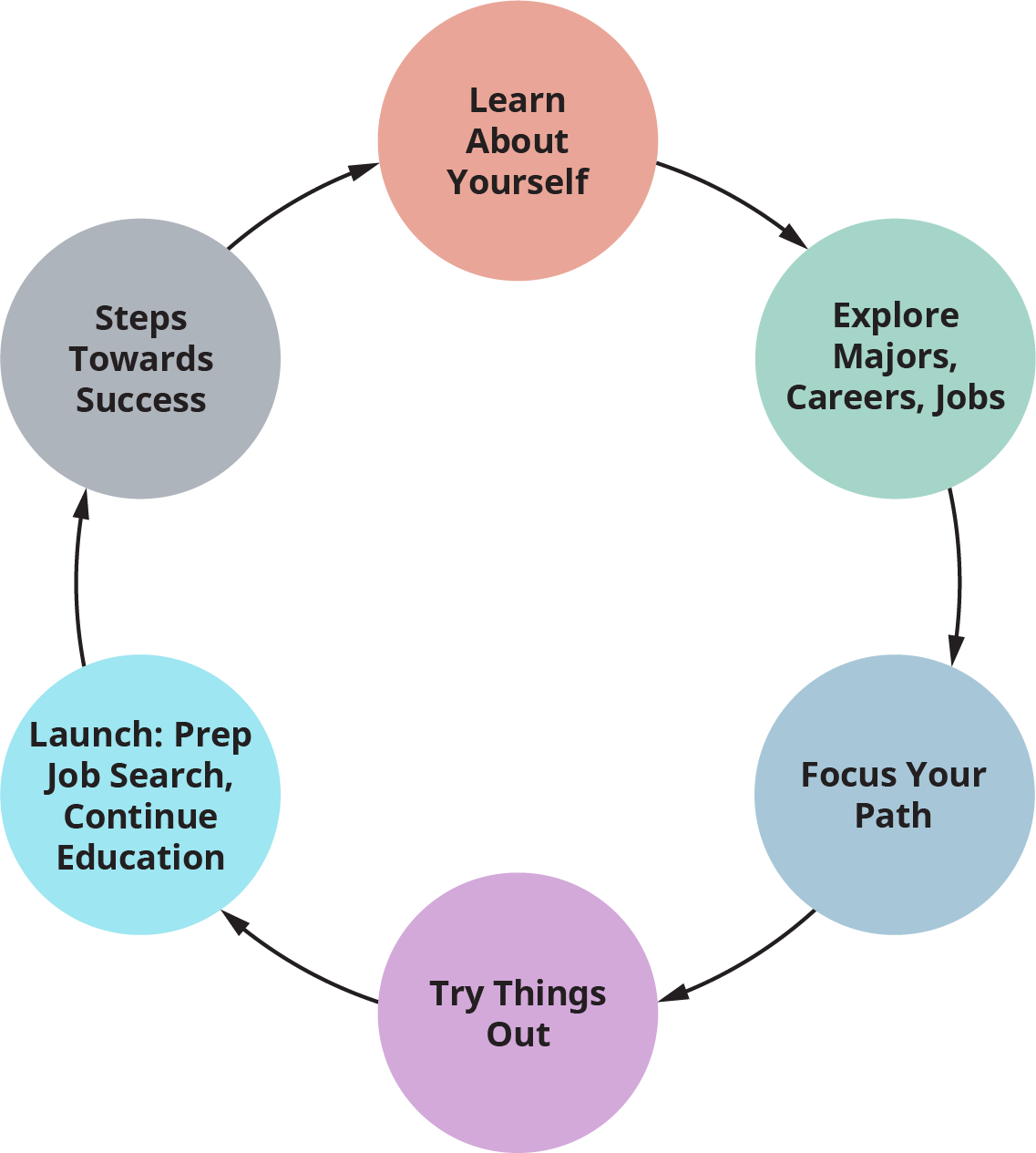
The Career Planning Cycle helps us apply some concrete steps to figuring out where we might fit into the work world. If you follow the steps, you will learn about who you truly are, and can be, as a working professional. You will discover important knowledge about the work world. You will gain more information to help you make solid career decisions. You will get experience that will increase your qualifications. You will be more prepared to reach your professional goals. And the good news is that colleges and universities are set up nicely to help you utilize this process.
Learn About Yourself
To understand what type of work suits us and to be able to convey that to others to get hired, we must become experts in knowing who we are. Gaining self-knowledge is a lifelong process, and college is the perfect time to gain and adapt this fundamental information. Following are some of the types of information that we should have about ourselves:
- Interests: Things that we like and want to know more about. These often take the form of ideas, information, knowledge, and topics.
- Skills/Aptitudes: Things that we either do well or can do well. These can be natural or learned and are usually skills—things we can demonstrate in some way. Some of our skills are “hard” skills, which are specific to jobs and/or tasks. Others are “soft” skills, which are personality traits and/or interpersonal skills that accompany us from position to position.
- Values: Things that we believe in. Frequently, these are conditions and principles.
- Personality: Things that combine to make each of us distinctive. Often, this shows in the way we present ourselves to the world. Aspects of personality are customarily described as qualities, features, thoughts, and behaviors.
In addition to knowing the things we can and like to do, we must also know how well we do them. What are our strengths? When employers hire us, they hire us to do something, to contribute to their organization in some way. We get paid for what we know, what we can do, and how well or deeply we can demonstrate these things. Think of these as your Knowledge, Skills, and Abilities (KSAs). As working people, we can each think of ourselves as carrying a “tool kit.” In our tool kit are the KSAs that we bring to each job. As we gain experience, we learn how best to use our tools. We gain more tools and use some more often than others, but all the tools we gather during our career stay with us in some form.
Activity
Consider the top KSAs you currently have in your tool kit. Consider at least one in each category that you would like to develop while you’re in college.
Because you’re expected to spend your time in college focusing on what you learn in your classes, it might seem like a lot of extra work to also develop your career identity. Actually, the ideal time to learn about who you are as a worker and a professional is while you are so focused on learning and personal development, which lends itself to growth in all forms. College helps us acquire and develop our KSAs daily through our coursework and experiences. What might be some ways you can purposefully and consciously learn about yourself? How might you get more information about who you are? And how might you learn about what that means for your career? Awareness of the need to develop your career identity and your vocational worth is the first step. Next, undertaking a process that is mindful and systematic can help guide you through. This process will help you look at yourself and the work world in a different way. You will do some of this in this course. Then, during your studies, some of your professors and advisors may integrate career development into the curriculum, either formally or informally. Perhaps most significantly, the career center at your school is an essential place for you to visit. They have advisors, counselors, and coaches who are formally trained in facilitating the career development process.
Often, career assessment is of great assistance in increasing your self-knowledge. It is most often designed to help you gain insight more objectively. You may want to think of assessment as pulling information out of you and helping you put it together in a way that applies to your career. There are two main types of assessments: formal assessments and informal assessments.
Formal Assessments
Formal assessments are typically referred to as “career tests.” There are thousands available, and many are found randomly on the Internet. While many of these can be fun, “free” and easily available instruments are usually not credible. It is important to use assessments that are developed to be reliable and valid. Look to your career center for their recommendations; their staff has often spent a good deal of time selecting instruments that they believe work best for students.
Here are some commonly used and useful assessments that you may run across:
- Interest Assessments: Strong Interest Inventory, Self-Directed Search, Campbell Interest and Skill Survey, Harrington-O’Shea Career Decision-Making System
- Personality Measures: Myers-Briggs Type Indicator, CliftonStrengths (formerly StrengthsQuest), Big Five Inventory, Keirsey Temperament Sorter, TypeFocus, DiSC
- Career Planning Software: SIGI 3, FOCUS 2
Get Connected
If you would like to do some formal assessment on your own, either in addition to what you can get on campus or if you don’t believe you have reliable access to career planning, this site developed by the U.S. Department of Labor has some career exploration materials that you may find helpful.
Informal Assessments
Often, asking questions and seeking answers can help get us information that we need. When we start working consciously on learning more about any subject, things that we never before considered may become apparent. Happily, this applies to self-knowledge as well. Some things that you can do outside of career testing to learn more about yourself can include:
Self-Reflection:
- Notice when you do something that you enjoy or that you did particularly well. What did that feel like? What about it made you feel positive? Is it something that you’d like to do again? What was the impact that you made through our actions?
- Most people are the “go to” person for something. What do you find that people come to you for? Are you good with advice? Do you tend to be a good listener, observing first and then speaking your mind? Do people appreciate your repair skills? Are you good with numbers? What role do you play in a group?
- If you like to write or record your thoughts, consider creating a career journal that you update regularly, whether it’s weekly or by semester. If writing your own thoughts is difficult, seek out guided activities that help prompt you to reflect.
- Many colleges have a career planning course that is designed to specifically lead you through the career decision-making process. Even if you are decided on your major, these courses can help you refine and plan best for your field.
Enlist Others:
- Ask people who know you to tell you what they think your strengths are. This information can come from friends, classmates, professors, advisors, family members, coaches, mentors, and others. What kinds of things have they observed you doing well? What personal qualities do you have that they value? You are not asking them to tell you what career you should be in; rather, you are looking to learn more about yourself.
- Find a mentor—such as a professor, an alumnus, an advisor, or a community leader—who shares a value with you and from whom you think you could learn new things. Perhaps they can share new ways of doing something or help you form attitudes and perceptions that you believe would be helpful.
- Get involved with one or more activities on campus that will let you use skills outside of the classroom. You will be able to learn more about how you work with a group and try new things that will add to your skill set.
- Attend activities on and off campus that will help you meet people (often alumni) who work in the professional world. Hearing their career stories will help you learn about where you might want to be. Are there qualities that you share with them that show you may be on a similar path to success? Can you envision yourself where they are?
- No one assessment can tell you exactly what career is right for you; the answers to your career questions are not in a test. The reality of career planning is that it is a discovery process that uses many methods over time to strengthen our career knowledge and belief in ourselves.
Activity
Choose one of the suggestions from the list, above, and follow through on it. Keep a log or journal of your experience with the activity and note how this might help you think about your future after college.
Explore Jobs and Careers
Many students seem to believe that the most important decision they will make in college is to choose their major. While this is an important decision, even more important is to determine the type of knowledge you would like to have, understand what you value, and learn how you can apply this in the workplace after you graduate. For example, if you know you like to help people, this is a value. If you also know that you’re interested in math and/or finances, you might study to be an accountant. To combine both of these, you would gain as much knowledge as you can about financial systems and personal financial habits so that you can provide greater support and better help to your clients.
The four factors of self-knowledge (interests, skills/aptitudes, values, and personality), which manifest in your KSAs, are also the factors on which employers evaluate your suitability for their positions. They consider what you can bring to their organization that is at once in line with their organization’s standards and something they need but don’t have in their existing workforce.
Along with this, each job has KSAs that define it. You may think about finding a job/career as looking like the figure below.
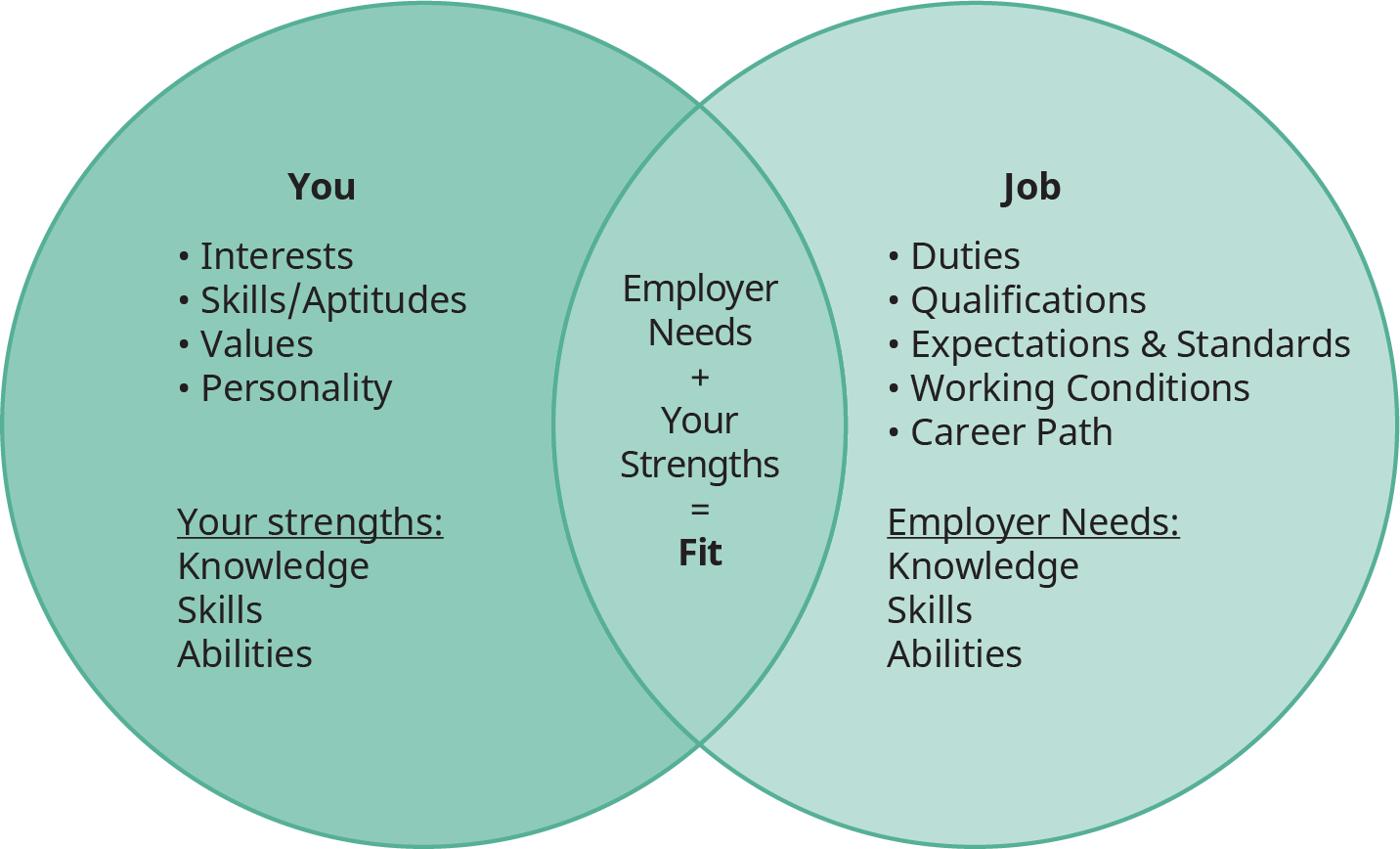
The importance of finding the right fit cannot be overstated. Many people don’t realize that the KSAs of the person and the requirements of the job have to match in order to get hired in a given field. What is even more important, though, is that when a particular job fits your four factors of self-knowledge and maximizes your KSAs, you are most likely to be satisfied with your work! The “fit” works to help you not only get the job, but also enjoy the job.
So if you work to learn about yourself, what do you need to know about jobs, and how do you go about learning it? In our diagram, if you need to have self-knowledge to determine the YOU factors, then to determine the JOB factors, you need to have workplace knowledge. This involves understanding what employers in the workplace and specific jobs require. Aspects of workplace knowledge include:
- Labor Market Information: Economic conditions, including supply and demand of jobs; types of industries in a geographic area or market; regional sociopolitical conditions and/or geographic attributes.
- Industry Details: Industry characteristics; trends and opportunities for both industry and employers; standards and expectations.
- Work Roles: Characteristics and duties of specific jobs and work roles; knowledge, skills, and abilities necessary to perform the work; training and education required; certifications or licenses; compensation; promotion and career path; hiring process.
This “research” may sound a little dry and uninteresting at first, but consider it as a look into your future. If you are excited about what you are learning and what your career prospects are, learning about the places where you may put all of your hard work into practice should also be very exciting! Most professionals spend many hours not only performing their work but also physically being located at work. For something that is such a large part of your life, it will help you to know what you are getting into as you get closer to realizing your goals.
How Do We Gain Workplace Knowledge?
- Understand that there is a wide range of occupations and industries that fit together so that we can see how all jobs contribute to the workplace. With the use of formal career assessments, it will be easy to see where you fit in using the map below.
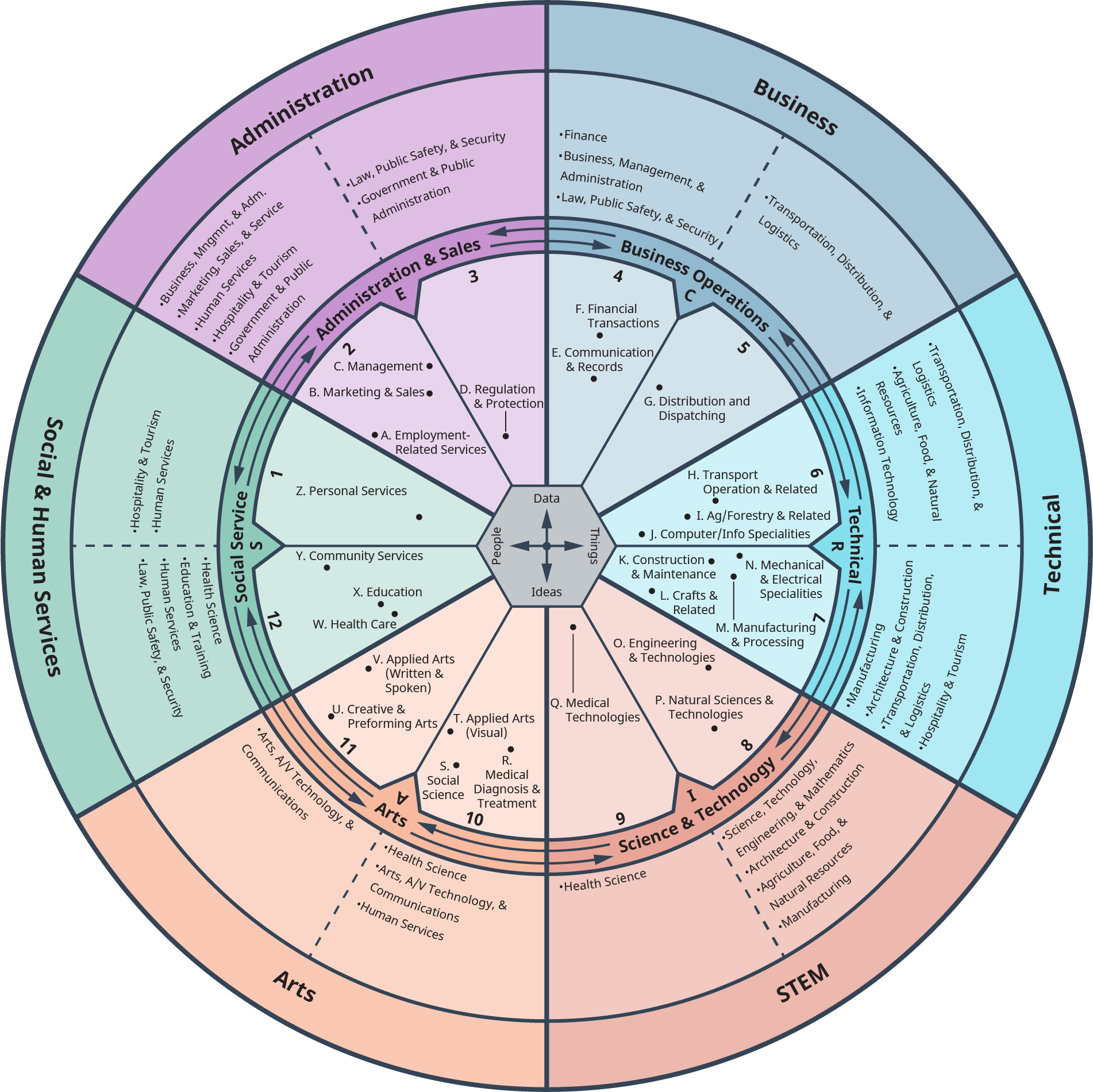 Figure 12.7 The World of Work Map demonstrates the interconnected areas of occupation and interest. You can use it to help navigate your exploration of workplace knowledge. (Credit: Based on Work by ACT.)
- Learn the “textbook” definitions of what is involved in the jobs you are considering. In Chapter 4, you used the Occupational Outlook Handbook to learn more about the requirements for occupations. Its sister site, will help show you more specific job titles.
- Read online information that is relevant to the professions you are interested in. Good sources for this include professional associations. Just “googling” information is risky. Look for professional and credible information. The Occupational Outlook Handbook has links to many of these sources. Your career center can also guide you.
- Whether you are just choosing your major or are already in a major and want to know what options it offers in terms of future work, look for this specific information. Your department may have this information; your campus career center definitely will. One very good site is What Can I Do With This Major?
- Join professional clubs on campus. Many of these organizations have guest speakers who come to meetings and talk about what their jobs are like. Often, they also sponsor field trips to different companies and organizations.
- As mentioned earlier, attend campus networking events and programs such as job fairs and recruiting information sessions so that you can talk to people who actually do the work and get their insights.
Something to keep in mind as you make choices about your major and career is that the training is not the job. What you learn in your college courses is often foundational information; it provides basic knowledge that you need for more complex concepts and tasks. For example, a second-year student who is premed has the interests and qualities that may make her a good physician, but she is struggling to pass basic chemistry. She starts to think that medical school is no longer an appropriate goal because she doesn’t enjoy chemistry. Does it make sense to abandon a suitable career path because of one 15-week course? In some ways, yes. In the case of medical school, the education is so long and intensive that if the student can’t persevere through one introductory course, she may not have the determination to complete the training. On the other hand, if you are truly dedicated to your path, don’t let one difficult course deter you.
The example above describes Shantelle. They weren’t quite sure which major to choose, and they were feeling pressure because the window for making their decision was closing. They considered their values and strengths—they love helping people and have always wanted to pursue work in medical training. As described above, Shantelle struggled in general chemistry this semester and found that they actually didn’t enjoy it at all. They’ve heard nightmare stories about organic chemistry being even harder. Simultaneously, Shantelle is taking Intro to Psychology, something they thought would be an easier course but that they enjoy even though it’s challenging. Much to their surprise, they found the scientific applications of theory in the various types of mental illness utterly fascinating. But given that their life dream was to be a physician, Shantelle was reluctant to give up on medicine because of one measly chemistry course. With the help of an advisor, Shantelle decided to postpone choosing a major for one more semester and take a course in clinical psychology. Since there are so many science courses required for premed studies, Shantelle also agreed to take another science course. Their advisor helped Shantelle realize that it was likely not a wise choice to make such an important decision based on one course experience.
Focus Your Path
When you know yourself and know what to expect from a workplace and a job, you have information to begin to make decisions. As we’ve discussed throughout this book, you’re not attending college solely to get a job. But this is likely one of your goals, and your time in school offers a tremendous opportunity to both prepare for your career (or careers) and make yourself more attractive to organizations where you want to work. Successfully learning the content of your classes and earning good grades are among the most important. Beyond these priorities, you’ll learn the most about yourself and your potential career path if you engage in activities that will help you make decisions. Simply sitting back and thinking about the decision doesn’t always help you take action.
Take Advantage of Every Resource You Can While in School
Your college has a wealth of departments, programs, and people dedicated to your success. The more you work to discover and engage with these groups, the more successfully you’ll establish networks of support and build skills and knowledge for your career.
Make plans to drop by your career services or a related office early in your time in school. There, you’ll learn about events you can attend, and you’ll get to know some of the people there who can help you. The department may offer the formal assessments discussed earlier in this chapter, including aptitude testing, which can help you discover some of your areas of strength and give you insight into some high-potential career destinations. Career services may also have skills/interest inventories. These can help you match your attributes and ambitions with potential careers and suggest additional resources to explore.
Your college is also likely to have a resource that goes far beyond the campus itself: the alumni association. College alumni often maintain a relationship with the school and with their fellow graduates. Just by attending the same college, you have something in common with them. You chose the same place, maybe for similar reasons, and you might be having similar experiences. Often, alumni are eager to help current students by offering their professional insights and making career connections. You can find out about alumni events on your campus website, at the career center, and in the alumni department. These events can be fun and beneficial to attend, especially those involving networking opportunities. Note that specific departments or campus organizations may have their own alumni groups, whether formal or informal. Try to find former students who majored in your field or who have a job similar to the one you’d like one day. Remember, members of alumni organizations make a choice to be involved; they want to be there. It’s very likely they’ll be interested in offering you some help, mentoring, or even introductions to the right people.
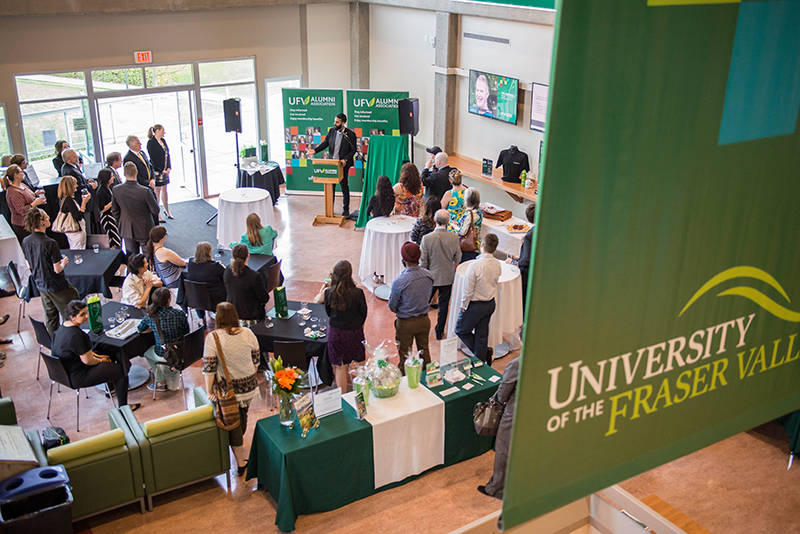
Alumni may often attend events at your college, such as visiting guest speakers, art show openings, homecoming, or sporting events. You can find and talk with them there (under the right circumstances) and enjoy the event at the same time.
Networking is such a critical part of professional life that nearly every city or region has organizations and events devoted to it. Meetups are occasions for people with shared interests, skills, and professions to gather together and talk about their experiences and insights. The events might involve a brief talk or demonstration, a discussion or question-and-answer period, and then plenty of time for mingling. You can likely find these events with a quick search. But before you go, carefully review the guidelines and limits on who can attend. Some meetups may not be open to students or others not formally employed in a field; they may also be held in bars or involve alcohol, preventing those under 21 from attending. Don’t be offended by these barriers—the meetup organizers have specific goals and members to consider—but if you find one you can attend, try it out.
You can also network with people right at your college. Many of your college faculty likely have (or had) other roles and positions. A computer science professor may have worked for a tech company before moving into academia. Accounting faculty, especially certified public accountants, might take on tax work every spring. Nursing faculty likely maintain a role with a hospital or other medical office. Learn from them what the job is like and how you can better prepare for it. And don’t forget to talk to adjunct instructors; they may have an entirely separate career on top of their teaching role that gives them access to a network of potential mentors and employers.
Finally, you’ll likely encounter graduate students or preprofessional students, some of whom may be in the workforce or have work experience. While they themselves are still working on their education, they may have insights, connections, and ideas regarding your career.
Try Things Out
In the first two steps of the Career Planning Cycle, you gather information. You may have some ideas about jobs and careers that you may like, but you also may wonder if you will really like them. How will you know? How can you be more certain? Take an interest or a skill, and try it out in an experience. By putting it to work for you in any one of a number of different environments, you can get practice and learn more about who you are and just how much you can do. It’s a great idea to try out a new skill or career field before you commit to it fully. You might find out that the field isn’t right for you, but you also may find that you are heading in the right direction and want to keep pursuing it. Experiences help you become more qualified for positions. One exciting aspect of college is that there is a huge variety of learning experiences and activities in which to get involved. The following are some ways that you can try things out and get experience.
Community Involvement, Volunteering, and Clubs
You’re in college to develop yourself as an individual. You’ll gain personally satisfying and enriching experience by becoming more involved with your college or general community. Organizations, clubs, and charities often rely on college students because of their motivation, knowledge, and increasing maturity. The work can increase your skills and abilities, providing valuable experience that will lead to positive results.
Participate in clubs and volunteer in areas that appeal to your interests and passions. It’s just as important that you enjoy them and make a difference as it is to increase career potential through networking and skill-building. But of course, it’s great to do both.
Once you join a club or related organization, take the time to learn about their leadership opportunities. Most campus clubs have some type of management structure—treasurer, vice president, president, and so on. You may “move up the ranks” naturally, or you may need to apply or even run for election. Some organizations, such as a campus newspaper, radio station, or dance team, have skill-based semiprofessional or roles such as advertising manager, sound engineer, or choreographer. These opportunities may not always be available to you as freshmen, but you can take on shorter-term roles to build your skills and make a bigger impact. Managing a fundraiser, planning an event, or temporarily taking on a role while someone else is busy are all ways to engage further.
Volunteering can be an important way to access a profession and get a sense for whether you will enjoy it or not, even before you do an internship. And in certain arenas, such as politics, it might be the only readily accessible approach, especially if you have no prior experience. In all of these cases, you can build important skills and increase your experience working with people in your chosen field. Spend time reflecting on and recording your experiences so that you’re better prepared to talk about them and utilize what you learned.
Internships and Related Experiences
Many employers value experience as much as they do education. Internships and similar fieldwork allow you to use what you’ve learned and, sometimes more importantly, see how things work “in the real world.” These experiences drive you to communicate with others in your field and help you understand the day-to-day challenges and opportunities of people working in similar areas. Even if the internship is not at a company or organization directly in your field of study, you’ll focus on gaining transferable skills that you can apply later on.
Speaking to career or academic counselors and planning your major will help you learn about internship requirements and recommendations. You’ll find out how, where, and when to apply, the level of commitment required, and any limitations or guidelines your college indicates. If you’re going to receive credit for your internship or fieldwork, it must be directly related to your field of study.
When you intern, you are usually treated like you work there full-time. It’s not just learning about the job; it’s doing the job, often similarly to an entry-level employee. The level of commitment may vary by the type of internship and may be negotiable based on your schedule. Be very clear about what’s required and what you can handle given your other commitments, because you want to leave a very good impression. (Internship managers are your top resource for employment references and letters of recommendation.)
Note that while internships and similar positions may seem to involve low-level work, you maintain your rights and should be treated properly. Getting coffee, organizing shelves, and copying papers are often part of the work. Your internship should be structured with duties, responsibilities, and goals for learning that are mutually agreed upon by both you and the internship site, as well as approved by an internship supervisor from your college or university. This will help ensure a positive and productive experience for both you and your internship sponsor.
Students who take internships generally report them to be worthwhile experiences. In a survey of students taken by the National Association of Colleges and Employers, approximately 75 percent of students responding to the survey said their professionalism/work ethic, teamwork/collaboration, and oral/written communication skills were “very” to “extremely” improved by their internship/coop experience, and 66 percent said the same of their critical thinking/problem-solving skills.3
Activity
Go to Internships.com and enter a specific keyword and location in the fields on the homepage, such as “airline” and “Bend, OR.” How many opportunities came back? How many piqued your interest?
Now, try to choose a broader, less specific keyword. For example, instead of “airline,” try “aviation” on the second search. If the first keyword was “physical therapy,” you might try “health care” for a broader search in the same field. Did you receive more opportunities the second time? Do you see ones that aren’t exactly in your field but that still seem interesting?
On sites like these, you can play with the options and filters to find a wide array of internship possibilities in related fields. In the example above, a future physical therapist who took an internship in another area of health care would certainly still learn a lot.
There are many and varied types of experiential learning opportunities that can help you learn more about different career opportunities. These are fully discussed in Chapter 4. The table below provides a brief overview.
| Internship | A period of work experience in a professional organization, in which participants (interns) are exposed to and perform some of the tasks of actual employees. Internships are usually a relatively high commitment, and may be paid and/or result in college credit. |
| Externship/Job Shadowing | Usually a briefer and lower-commitment experience than internships, in which participants are observing work activities and perhaps undertaking small projects. Unpaid and not credit-bearing. |
| Fieldwork | A period or trip to conduct research or participate in the “natural environment” of a discipline or profession. Fieldwork may involve visiting a work site, such as a hospital or nursing home, or being a part of a team gathering data or information. |
| Apprenticeship | A defined period of on-the-job training in which the student is formally doing the job and learning specific skills. Unlike most internships, apprenticeships are usually formal requirements to attain a license or gain employment in skilled trades, and they are growing in use in health care, IT, transportation, and logistics. |
| Undergraduate Research | Even as an undergrad, you may find opportunities to partake in actual research in your field of study. Colleges often have strict guidelines on types and levels of participation, and you will likely need to apply. The benefits include firsthand knowledge of a core academic activity and exposure to more people in your field. |
| Related Employment | It may be possible to get a regular, low-level paying job directly in your field of study or in a related place of work. While it’s not essential, simply being around the profession will better inform and prepare you. |
| Clinicals, Student Teaching, and Related Experiences | Health care, education, and other fields often have specific requirements for clinicals (learning experience in health care facilities) or student teaching. These are often components of the major and required for both graduation and licensure. |
| Service Learning | Students learn educational standards through tackling real-life problems in their community. Involvement could be hands-on, such as working in a homeless shelter. Students could also tackle broad issues in an indirect manner, such as by solving a local environmental problem. |
Productive Downtime
Throughout this book, we’ve discussed all the work required for a successful and productive college experience. And in this chapter, we’ve outlined a wide range of extracurricular activities that are likely necessary to achieve your career goals. But as we’ve also made clear, balance and rest are critical for success and well-being. Everyone needs time off.
So, when you have a school break, relax. Spend time with the people who motivate and help you—family and friends—or take a trip if that’s possible. If you work during school and school breaks, the decrease in your school responsibilities should help recharge your batteries.
Another way you might spend your time off from school is to find an employment and/or experiential opportunity, especially during a longer time off. Winter break may afford a weeklong volunteer opportunity or a brief externship. Summer break is particularly helpful for formal internships and other experiences.
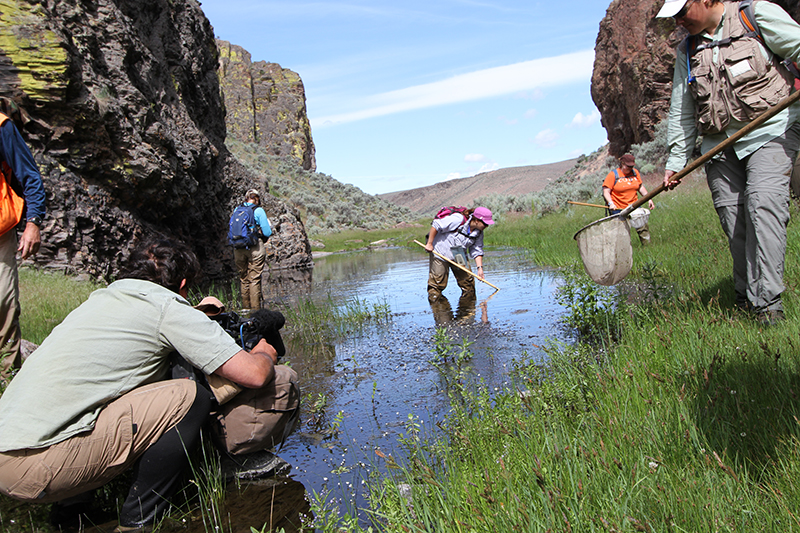
If you do seek a summer internship or related activity, be aware that they can be very competitive. With many college students off for the summer, they may be targeting the same opportunities as you are. Work with your academic or career advisors to start the process early and put yourself in the best position to get an internship. Consider all of the application components, including essays, portfolio items, and letters of recommendation; all of these may take time to generate. If possible, pursue multiple opportunities to increase your chances. Just be clear on the application policies, and be sure to inform them if you take another position.
Summer jobs, whether related to your field or not, may also be hard to come by without prior planning. If you go away to school and need a job at home over the summer, be sure to connect with the potential employer early. Get them the application, resume, and any certifications or recommendations with plenty of time for them to process and contact you for clarification or follow-up. Employers who regularly employ college students will likely be comfortable working via email or by phone, but ask if an in-person interview is necessary, and see if you can schedule it during a spring break or as soon as you get back from school. Even if you don’t go away to school, plan and connect early. You wouldn’t want all the other students to come home and take your opportunity when you’ve been there all along.
While you're not focused on your schoolwork, or even after you graduate, you can keep learning. Beyond the different types of degrees and certificates discussed in the Academic Pathways chapter, you'll be more prepared and more attractive to a potential employer if you demonstrate a continued thirst and effort to gain knowledge and "remain current." Find the leaders in your field and read their articles or books (your future employers may be familiar with them). Or consider more formal summer courses, short-courses, or online learning opportunities. Each profession has its own resources. For example, in the software and computing field, Thinkful offers courses and mentoring for students and professionals.
Transferable Skills
Whether or not your internship or other experiences are directly connected to your career, you should focus as much as possible on building and improving transferable skills. These are abilities and knowledge that are useful across an array of industries, job types, and roles. They can be transferred—hence the name—from where you learned them to another career or area of study.
Examples of transferable skills include communication, personnel management/leadership, teamwork, computation/quantitative literacy, information technology, research/analysis, foreign language, and so on. If you search for lists of transferable skills, you’ll see that some sites only include compilations of a few very broad areas, such as communication, while others provide longer and more specific lists, such as breaking down communication into writing, verbal, and listening skills. Employers believe that transferable skills are critical to the success of their recent college graduate new hires. The top four career competencies that employers want are critical thinking/problem solving, teamwork/collaboration, professionalism/work ethic, and oral/written communication.4 If you remember the statistics noted above, students said that all four of these skills were significantly improved through their internship experiences.
These are considered skills because they are not simply traits or personality elements; they are abilities and intelligences you can develop and improve. Even if you’re a great writer before starting an internship, you may need to learn how to write in a more professional manner—becoming more succinct, learning the executive summary, conforming to templates, and so on. Once you establish that skill, you can not only mention it on a resume or interview, but also discuss the process by which you improved, demonstrating your adaptability and eagerness to learn.
Not everyone can land an internship or perform fieldwork. Perhaps you need to work nearly full-time while in school. If so, focus on developing transferable skills in that environment. Take on new challenges in areas where you don’t have experience. For example, if you work in retail, ask your manager if you can help with inventory or bookkeeping (building quantitative literacy skills). If you’re a waiter, help the catering manager plan a party or order food (building organizational skills). Remember, extending yourself in this way is not simply a means to enhance your resume. By taking on these new challenges, you’ll see a side of the business you hadn’t before and learn things that you can apply in other situations.
Whether or not it’s required as a part of your internship or other experience, be sure to reflect on your time there—what you did, what you learned, where you excelled, where you didn’t excel. Maintaining a journal of some sort will enable you to share your experiences and employ your transferable skills in your college courses and other activities. Jot down some anecdotes, events, and tasks you performed. Any materials or documents you produced can go into your portfolio, and the record of your experience will serve you well while searching for a job. Consider that it is customary to be asked during a job interview to share a personal strength and a weakness. Sharing a strength is often more expected and, thus, easier to plan for. While it may seem reasonable to say that your weakness is that you’re always late, it’s better to provide a weakness within the context of work experience. For example, if you have had a part-time job where one of your colleagues was always slacking off and putting the load on others, you may have felt frustrated and even expressed your anger. Rather than view this as a negative, consider the positive benefit and craft this into a solid answer to the likely interview question. For example, “I have found that I’m rather impatient with colleagues who take shortcuts to a solution and don’t really apply themselves. My weakness is impatience. However, rather than call it out in a negative way, I share my observation as constructive feedback and let it go. My colleague can take it or leave it, but I’m not carrying it with me.” If you wrote about this experience around the time that it occurred, it will be easier to shape into a thoughtful response later. Continuing to work on your transferable skills will allow you to improve them and make a better impression on faculty, advisors, and potential employers.
What to Do to Get Ready
Being prepared to find a job means putting evidence of your KSAs together in a way that employers will understand. It is one thing to say you can do something; it is another to show that you can. The following are things that you will want to compile as a part of your college career.
Resumes and Profiles: The College Version
You may already have a resume or a similar profile (such as LinkedIn), or you may be thinking about developing one. Usually, these resources are not required for early college studies, but you may need them for internships, work-study, or other opportunities. When it comes to an online profile, something that is a public resource, be very considerate and intentional when developing it.
Resume
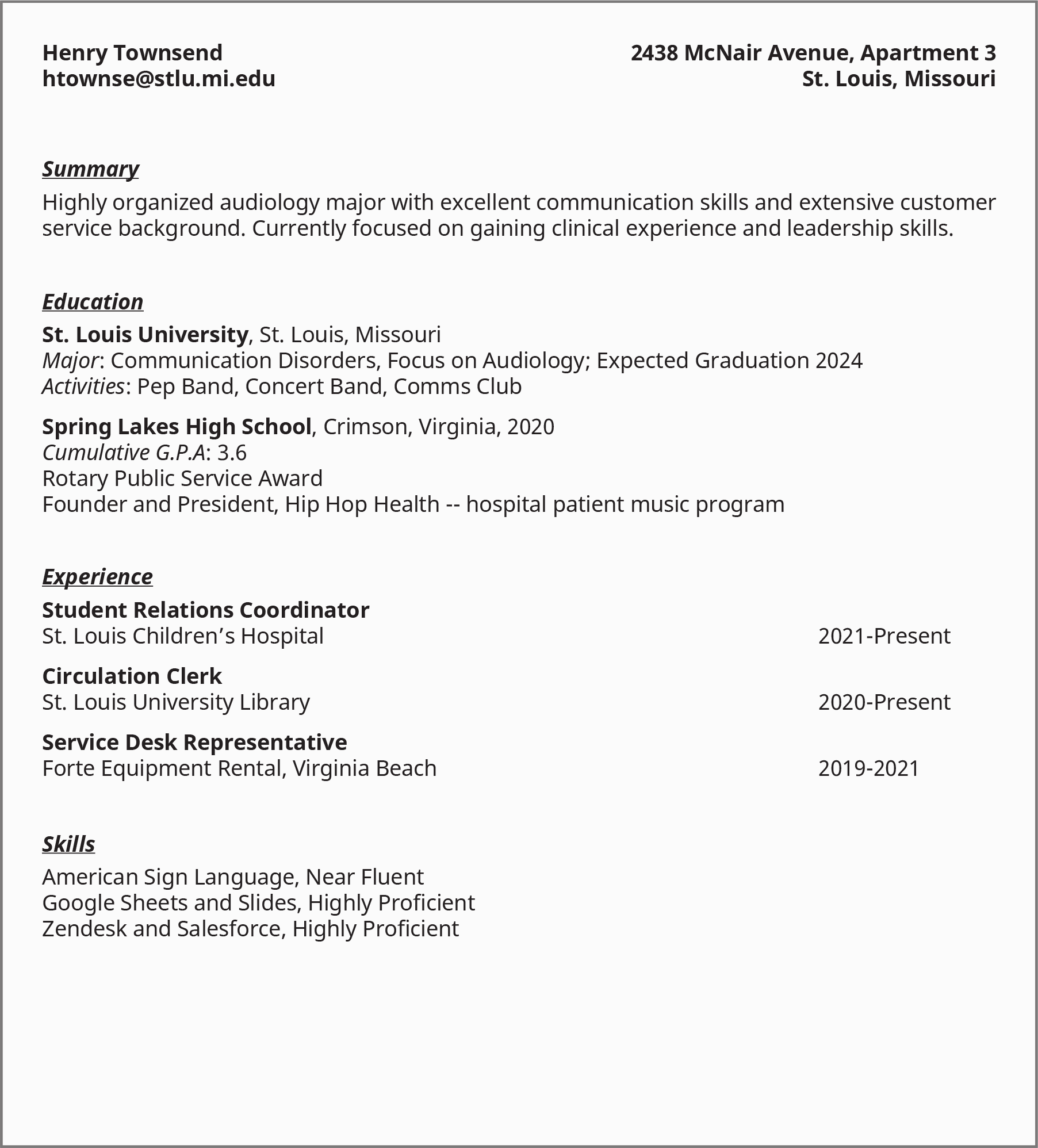
A resume is a summary of your education, experience, and other accomplishments. It is not simply a list of what you’ve done; it’s a showcase that presents the best you have to offer for a specific role. While most resumes have a relatively similar look and feel, there are some variations in the approach. Especially when developing your first résumé or applying in a new area, you should seek help from resources such as career counselors and others with knowledge of the field. Websites can be very helpful, but be sure to run your résume by others to make sure it fits the format and contains no mistakes.
A resume is a one-page summary (two, if you are a more experienced person) that generally includes the following information:
- Name and contact information
- Objective and/or summary
- Education—all degrees and relevant certifications or licenses
- While in college, you may list coursework closely related to the job to which you’re applying.
- Work or work-related experience—usually in reverse chronological order, starting with the most recent and working backward. (Some resumes are organized by subject/skills rather than chronologically.5)5Writing@CSU. “Organizing Your Resume.” https://writing.colostate.edu/guides/page.cfm?pageid=1517&guideid=77
- Career-related/academic awards or similar accomplishments
- Specific work-related skills
While you’re in college, especially if you went into college directly after high school, you may not have formal degrees or significant work experience to share. That’s okay. Tailor the résumé to the position for which you’re applying, and include high school academic, extracurricular, and community-based experience. These show your ability to make a positive contribution and are a good indicator of your work ethic. Later on in this chapter, we’ll discuss internships and other programs through which you can gain experience, all of which can be listed on your resume. Again, professionals and counselors can help you with this.
If you have significant experience outside of college, you should include it if it’s relatively recent, relates to the position, and/or includes transferable skills (discussed above) that can be used in the role for which you’re applying. Military service or similar experience should nearly always be included. If you had a long career with one company quite some time ago, you can summarize that in one resume entry, indicating the total years worked and the final role achieved. These are judgment calls, and again you can seek guidance from experts.
Digital Profiles
An online profile is a nearly standard component of professional job seeking and networking. LinkedIn is a networking website used by people from nearly every profession. It combines elements of résumés and portfolios with social media. Users can view, connect, communicate, post events and articles, comment, and recommend others. Employers can recruit, post jobs, and process applications. Alternatives include Jobcase, AngelList, Hired, and Nexxt. These varying sites work in similar ways, with some unique features or practices.
Some professions or industries have specific LinkedIn groups or subnetworks. Other professions or industries may have their own networking sites, to be used instead of or in addition to LinkedIn. Industry, for example, is a networking site specifically for culinary and hospitality workers.
As a college student, it might be a great idea to have a LinkedIn or related profile. It can help you make connections in a prospective field, and provide access to publications and posts on topics that interest you. Before you join and develop a public professional profile, however, keep the following in mind:
- Be professional. Write up your profile information, any summary, and job/education experience separately, check for spelling and other errors, and have someone review before posting. Be sure to be completely honest and accurate.
- Your profile isn’t a contest. As a college student, you may only have two or three items to include on your profile. That’s okay. Overly long LinkedIn profiles—like overly long resumes—aren’t effective anyway, and a college student’s can be brief.
- Add relevant experience and information as you attain it. Post internships, summer jobs, awards, or work-study experiences as you attain them. Don’t list every club or organization you’re in if it doesn’t pertain to the professional field, but include some, especially if you become head of a club or hold a competitive position, such as president or member of a performance group or sports team.
- Don’t “overconnect.” As you meet and work with people relevant to your career, it is appropriate to connect with them through LinkedIn by adding a personal note on the invite message. But don’t send connection invites to people with whom you have no relationship, or to too many people overall. Even alumni from your own school might be reluctant to connect with you unless you know them relatively well.
- Professional networking is not the same as social media. While LinkedIn has a very strong social media component, users are often annoyed by too much nonprofessional sharing (such as vacation/child pictures); aggressive commenting or arguing via comments is also frowned upon. As a student, you probably shouldn’t be commenting or posting too much at all. Use LinkedIn as a place to observe and learn. And in terms of your profile itself, keep it professional, not personal.
- LinkedIn is not a replacement for a real resume.
There’s no need to rush to build and post an online professional profile—certainly not in your freshman year. But when the time is right, it can be a useful resource for you and future employers.
Social Media and Online Activity Never Go Away
While thinking about LinkedIn and other networks, it’s a good time to remember that future employers, educational institutions, internship coordinators, and anyone else who may hire or develop a relationship with you can see most of what you’ve posted or done online. Companies are well within their rights to dig through your social media pages, and those of your friends or groups you’re part of, to learn about you. Tasteless posts, inappropriate memes, harassment, pictures or videos of high-risk behavior, and even aggressive and mean comments are all problematic. They may convince a potential employer that you’re not right for their organization. Be careful of who and what you retweet, like, and share. It’s all traceable, and it can all have consequences.
For other activities on social media, such as strong political views, activism, or opinions on controversial topics, you should use your judgment. Most strong organizations will not be dissuaded from working with you because you’re passionate about something within the realm of civility, but any posts or descriptions that seem insensitive to groups of people can be taken as a reason not to hire you. While you have freedom of speech with regard to the government, that freedom does not extend to private companies’ decisions on whether to hire you. Even public institutions, such as universities and government agencies, can reject you for unlawful activity (including threats or harassment) revealed online; they can also reject you if you frequently post opinions that conflict with the expectations of both your employer and the people/organizations they serve.
With those cautions in mind, it’s important to remember that anything on your social media or professional network profiles related to federally protected aspects of your identity—race, national origin, color, disability, veteran status, parental/pregnancy status, religion, gender, age, or genetic information (including family medical history)—cannot be held against you in hiring decisions.
Building Your Portfolio
Future employers or educational institutions may want to see the work you’ve done during school. Also, you may need to recall projects or papers you wrote to remember details about your studies. Your portfolio can be one of your most important resources.
Portfolio components vary according to field. Business students should save projects, simulations, case studies, and any mock companies or competitions they worked on. Occupational therapy students may have patient thank-you letters, summaries of volunteer activity, and completed patient paperwork (identities removed). Education majors will likely have lesson plans, student teaching materials, sample projects they created, and papers or research related to their specialization.
Other items to include a portfolio:
- Evidence of any workshops or special classes you attended. Include a certificate, registration letter, or something else indicating you attended/completed it.
- Evidence of volunteer work, including a write-up of your experience and how it impacted you.
- Related experience and work products from your time prior to college.
- Materials associated with career-related talks, performances, debates, or competitions that you delivered or took part in.
- Products, projects, or experiences developed in internships, fieldwork, clinicals, or other experiences (see below).
- Evidence of “universal” workplace skills such as computer abilities or communication, or specialized abilities such as computation/number crunching.
A portfolio is neither a scrapbook nor an Instagram story. No need to fill it with pictures of your college experience unless those pictures directly relate to your career. If you’re studying theology and ran a religious camp, include a picture. If you’re studying theology and worked in a food store, leave it out.
Certain disciplines, such as graphic design, music, computer science, and other technologies, may have more specific portfolio requirements and desired styles. You’ll likely learn about that in the course of your studies, but be sure to proactively inquire about these needs or seek examples. Early in your college career, you should be most focused on gathering components for your portfolio, not formalizing it for display or sharing.
Preparing to Network
Throughout this chapter, we have discussed how important relationships are to your career development. It can sometimes be a little intimidating to meet new people in the professional environment. But with preparation and understanding, these encounters can be not only helpful, but also rewarding. Here are some ideas to consider when meeting new people who can be helpful to your career:
- Be yourself. You’re your own best asset. If you’re comfortable with who you are and where you come from, others will be, too.
- Remember, you’re in college and they know it. Don’t try to impress everyone with what you know; alumni or faculty know more. Instead, talk about what you’re learning—your favorite class, the project you’re most proud of, or even the ones by which you’ve been most challenged.
- Be polite, not too casual. If your goal is to become a professional, look and sound the part.
- Listen.
- Think of some questions ahead of time. Don’t aim for difficult questions or anything too personal, but asking people how they got into their career, with whom they studied in college, what their job is like, and similar questions will both start conversations and provide you with meaningful insight.
- Don’t stress. Remember, if alumni, even highly successful ones, are speaking to you, it’s usually because they want to. An encounter over finger food or a brief meetup in the Rad Tech department office isn’t going to make or break your job prospects.
- If appropriate and timely, ask if you can keep in touch. Be prepared with a polished email address and phone number. For example, if your current address is “fortnitefan@gmail.com,” consider creating a second account that’s more professional.
- Say thank you. No need to go on and on, but thank them for any advice they give or simply for taking the time to talk with you
While you’re in college, don’t try to impress everyone with what you know. Instead, talk about what you’re learning.
Making Your Case through the Words of Others: Letters of Recommendation
Whether you go on to graduate school or directly into the workforce (or both at the same time), decision makers will want to learn more about you. Your grades, interviews, test scores, and other performance data will tell them a lot. But sometimes they’ll want to hear from others.
Letters of recommendation are often a standard component of convincing people you’re the right person to join their organization. Some positions or institutions require a certain quantity of letters and may have specific guidance on who should write them. Other companies will accept them as additional evidence that you’re a great candidate. Either way, gathering such letters or having a few people whom you can ask for them will put you in a better position. Note that internships, especially competitive ones, may also require letters of recommendation.

Whom to ask for a letter? They’re usually written by instructors, department chairs, club advisors, managers, coaches, and others with whom you’ve had a good relationship. Maybe it’s someone who taught two or three of your courses, or someone you helped in a volunteer or work-study capacity.
Just by taking the time to write the letter, a faculty member is sending a message: “The person about whom I’m writing impressed me.” So the first step is to make a good impression on the person you’re asking to write a letter. You may do this in many ways. Getting a good grade in the class is important, but a faculty member may be more impressed by your perseverance, improvement over time, or creativity in meeting challenges.
How to ask? Be straightforward and direct. The appeal is best made in person, but be prepared for the person you’re asking to ask for some time to make the decision. People who get frequent requests may have a policy or even a form to fill out. They may ask you to provide more information about yourself so that they can write an original letter. If they do so, be thorough but prompt—you don’t want to keep them waiting. And if you have a deadline, tell them.
When to ask? If you encounter a faculty member early in your college career who you think would be the best person to write a letter for you, ask them what they think toward the end of your course or soon after. They may feel it’s too early or not specific enough to simply hand you a general letter at that time. If so, ask if you can come back when you are applying to internships, jobs, or grad schools.
If you wait until you’re applying or you’re about to graduate, you may have a more specific subject or reason for a letter. Be sure to tell the writer where you’re applying and what type of career you’re going into, so they can tailor the recommendation to that area.
Thank-you notes. They wrote you a letter, so you should write them one in return. A brief and personal thank-you note is appropriate and necessary.
Steps to Success
“Things change—circumstances change. Learn to adapt. Adjust your efforts and yourself to what is presented to you so you can respond accordingly. Never see change as a threat—do not get intimidated by it. Change can be an opportunity to learn, to grow, to evolve, and to become a better person.”
―Rodolfo Costa6
6Costa, Robert. Advice My Parents Gave Me: Aand Other Lessons I Learned from My Mistakes. 2011.
Preparing for Change and Being Open to Opportunities
Earlier in this text, we discussed managing change, adapting to the unexpected, and handling setbacks. These are critical skills that, while difficult during the process, ultimately build a better—and more employable—you. While you can’t prepare for every obstacle or surprise, you can be certain that you’ll encounter them.
You may go through all of college, and even high school, with one job in mind. You may apply early to a specific program, successfully complete all the requirements, and set yourself on a certain career path. And then something may change.
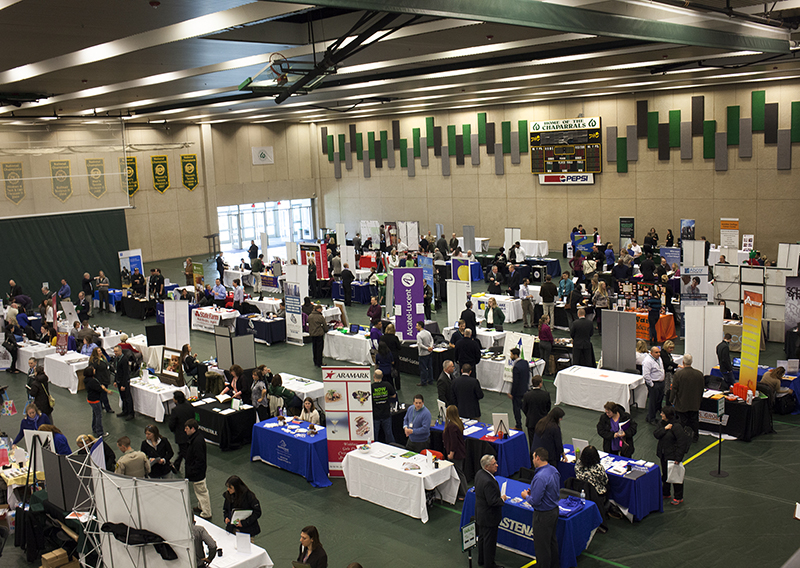
As described above, changes in your interests or goals are a natural part of developing your career; they’re nothing to be ashamed of. Most college students change majors several times. Even once they graduate, many people find themselves enjoying careers they didn’t envision. Ask the people around you, and many will share stories about how they took a meandering or circuitous path to their profession. Some people end up in jobs or companies that they didn’t know existed when they started school.
What’s most important is that you build on your successes and failures, consider all your experiences, and pursue your purpose and overarching personal goals. For example, if you want to become a police officer but cannot complete all of the degree requirements on time, taking a job as a security officer or even an unrelated job in the meantime might lead to a great deal of satisfaction and set you on a different path. If, after that, you still want to pursue law enforcement, you can build it into your plan—managing your priorities, gaining the required experience and credentials, and applying for jobs closer to your chosen career.
This early in your college experience, you shouldn’t be too worried about how to conduct job interviews or explain employment gaps or changing directions. However, you may need or want to explain the thinking behind your future plans to academic advisors, internship managers, your peers, and your family. You should feel free to do so openly, but you’ll probably be better prepared if you revisit some of the ideas discussed earlier in this chapter. Consider how a shift in your plans, whether slight or significant, reflects who you are now and who you hope to be in the future. Knowing yourself as an emerging and new professional by discovering and developing your interests, skills, values, personality, and strengths is something that everyone should do on an ongoing basis throughout their lives. Explore job opportunities or career paths available to people in your new major or discipline area. Think about whether you need to handle any financial impacts, such as paying for additional education or delaying employment.
Employers, for their part, are often unfazed by changes or even mistakes. Remember, when they ask about your greatest weakness or failure, they want to hear something genuine. Just like the alumni you meet or the faculty you’re asking for recommendations, interviewers may be more impressed by how and what you’ve learned rather than how you followed a preplanned path. Remember, most jobs are a continuous thread of situations to think through, information to analyze, and problems to solve. Your ability to solve your own problems, and reflect and discuss them later, will show that you’re ready to do the same for an employer.
12.3 Where Can You Go from Here?
| Estimated completion time: 7 minutes. |
Hopefully you’ve noticed that we’ve ended each chapter of this book with a subsection called “Where Do You Go from Here?” In many of those cases, the story or reflection was aimed at giving you some ideas about how you could apply the topics and skills from that chapter to college and your career. Now we’re at the last chapter, and the question is even more personal and a little different: Where can you go? Where do you want to go? And, perhaps more importantly, why?
The provided ideas and methods regarding choosing your career are proven winners. Learning about yourself, whether through simple reflection or formal analysis, is important to find your place. But consider the importance and reality of change and your openness to it. Regardless of your major, you will embark on a job and a career that will change many times over the course of your life. You’ll likely change responsibilities, roles, companies, and even industries. Even if you join a company one week after graduation and stay with it until you retire, the job and the company won’t remain the same. The world moves far too quickly for that, which is a good thing. All of those changes are opportunities to improve yourself and get closer to the “why” of your work: your purpose.
Your purpose is the answer to all types of questions that people may ask you. “Do you like your job?” “How did you get into that?” “Is it worth it?” But more importantly, your purpose is the answer to all types of questions that you should ask yourself. If you keep asking yourself those questions and give yourself time to answer, you’ll have the best understanding of not only what you want to do, but why.
You may find out that no single job or career is going to fulfill your purpose. If your foremost goal—your ideal—is being a good parent, your job might simply be the financial means to help accomplish that. If you want to eradicate poverty, you may do that through a job plus volunteer work plus a management position at a foundation.
Don’t think, however, that you can’t fulfill your purpose within your career. It may take a few tries and restarts, but you can make a widespread impact in a number of ways. Furthermore, if you’re having trouble entering a career-oriented purpose through the “front door,” your skills and abilities might get you in through the side door. For example, if your purpose is to help eradicate racial and socioeconomic differences in America, you can work toward that in dozens of ways. At first it may seem that being a social worker, political activist, civil rights lawyer, or educator is the primary entryway—the front door. But what if none of these work out for you? What if you don’t fit any of these molds, but you’re the best salesperson most people have ever met? Every sales job you’ve taken, you’ve blown past your goal and earned top awards and bonuses. You’ve come so far that giving up your career would be financially devastating. So how can you use your skills and experience toward your purpose? Well, you could volunteer to use your sales skills to raise money or convince lawmakers to change things. Or you could get a job where you’re selling products or services that help people in the exact situations you are trying to improve. You could sell low-cost telecommunication systems to towns and school systems so that residents have better access to the Internet, helping them learn and stay connected. You could sell building safety systems to keep people secure. You could sell educational technology, financial services, or even low-cost solar paneling to improve the lives and independence of people in impoverished areas. Your work would be similar to what you’ve done your whole life, but you would feel personally fulfilled and connected to a purpose.
In psychology, advertising, education, and other disciplines, researchers and professionals use a concept called Maslow’s Hierarchy of Needs. In essence, it’s a progression that starts with satisfying our most basic, physical needs (food, shelter) and moves through our more social and societal needs (cooperation, belonging) to our highest needs—feeling fulfilled and complete. (This brief description oversimplifies a rather detailed theory.)
Given this base introduction, consider how Maslow’s theory applies to your future. At the bottom, your most basic needs are fulfilled by a job. It pays the bills, keeps you secure, and puts food on your table. At the next level is your career. Your career is more consistent; you invest more in it and probably are more heavily rewarded. In your career, you’ll likely build up relationships over time, both professional and personal, creating a sense of community and belonging. Some people will come to associate you with your career, and you may feel partly defined by it. But it likely won’t fulfill you all on its own.
At the highest level, the level that allows you to become more fulfilled and complete, is your purpose. That’s the piece you strive for, the piece that helps you navigate your path. It’s what you may see yourself still moving toward in a later part of your life. It’s what you most want or even need to accomplish.
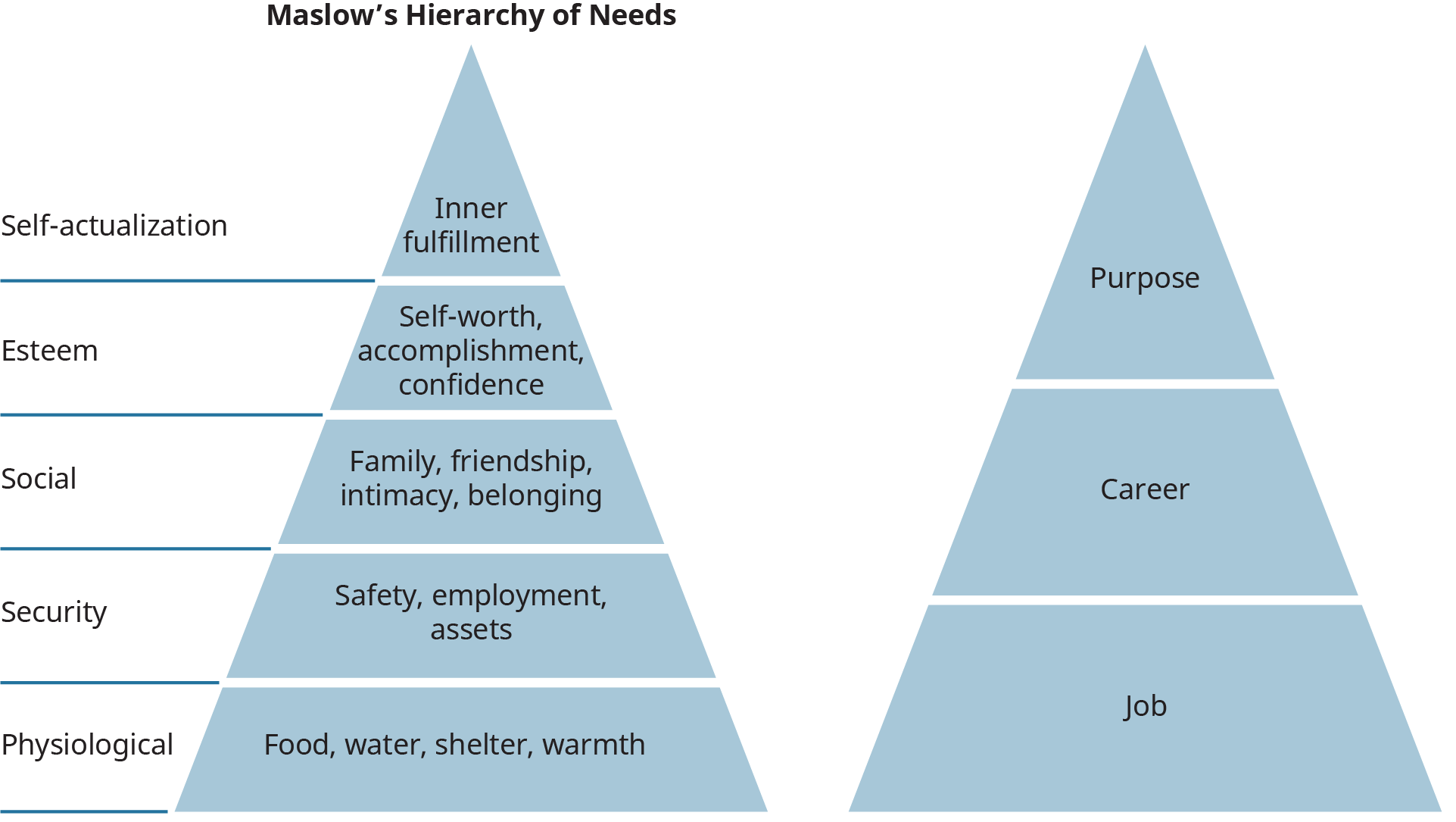
Just as you’ll likely have more than one job and even more than one career, you will have more than one purpose. You will even have them at the same time. You can be 100 percent driven to be the best possible therapist and 100 percent driven to be the best possible older sibling, all while being 100 percent driven to continually deepen your knowledge of yoga. Your time and your focus will be split between them, but they will still each fulfill you. As you get older and gain experiences, both positive and negative, your priorities may change. But you’ll be successful as long as you adhere to the principles we’ve discussed and the qualities, values, and abilities you’ve identified in yourself. College offers you the opportunity to keep asking yourself the best, most challenging questions, all while you have many people dedicated to helping you find the answers. Those answers may surprise you, but the important thing is to keep asking and keep learning.