第 5 节 · SECTION 05
4 Planning Your Academic Pathways

Chapter Outline
Introduction
Student Survey
How do you feel about your readiness to create an academic and life plan? These questions will help you determine how the chapter concepts relate to you right now. As you are introduced to new concepts and practices, it can be informative to reflect on how your understanding changes over time. We’ll revisit these questions at the end of the chapter to see whether your feelings have changed. Take this quick survey to figure it out, ranking questions on a scale of 1–4, 1 meaning “least like me” and 4 meaning “most like me.”
- I have reflected on and can identify my personal values.
- I have set both short- and long-term academic goals.
- I am familiar with the requirements I must complete and options I must select to obtain a college degree.
- I am familiar with the resources, tools, and individuals who can assist me in developing an effective plan for success.
You can also take the Chapter 4 survey anonymously online.
Student Profile
“I came into my university with little to no knowledge about how to decide a college major. I can now say with confidence that I have found the major for me! This was not an easy process though. It takes a lot of reflection to decide where you will focus your time and energy for your college career. The most important thing I had to consider was what major would provide me with learning outcomes that matter the most to me? I switched my major three or four times and each time I weighed the pros and cons of the major I was exiting and the one I was transitioning into. I decided to major in sociology and it has been the best decision of my academic career! I value social awareness and deep understandings of social phenomenon and sociology provided the course material necessary to place me on a path to begin learning about those topics. As a first-generation and low-income student navigating college pathways can be difficult. That is why it is so important to be open to change and set on learning what you want to learn how to get yourself to the next step!”
—Drew Carter, Rice University
About This Chapter
Among the most celebrated differences between high school and college is the freedom that students look forward to when they complete their mandatory high school education and take up the voluntary pursuit of a college degree. Though not every college freshman comes fresh from high school, those who do might be looking forward to the freedom of moving away from home onto a campus or into an apartment. Others might be excited about the potential to sleep in on a Monday morning and take their classes in the afternoon. For others, balancing a class schedule with an already-busy life filled with work and other responsibilities may make college seem less like freedom and more like obligation. In either case, and however they might imagine their next experience to be, students can anticipate increased freedom of choice in college and the ability to begin to piece together how their values, interests, and developing knowledge and skills will unfold into a career that meets their goals and dreams.
In Chapter 3: Managing Your Time and Priorities, we cover how goal setting and prioritizing help you plan and manage your time effectively. This chapter extends that discussion by recognizing that it can be challenging to stay on task and motivated if you don’t see how those tasks fit into a larger plan. Even the freedom to choose can become overwhelming without a plan to guide those choices. The goal of this chapter is to help you develop the personal skills and identify the resources, tools, and support people to help you make sense of your choices and formulate a personal academic and career plan. We will also consider how to take those first steps toward making your plan a reality and what to do if or when you realize you’re off track from where you had hoped to be.
By the time you complete this chapter, you should be able to do the following:
- Use your personal values to guide your decision-making, set short-term goals that build toward a long-term goal, and plan how you will track progress toward your goals.
- List the types of college certificates, degrees, special programs, and majors you can pursue, as well as general details about their related opportunities and requirements.
- Take advantage of resources to draft and track an academic plan.
- Recognize decision-making and planning as continuous processes, especially in response to unexpected change.
4.1 Defining Values and Setting Goals
| Estimated completion time: 24 minutes. |
Questions to Consider:
- What beliefs help shape your decision-making and goals?
- How do you set manageable goals that will help you stay on track?

“In every single thing you do, you are choosing a direction. Your life is a product of choices.”
— Dr. Kathleen Hall, CEO of the Stress Institute and Mindful Living Network1
1Hall, Kathleen. Alter Your Life: Overbooked, Overworked, Overwhelmed? Oak Haven Press. Georgia. 2005.
A recent high school graduate, Mateo was considering his options for the future. He knew he wanted to go to college, but he wasn’t quite sure what he would study. At a family picnic to celebrate his graduation, he talked about his indecision with his two uncles. One uncle, his Uncle Nico, told him that his best bet was to find out what types of jobs would be hiring in a couple years at high enough salary for Mateo to afford to live however he desired. His other uncle, who rarely agreed with Uncle Nico, nodded and said, “Hey, that’s one way to look at it, but don’t you want to enjoy what you do every day regardless of how much money you make? You should do whatever interests you. After all, don’t they say that if you love what you do, you’ll never work a day in your life?”
Mateo appreciated the advice of his uncles and realized that they might both be right. He wanted to do something that interested him, but he also wanted to be employable and to make money. Clarifying his interests and recognizing his values would be key to helping Mateo decide his path.
Values
Values are the basic beliefs that guide our thinking and actions. Whether we are consciously aware of them or not, values influence both our attitudes and our actions. They help us determine what is important and what makes us happy. It is important to think about and reflect on your values, especially as you make decisions.
Activity
Determining Your Values
To begin to identify some of your personal values, consider the examples listed below. As a first step, select the five that you find most important, that bring you the greatest happiness, or that make you feel the most proud. Then, rank those five values in order of importance. Feel encouraged to write in other options that are relevant to you.
| Achievement | Efficiency | Hard Work | Positivity |
| Adventure | Empathy | Health | Security |
| Ambition | Equality | Honesty | Selflessness |
| Balance | Excellence | Honor | Service |
| Belonging | Exploration | Humility | Simplicity |
| Calm | Fairness | Independence | Spontaneity |
| Challenge | Faith | Intelligence | Stability |
| Commitment | Family | Joy | Strength |
| Community | Fitness | Justice | Success |
| Competition | Flexibility | Love | Trustworthiness |
| Contribution | Freedom | Loyalty | Understanding |
| Control | Friends | Making a Difference | Uniqueness |
| Creativity | Fun | Merit | |
| Curiosity | Generosity | Openness | |
| Dependability | Growth | Originality | |
| Diversity | Happiness | Perfection |
Another way to recognize the important influence of values is to consider if you have ever made a decision that you later regretted. Did you reflect on your values prior to making that choice? Sometimes others ask us to do things that are inconsistent with our values. Knowing what you value and making plans accordingly is an important effort to help you stay on track toward your goals.
Analysis Question
Recall a decision that you have recently made (for example, a smaller decision about how to spend your Saturday, or maybe a larger decision about where to apply for part-time work). Did the values you identified through this exercise influence that decision? If so, how?

Goals and Planning
Have you ever put together a jigsaw puzzle? Many people start by looking for the edge and corner pieces to assemble the border. Some will then group pieces with similar colors, while others just try to fit in new pieces as they pick them up. Regardless of strategy, a jigsaw puzzle is most easily solved when people have a picture to reference. When you know what the picture should look like, you can gauge your progress and avoid making mistakes. If you were to put a puzzle together facedown (cardboard side up, rather than picture side up), you could still connect the pieces, but it would take you much longer to understand how it should fit together. Your attempts, beyond the border, would be mostly by trial and error. Pursuing anything without goals and a plan is like putting together an upside-down puzzle. You can still finish, or get to where you’re meant to be, but it will take you much longer to determine your steps along the way.
In Chapter 3, you learned about the SMART goal method for setting actionable goals, or goals that are planned and stated with enough clarity for the goal-setter to take realistic action toward meeting those goals. SMART goals help you focus on your priorities and manage your time while also providing a means of organizing your thinking and actions into manageable steps. Long- and short-term goals help to connect the action steps.
Long-Term Goals
Long-term goals are future goals that often take years to complete. An example of a long-term goal might be to complete a bachelor of arts degree within four years. Another example might be purchasing a home or running a marathon. While this chapter focuses on academic and career planning, long-term goals are not exclusive to these areas of your life. You might set long-term goals related to fitness, wellness, spirituality, and relationships, among many others. When you set a long-term goal in any aspect of your life, you are demonstrating a commitment to dedicate time and effort toward making progress in that area. Because of this commitment, it is important that your long-term goals are aligned with your values.
Short-Term Goals
Setting short-term goals helps you consider the necessary steps you’ll need to take, but it also helps to chunk a larger effort into smaller, more manageable tasks. Even when your long-term goals are SMART, it’s easier to stay focused and you’ll become less overwhelmed in the process of completing short-term goals.
You might assume that short-term and long-term goals are different goals that vary in the length of time they take to complete. Given this assumption, you might give the example of a long-term goal of learning how to create an app and a short-term goal of remembering to pay your cell phone bill this weekend. These are valid goals, but they don’t exactly demonstrate the intention of short- and long-term goals for the purposes of effective planning.
Instead of just being bound by the difference of time, short-term goals are the action steps that take less time to complete than a long-term goal, but that help you work toward your long-term goals. To determine your best degree option, it might make sense to do some research to determine what kind of career you’re most interested in pursuing. Or, if you recall that short-term goal of paying your cell phone bill this weekend, perhaps this short-term goal is related to a longer-term goal of learning how to better manage your budgeting and finances.
Setting Long- and Short-Term Goals
Sunil’s story provides an example of effective goal setting. While meeting with an academic advisor at his college to discuss his change of major, Sunil was tasked with setting long- and short-term goals aligned with that major. He selected a degree plan in business administration, sharing with his advisor his intention to work in business and hopefully human relations in particular. His advisor discussed with him how he could set short-term goals that would help his progress on that plan. Sunil wondered if he should be as specific as setting short-term goals week by week or for the successful completion of every homework assignment or exam. His advisor shared that he could certainly break his goals down into that level of specificity if it helped him to stay focused, but recommended that he start by outlining how many credits or courses he would hope to complete. Sunil drafted his goals and planned to meet again with his advisor in another week to discuss.
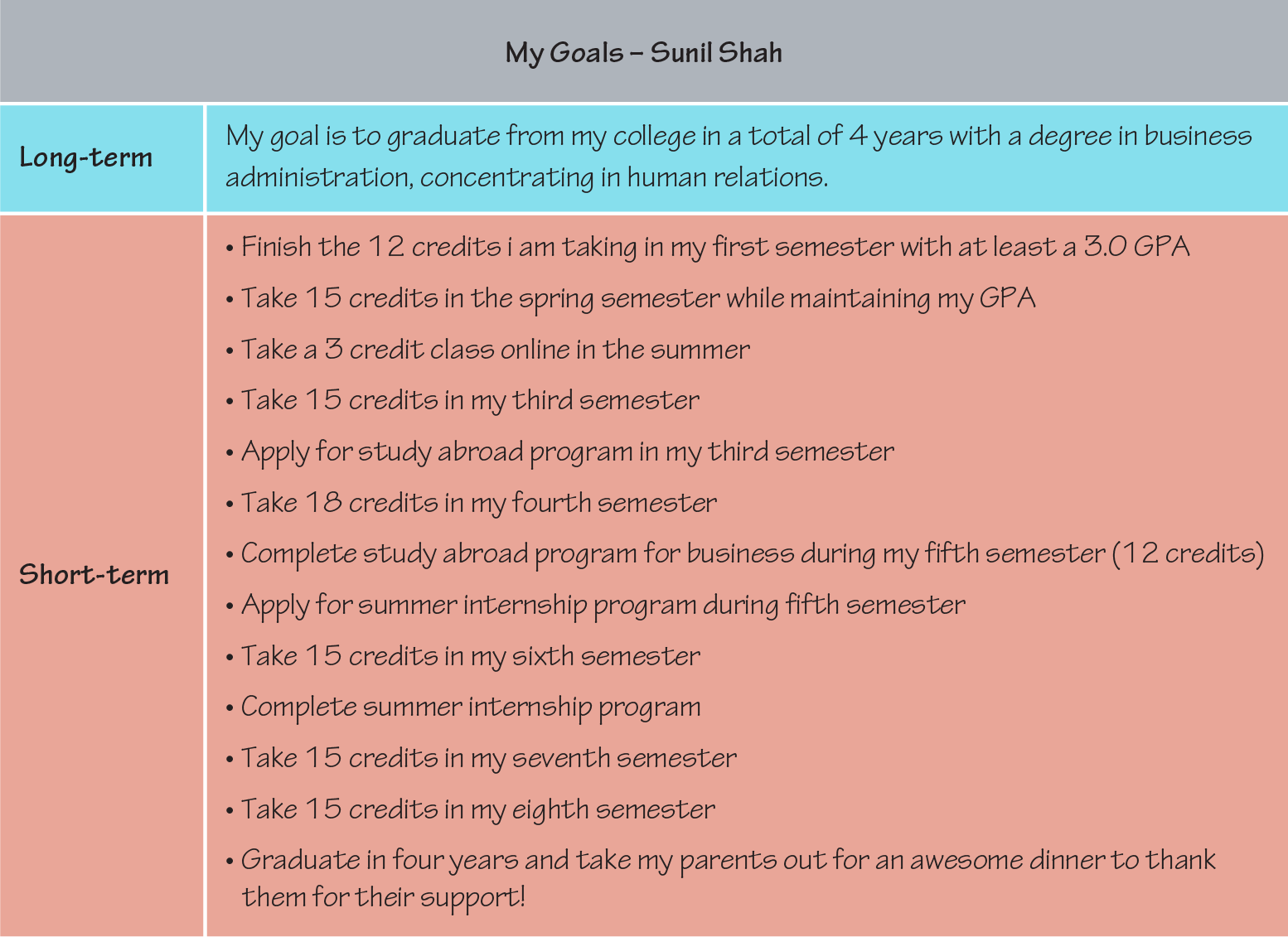
Sunil worried that his list of short-term goals looked more like a checklist of tasks than anything. His advisor reassured him, sharing that short-term goals can absolutely look like a checklist of tasks because their purpose is to break the long-term goal down into manageable chunks that are easier to focus on and complete. His advisor then recommended that Sunil add to his plan an additional note at the end of every other semester to “check in” with his advisor to make certain that he was on track.
Planning for Adjustments
You will recall from the SMART goals goal-setting model that goals should be both measurable and attainable. Far too often, however, we set goals with the best of intentions but then fail to keep track of our progress or adjust our short-term goals if they’re not helping us to progress as quickly as we’d like. When setting goals, the most successful planners also consider when they will evaluate their progress. At that time, perhaps after each short-term goal should have been met, they may reflect on the following:
- Am I meeting my short-term goals as planned?
- If so, celebrate!
- If not, you may want to additionally consider:
- Are my short-term goals still planned across time in a way where they will meet my long-term goals?
- If so, continue on your path.
- If not, reconsider the steps you need to take to meet your long-term goal. If you’ve gotten off track or if you’ve learned that other steps must be taken, set new short-term goals with timelines appropriate to each step. You may also want to seek some additional advice from others who have successfully met long-term goals that are similar to your own.
- Are my long-term goals still relevant, or have my values changed since I set my goals?
- If your goals are still relevant to your interests and values, then continue on your path, seeking advice and support as needed to stay on track.
- If your goals are no longer relevant or aligned with your values, give careful consideration to setting new goals.
While departing from your original goals may seem like a failure, taking the time to reflect on goals before you set them aside to develop new ones is a success. Pivoting from a goal to new, better-fitting goal involves increased self-awareness and increased knowledge about the processes surrounding your specific goal (such as the details of a college transfer, for example). With careful reflection and information seeking, your change in plans may even demonstrate learning and increased maturity!
Application
Take a moment to practice setting long- and short-term goals. Your short-term goal should help you progress toward your long-term goal. Include a plan for when and how you will know if you’re on track or if you need to adjust your goals to match new priorities.
My Long-Term Goal: |
My Short-Term Goal: |
My Plan for Checking My Progress: |
Keep in mind that values and goals may change over time as you meet new people, your life circumstances change, and you gain more wisdom or self-awareness. In addition to setting goals and tracking your progress, you should also periodically reflect on your goals to ensure their consistency with your values.
Analysis Question
Now that you’ve set some goals, what is your plan to track your progress on those goals? Can you identify a time you will set aside to intentionally reflect on your progress and whether you need to set any new short-term goals or perhaps adjust your larger plans?
4.2 Planning Your Degree Path
| Estimated completion time: 32 minutes. |
Questions to Consider:
- What types of college degrees or certifications can I pursue?
- What is the difference between majors and minors?
- How do preprofessional programs differ from other majors?
- Do some majors have special requirements beyond regular coursework?
To set goals for your academic and career path, you must first have an understanding of the options available for you to pursue and the requirements you will need to meet. The next section provides an overview of academic programs and college degrees that are common among many colleges and universities in the United States. Please note that each institution will have its own specific options and requirements, so the intention of this section is both to help you understand your opportunities and to familiarize you with language that colleges typically use to describe these opportunities. After reviewing this section, you should be better able to formulate specific questions to ask at your school or be better prepared to navigate and search your own college’s website.
Types of Degrees
Whereas in most states high school attendance through the 12th grade is mandatory, or compulsory, a college degree may be pursued voluntarily. There are fields that do not require a degree. Bookkeeping, computer repair, massage therapy, and childcare are all fields where certification programs—tracks to study a specific subject or career without need of a complete degree—may be enough.
However, many individuals will find that an associate’s or bachelor’s degree is a requirement to enter their desired career field. According to United States Census data published in 2017, more than one-third of the adult population in the country has completed at least a bachelor’s degree, so this may be the degree that is most familiar to you.
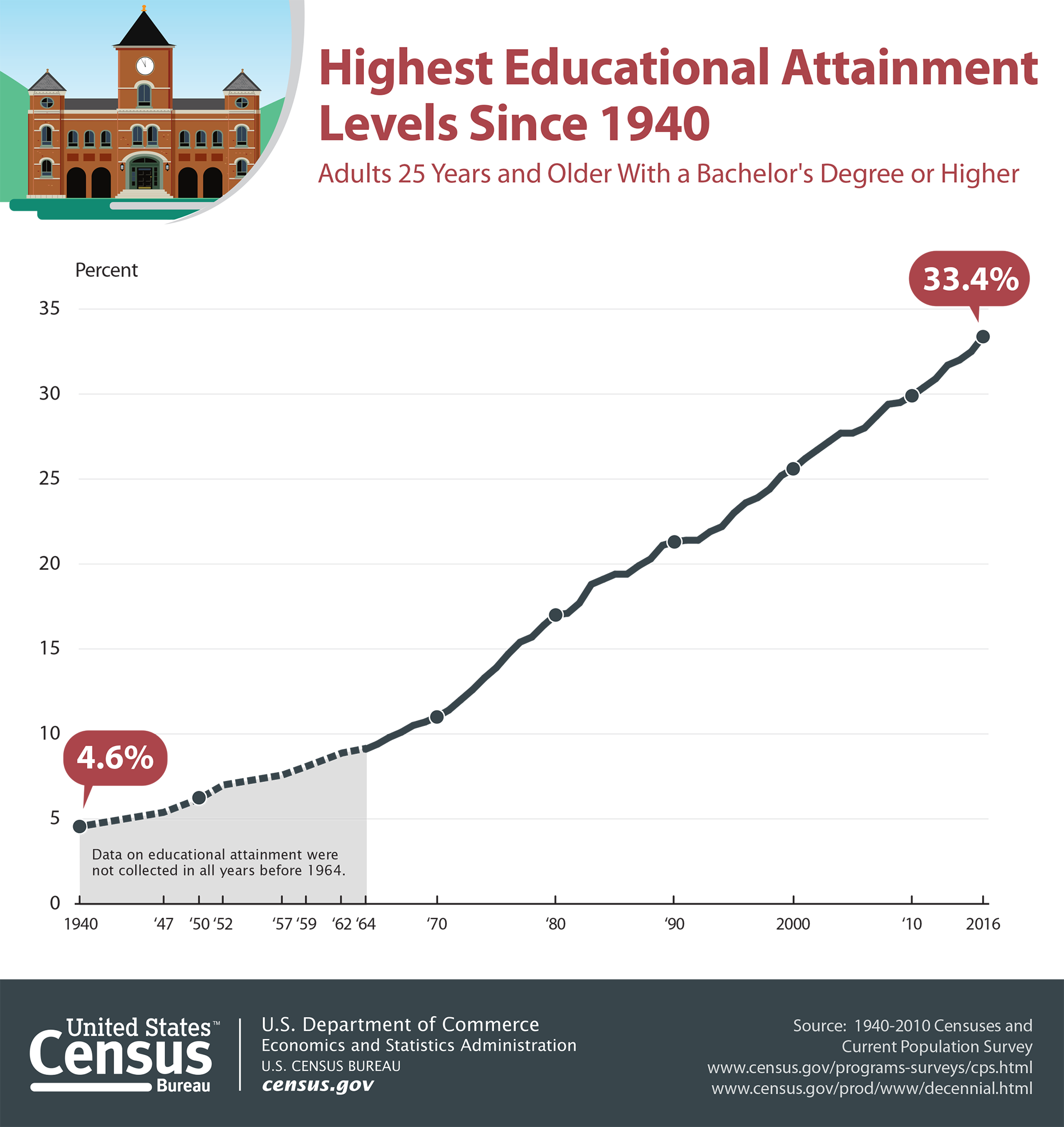
Not every job requires a bachelor’s degree, and some require even higher degrees or additional specialized certifications. As you develop your academic plan, it is important to research your field of interest to see what requirements might be necessary or most desirable.
| Require Associate’s Degrees | Require Bachelor’s Degrees | Require Additional Certifications | Require Graduate Degrees |
|---|---|---|---|
| Radiology Technician | Nurse | Public School Teacher | Lawyer |
| Dental Hygienist | Computer/Information Systems Manager | Accountant | College or University Professor |
| Web Developer | Airline Pilot | Financial Advisor | Pharmacist |
| Graphic Designer | Electrical Engineer | Marriage and Family Therapist | |
| Automotive Technician | Construction Manager | Occupational Therapist |
To distinguish between the types of degrees, it is useful to understand that courses are often assigned a number of credits, sometimes called semester hours as well. Credits relate to the calculated hours during a course that a student spends interacting with the instructor and/or the course material through class time, laboratory time, online discussions, homework, etc. Courses at all degree levels are typically assigned a value of one to six credits, although students often need to complete a developmental education course or two, often in English or math. These requirements, which cost as much as typical college courses but do not grant college credit, are meant to provide some basic information students may have missed in high school but that will be necessary to keep up in college-level coursework.
The minimum or maximum number of credits required to graduate with different degrees varies by state or institution, but approximate minimum numbers of credits are explained below. Keep in mind that although a minimum number of credits must be completed to get a certain degree, total credits completed is not the only consideration for graduation—you must take your credits or courses in particular subjects indicated by your college.
To determine your best degree option, it might make sense to do some research to determine what kind of career you’re most interested in pursuing. Visit your campus career center to meet with a counselor to guide you through this process. These services are free to students—similar services can be pricey once you’ve graduated, so take advantage. There are other tools online you can investigate.
Get Connected
These free, online self-assessments help you narrow down your choices.
- MyPlan identifies your motivations by having you rank different aspects of work, then creating a ranked list of different possible jobs.
- MAPP Test helps you determine what you love to do and what you don’t love to do and then creates a list of jobs that might be a good fit for you.
- The Career Cluster Interest Survey is a quick tool to let you create career clusters based on personal qualities and school subjects and activities you especially enjoy.
Associate’s Degrees
To enter an associate’s degree program, students must have a high school diploma or its equivalent. Associate’s degree programs may be intended to help students enter a technical career field, such as automotive technology, graphic design, or entry-level nursing in some states. Such technical programs may be considered an Associate of Applied Arts (AAA) or Associate of Applied Science (AAS) degrees, though there are other titles as well.
Other associate’s degree programs are intended to prepare a student with the necessary coursework to transfer into a bachelor’s degree program upon graduation. These transfer-focused programs usually require similar general education and foundational courses that a student would need in the first half of a bachelor’s degree program. Transfer-focused associate’s degrees may be called Associate of Arts (AA) or Associate of Science (AS), or other titles, depending on the focus of study.

An associate’s degree is typically awarded when a student has completed a minimum of 60 credits, approximately 20 courses, meeting the requirements of a specific degree. Some technical associate’s degrees, such as nursing, may require additional credits in order to meet requirements for special certifications. You may find that your college or university does not offer associate’s degrees. Most associate’s degrees are offered by community or junior colleges, or by career and technical colleges.
Activity
What to Ask
If you’re planning your associate’s degree, here are some specific questions you may want to research.
If you intend to enter a technical career that requires special certification:
- Does your college prepare you to take a certification exam, or will you be meeting those requirements through your courses?
- Does your college have any special internship or employment placement arrangements with employers to help you gain experience or get started in the field?
If you intend to transfer upon graduation:
- Is your college regionally accredited?
- Does your college have any special transfer agreements for guaranteed transfer of credits or perhaps for discounted tuition?
- Does your state have special transfer agreements or requirements that make it easier to transfer to colleges or universities within the same state?
Bachelor’s Degrees
When someone generally mentions “a college degree,” they are often referring to the bachelor’s degree, or baccalaureate degree. Because it takes four years of full-time attendance to complete a bachelor’s degree, this degree is also referred to as a “four-year degree.” Similar to an associate’s degree, to enter a bachelor’s degree program a student must have completed a high school diploma or its equivalent. Both associate’s degrees and bachelor’s degrees are considered undergraduate degrees, thus students working toward these degrees are often called undergraduates. A student with an associate’s degree may transfer that degree to meet some (usually half) of the requirements of a bachelor’s degree; however, completion of an associate’s degree is not necessary for entry into a bachelor’s degree program.
A bachelor’s degree is usually completed with a minimum of 120 credits, or approximately 40 courses. Some specialized degree programs may require more credits. (If an associate’s degree has been transferred, the number of credits from that degree usually counts toward the 120 credits. For example, if an associate’s degree was 60 credits, then a student must take 60 additional credits to achieve their bachelor’s degree.)
Bachelor of Arts (BA), Bachelor of Science (BS), Bachelor of Science in Nursing (BSN), and Bachelor of Fine Arts (BFA) are the most popular degree titles at this level and differ primarily in their focus on exploring a broader range of subject areas, as with a BA, versus focusing in more depth on a particular subject, as with a BS, BSN, or BFA. Regardless of whether a student is pursuing a BA, BS, BSN, or BFA, each of these programs requires a balance of credits or courses in different subject areas. In the United States, a bachelor’s degree comprises courses from three categories: general education courses, major courses, and electives. A fourth category of courses would be those required for a minor, which we will discuss in more detail in the section on majors and minors.
General Education
General education, also called core curriculum, is a group of courses that are often set as requirements by your state or by your individual college. These courses provide you with a foundation of knowledge across a breadth of fields and are also intended to help you further develop college-level critical-thinking and problem-solving abilities. You may be able to select courses from a general education menu of courses available at your institution. More than half of your bachelor’s degree program is likely made up of general education courses.
| English composition |
| Humanities courses that study our beliefs and the expression of our beliefs such as literature, philosophy, politics, art, or religious studies |
| Social science courses that study our behavior such as psychology, sociology, anthropology, or economics |
| Laboratory science courses such as biology, chemistry, physics, and environmental science |
| Mathematics |
| Technology or computer skills |
| Foreign language, diversity, or global studies courses that provide introduction to different cultures or global social issues and promote cultural awareness |
| College success or first-year experience courses that provide introduction to your specific institution, discuss college-level expectations and skills, and/or provide assistance with academic and career planning |
Major Courses
Major courses are courses in your field of interest and provide you with the foundational knowledge required for further study in that field or with the skills necessary to enter your career. Some schools may refer to these as career studies courses. Major courses often have a series of prerequisites, or courses that must be taken in sequence prior to other courses, starting with an introductory course and progressing into more depth. Major courses usually make up about a fourth or more of a bachelor’s degree (30 credits, or approximately 10 courses). A BS or BFA degree may require more major courses than a BA degree. Colleges and universities usually require students to select a major by the time they’ve completed 30 total credits.
Electives
Electives are free-choice courses. Though you may have a choice to select from a menu of options to meet general education and major requirements, electives are even less restricted. Some students may be able to take more electives than others due to their choice of major or if they are able to take courses that meet more than one requirement (for example, a sociology course may be both a major requirement and a general education social science course). Some colleges intentionally allow room for electives in a program to ensure that students, particularly those students who are undecided about their major, are able to explore different programs without exceeding the total number of credits required to graduate with a bachelor’s degree. In other cases, students may have taken all of their major courses and fulfilled their general education requirements but still need additional credits to fulfill the minimum to graduate. The additional courses taken to meet the total credit requirement (if necessary) are considered electives.
Graduate Degrees
According to United States Census data published in 2018, 13.1 percent of the U.S. adult population have completed advanced degrees.3 Whereas associate’s and bachelor’s degrees are considered undergraduate degrees and require high school graduation for entry, advanced degrees called graduate degrees require prior completion of a bachelor’s degree. Some professions require graduate degrees as a minimum job qualification, such as pharmacists, lawyers, physical therapists, psychologists, and college professors. In other cases, students may be motivated to pursue a graduate degree to obtain a higher-level job or higher salary, or to be more competitive in their field. Some students are also interested in learning about some subject in greater depth than they did at the undergraduate level. Because graduate degrees do not include general education or free elective courses, they are very focused on career-specific knowledge and skills. Graduate degrees include master’s, doctoral, and professional degrees. Master’s degrees often require 30–60 credits and take one to two years of full-time attendance to complete. Some master’s degrees, like those for counselors, require supervised job experience as a component of the degree and therefore require more credits.

Doctorate and professional degrees are the highest level of advanced degrees. Approximately 3.5% of the U.S. adult population has completed a doctorate or professional degree. Very few careers require this level of education for entry, so fewer individuals pursue these degrees. Doctorates are offered in many subjects and primarily prepare students to become researchers in their field of study. This in-depth level of education often requires an additional 90–120 credits beyond the bachelor’s degree, and may or may not require a master’s degree prior to entry. (A master’s degree as an entry requirement may reduce the number of credits required to complete the doctoral degree.)
Professional degrees are a specific type of doctorate-level degree that focus on skills to be applied in a practical, or hands-on, career rather than as a researcher. The most common professional degrees are Doctor of Medicine (MD) for aspiring medical doctors, Juris Doctor (JD) for aspiring lawyers, Doctor of Pharmacy (PharmD) for aspiring pharmacists, and Doctor of Education (EdD) for aspiring school and college or university administrators. If the career you are pursuing requires a graduate degree, you should keep this end goal in mind as you plan for the timeline and finances required to meet your goals. You may also want to inquire about special agreements that your college or university may have to expedite admission into or completion of graduate degrees. For example, some universities offer 4+1 master’s programs, wherein students take both bachelor’s and master’s level courses during their last year as an undergraduate to accelerate the completion of both degrees.
Other Post-Baccalaureate Credentials
Post-baccalaureate refers to structured learning experiences pursued after a bachelor’s degree is achieved. While some such activities are structured into graduate degrees as described in the sections above, other fields value continuing education credits, competency badges, and additional certifications. These post-baccalaureate credentials may need to be completed prior to entering a career field, may be obtained as an option to gain competitive advantage for hiring, or may be achieved during the course of an individual’s career to stay current, maintain qualification, or be promoted. To determine if your field requires post-baccalaureate credentials, you may want to speak with an established professional in that career, review the qualifications section of related job descriptions, or visit with a career counselor on your campus. In a world that changes as rapidly as ours, engaging in lifelong learning is advisable regardless of the specific requirements of any particular career choice.

Activity
Draft an Education Timeline
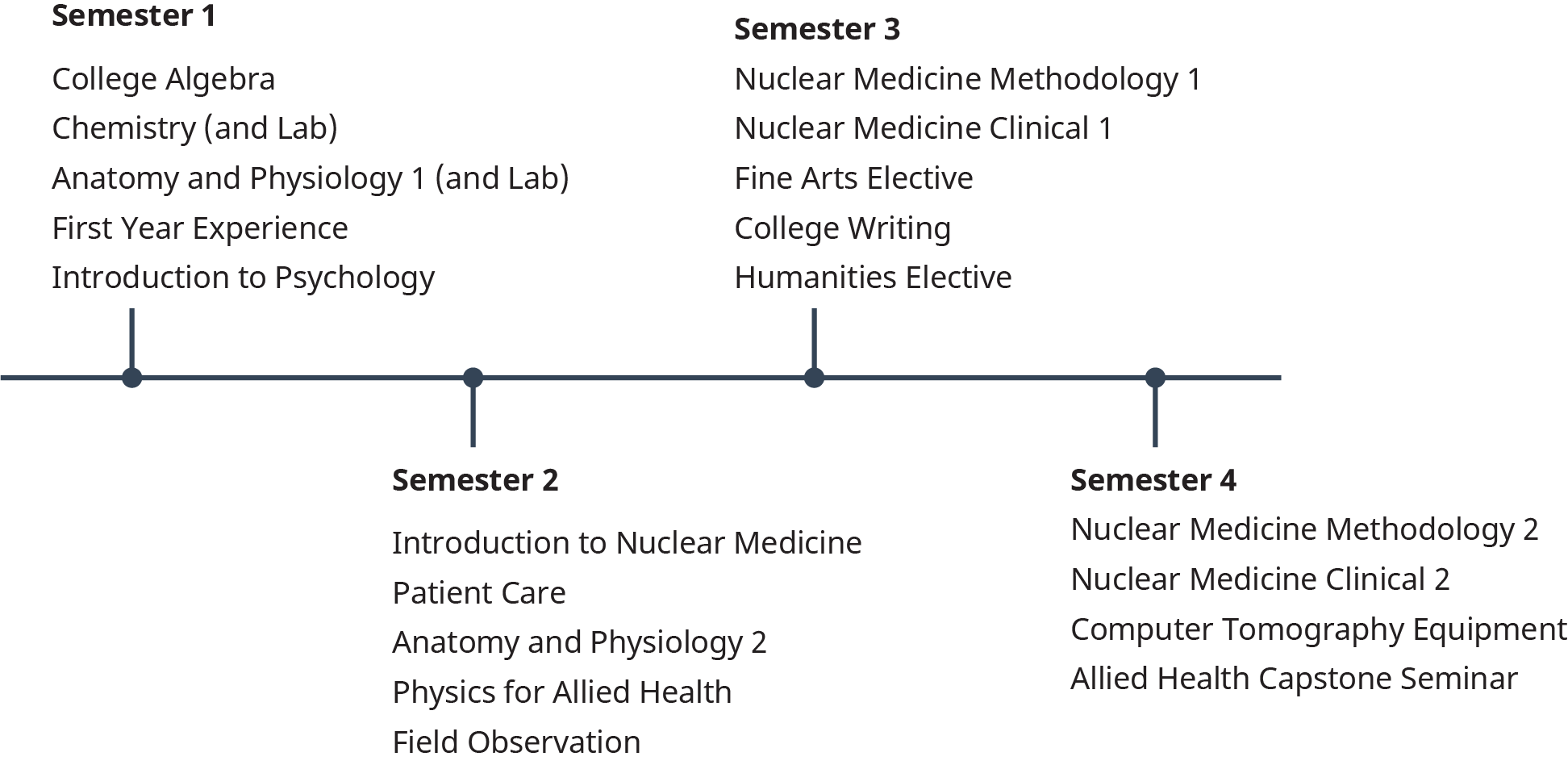
Use the Bureau of Labor Statistics online Occupational Outlook Handbook to search for occupations that interest you, and note the level of education that these jobs require. Refer to your college’s academic catalog (frequently located on the college’s website) or curriculum maps to see the suggested sequence of courses for majors that relate to your career or careers of interest.
Select three interesting jobs and sketch a timeline for each, starting with your first semester of undergraduate study (whether you’re getting an associate’s or a bachelor’s) and ending with the point when you will meet the minimum requirements to be qualified for that job. Keep in mind that the timeline of students attending full-time may differ from those who are attending part-time.
Majors and Minors
One of the most common questions an undergraduate college student will be asked is “What’s your major?” As we already noted, your major is only one part of your undergraduate (associate’s or bachelor’s) degree, but it is the part that most demonstrates your interests and possible future goals. At some point during your studies you will be asked to decide on, or declare, a major. You may also be able to select a minor or additional concentration. Whereas a major comprises approximately 10–12 courses of a bachelor’s degree program and is required, a minor is usually 5–8 courses, is often optional, and may count toward or contribute to exceeding the total number of credits required for graduation. Rather than take elective courses, some students will select courses that meet the requirements for a minor. When selecting a major and possibly a minor, you’ll want to consider how the knowledge and skills you gain through those fields of study prepare you for a particular career. Majors and minors can be complementary. For example, a major in business might be well-matched with a minor in a foreign language, thus allowing the student to pursue a career in business with a company that hires bilingual employees. It is important to research careers of interest to you when selecting your major and/or minor to determine what will best help you to meet your goals.

Preprofessional Programs
Some undergraduate degrees are specifically designed to prepare students to later pursue professional degrees (such as the MD or PharmD) at the graduate level. Such programs are called preprofessional programs, preprofessional majors, or preprofessional tracks. The most common preprofessional programs are premed, prelaw, and prepharmacy, but you may see other offerings. Although some preprofessional programs are structured as majors that you can declare, many preprofessional programs are a sequence of recommended courses and activities that a student can follow alongside a related major. While following a preprofessional program may not guarantee your admittance to a professional program, it does increase the likelihood of acceptance to and preparation for a graduate professional program.
Consider Loretta’s story as an example of how a student might be on a preprofessional track. Loretta has decided that she would like to become a medical doctor. She has declared biology as her major and is taking the courses required to graduate with a bachelor of science degree in biology. Her university does not have a premed major, but it does have a premed track. She informs her academic advisor of her career goals, and her advisor provides her information about the premed track. The premed track includes a list of courses that students should take to prepare for the medical school entrance exams, called MCATs. Some of these courses are biology courses that overlap with Loretta’s biology major, while others are higher-level chemistry courses that are not required for her major. She can take these chemistry courses, and any other premed-track courses, as her elective courses. The premed track at Loretta’s university includes opportunities to attend MCAT study workshops and premed student club meetings. It also provides recommendations for summer volunteering and internships that will strengthen Loretta’s resume and application to medical school following the completion of her bachelor’s degree.
Special Requirements of Majors
While preprofessional programs prepare students for entrance into graduate professional degree programs, some undergraduate majors involve special requirements beyond the usual courses and classroom experience to prepare students for entrance to their career. Such requirements provide students practical experience or prerequisites for licensure necessary for a particular job. When requirements are major-specific, it is often because the requirement is state-mandated for that job. Majors that often include state-mandated special requirements are education, social work, and nursing. Some colleges and universities may require all students to participate in additional experiences beyond their regular coursework. You will want to ask your college about details specific to your major or institution. In this section we will generally discuss four such special requirements and experiences: fieldwork and internships, clinicals, student teaching, and service learning.
Fieldwork and Internships
Fieldwork and internships may also be referred to as practicums and field experience. These requirements provide hands-on work experience in a career, or field. When fieldwork or internships are required for your major, such as with a social work major, it is often listed as a course requirement among your major requirements. In other words, you usually receive credits for your fieldwork as you would for a lab or lecture course. Your fieldwork instructor will likely ask you to reflect on and report on your experiences. They will likely confer with a supervisor at your fieldwork site, the place where you are working, to help assess your hands-on learning. Fieldwork and internships provide students with opportunities to practice the skills they’ve learned in the classroom while also introducing them to the values and culture of the organizations and communities in which they hope to be employed. It is important to note that fieldwork and internship experiences are often available to students even if they are not required for their major. You may want to inquire with your academic advisors, faculty, or career services office to determine what opportunities might be available for you to gain this type of experience in your field of interest.
Clinicals
Clinicals are a type of fieldwork specifically required of nursing students. Clinicals may take place in hospitals, nursing homes, or mental health facilities. They provide nursing students who are nearing the end of their degree programs with the opportunity to practice nursing skills that cannot be learned in a regular classroom. During clinicals, students will interact with real patients to conduct physical examinations, draw blood, administer medicine, and provide other care as necessary. Because of the risk to patients, students participating in clinicals are more closely supervised by experienced professionals than those in other types of fieldwork experiences. Thus, clinicals function very much like a real-world classroom and progress to more independent work through the semester. Before undertaking clinicals, nursing students will need to complete certain coursework and pass a physical examination and background check. Because clinicals are often much longer than a class meeting, students will need to work with staff from the program to plan their schedule. It may not be feasible to work at another job while completing clinicals, so if you must work while you’re in college, it’s important to discuss this with nursing staff or academic advisors and to plan ahead.
Student Teaching
Student teaching is a specific type of fieldwork undertaken by students who plan to teach at the preschool, elementary, or middle and high school levels. Education students are often required to complete a student teaching experience in order to obtain a teaching license in their state. Students must often complete core education coursework prior to student teaching and must complete a background check prior to placement in a school setting. During their student teaching experience, students are usually paired one-on-one with an experienced teacher and have the opportunity to observe that teacher, get to know the students, understand the classroom culture, and participate in lessons as a teaching assistant as needed or appropriate. Much like nursing clinicals, this highly supervised fieldwork experience usually progresses to more independent work when the student teacher is asked to deliver and reflect on a lesson plan of their own design. Keep in mind as you plan for student teaching that unlike other fieldwork experiences, student teaching is limited to fall or spring semesters and cannot be completed in the summer because most schools are closed during the summer terms. Also, it may not be feasible to work at another job while completing your student teaching experience, so if you must work while you’re in college, it’s important to discuss this with your program staff or academic advisors and to plan ahead.

Service Learning
While service learning may not be required of a specific major, you may see this special requirement for a course or as a general graduation requirement for your college or university. It’s also an excellent opportunity to try out something that interests you, something that could lead to or be part of your eventual career.
Service learning is very much like volunteering or community service. The purpose of service learning is to interact with and meet the needs of your local community. Service learning does differ from volunteering in that it is more structured to meet specific learning goals. For example, if you were engaging in service learning for an environmental science course, your activities would likely be focused on local environmental issues. Or, if you were engaging in service learning for a sociology course, you would likely be working with local community groups or organizations not only to assist these organizations, but also to observe how groups interact. Like fieldwork, service learning provides you an opportunity to observe and apply concepts learned in the classroom in a real-world setting. Students are often asked to reflect on their service learning activities in the context of what they’ve been learning in class, so if you’re engaged in service learning, be thinking about how the activities you do relate to what you’ve learned and know.
What Students Say
- Does your major have any special requirements that must be completed outside of the classroom?
- Fieldwork, internships, and/or student teaching
- Clinicals
- Other (write in)
- None
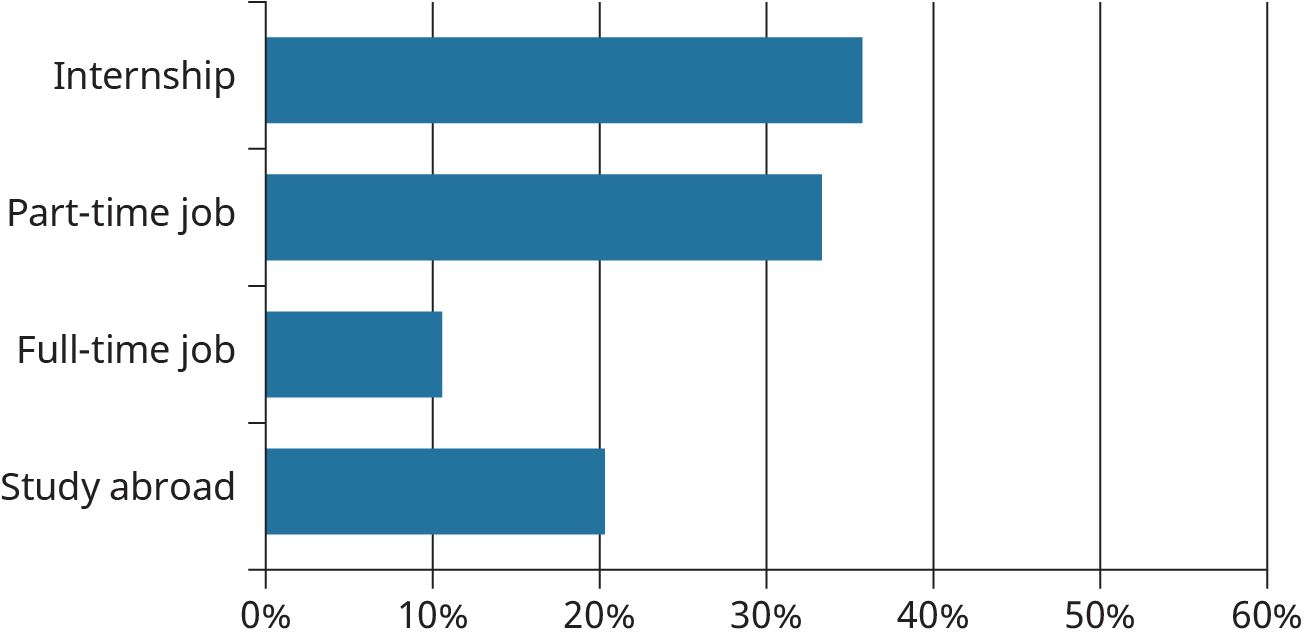
- While in college, which of the following do you think you are most likely to do?
- Internship
- Part-time job
- Full-time job
- Study Abroad
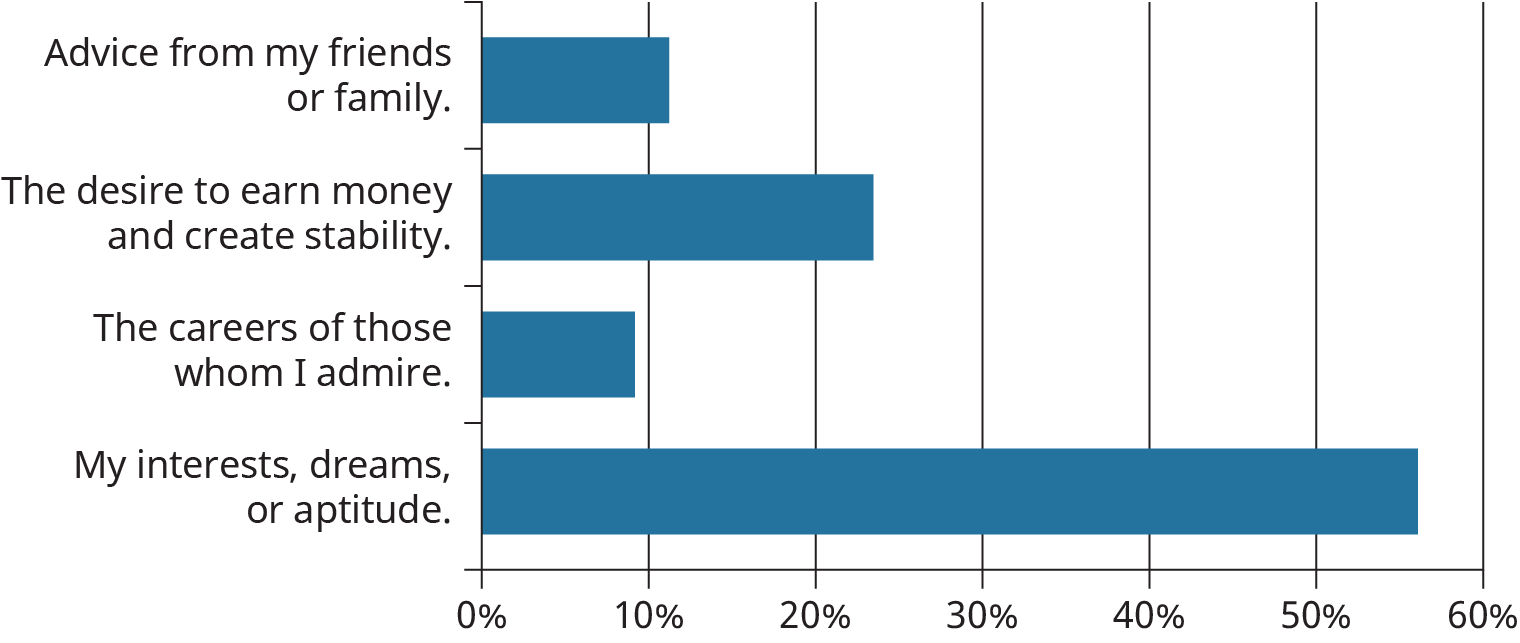
- What has influenced your academic and career plan the most? (rank order)
- The advice of friends and/or family
- The practical, hands-on experiences I’ve had outside of the classroom
- The knowledge and skills I’ve learned in class
- The advice I’ve gotten from mentors, advisors, or college faculty
You can also take the anonymous What Students Say surveys to add your voice to this textbook. Your responses will be included in updates.
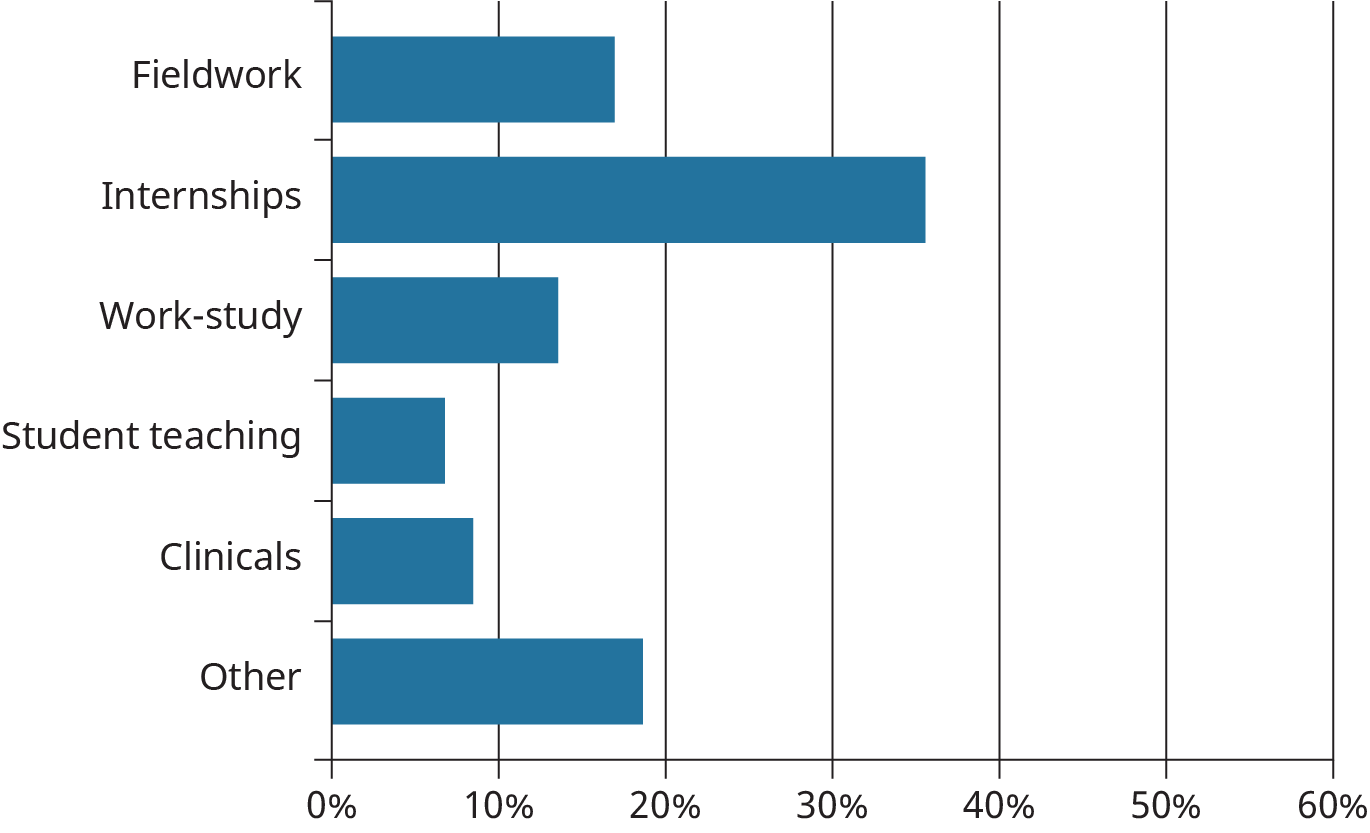
Students offered their views on these questions, and the results are displayed in the graphs below.
Does your major have any special requirements that must be completed outside of the classroom?
While in college, which of the following do you think you are most likely to do?
What has influenced your academic and career plan the most?
4.3 Making a Plan
| Estimated completion time: 28 minutes. |
Questions to Consider:
- What resources are available to help me understand my degree program requirements?
- Who can assist me in making a plan?
- What tools are available to help me develop and track the progress of my plan?
- Is there anything else I can do now to plan for after I graduate?
As previously noted, most associate’s degrees require a minimum of 60 credit hours for completion, and bachelor’s degrees minimally require a total of 120 credits. Some individuals refer to these degrees as “two-year” and “four-year” degrees, respectively. To complete a 60-credit associate’s degree in two years, you would need to take 15 credits (about five classes) in the fall and spring semesters during both years of your attendance. To complete a 120-credit bachelor’s degree in four years, you would need to take 15 credits in the fall and spring semesters each of your four years. It is therefore entirely possible to complete these degrees in two and four years, particularly if you use the three primary resources that colleges provide to help you with your planning: curriculum maps, academic advisors, and interactive planning technology.
Curriculum Maps
Many colleges and universities will provide curriculum maps, or course checklists to illustrate the sequence of courses necessary to follow this timeline. These timelines often assume that you are ready to take college-level math and English courses and that you will be attending college as a full-time student. If placement tests demonstrate a need for prerequisite math and English coursework to get you up to speed, your timeline will likely be longer.
Many students attend college part-time, often because of family or work responsibilities. This will obviously have an impact on your completion timeline as well. Programs that have special requirements may also require that you plan for additional time. For example, it may be the case that you cannot take other courses while completing clinicals or student teaching, so you will need to plan accordingly. Alternatively, you may be able to speed up, or accelerate, your timeline to degree by taking courses during summer or winter terms. Or if you take fewer than 15 credits per semester, you can take courses during the summer terms to “make up” those credits and stay on track toward those two- or four-year graduation goals.4
Academic Advisors
All colleges and universities provide resources such as a curriculum map to assist you with your academic planning. Academic advisors may also be called success coaches, mentors, preceptors, or counselors. They may be staff members, or faculty may provide advisement as an additional role to their teaching responsibilities. Regardless of what your college calls this role, academic advisors are individuals who are able to assist you in navigating the puzzle of your academic plan and piecing your courses and requirements together with your other life obligations to help you meet your goals.
An advisor is an expert on college and major requirements and policies, while you are the expert on your life circumstances and your ability to manage your study time and workload. It is also an advisor’s responsibility to understand the details of your degree requirements. This person can teach you how to best utilize college resources to make decisions about your academic and career path. An advisor can help you connect with other college staff and faculty who might be integral to supporting your success. Together with your advisor, you can create a semester-by-semester plan for the courses you will take and the special requirements you will meet. Refer to the end of this section for a detailed planning template that you could use in this process. Even if your college does not require advising, it is wise to meet with your advisor every semester to both check your progress and learn about new opportunities that might lend you competitive advantage in entering your career.
Common Functions of Academic Advisors
Academic advisors can help you:
- Set educational and career goals
- Select a major and/or minor
- Understand the requirements of your degree
- Navigate the online tools that track the progress of your degree
- Calculate your GPA and understand how certain choices may impact your GPA
- Discuss your academic progress from semester to semester
- Assist with time management strategies
- Connect with other support and resources at the college such as counseling, tutoring, and career services
- Navigate institutional policies such as grade appeals, admission to special programs, and other concerns
- Strategize how to make important contacts with faculty or other college administrators and staff as necessary (such as discussing how to construct professional emails)
- Discuss transfer options, if applicable
- Prepare for graduate school applications
Interactive Planning Technology
In addition to a curriculum map and an advisor, colleges and universities usually have technological tools that can assist you in your academic planning. Degree audit reporting systems, for example, are programmed to align with degree requirements and can track individual student progress toward completion. They function like an interactive checklist of courses and special requirements. Student planning systems often allow students to plan multiple semesters online, to register for planned courses, and to track the progress of their plan. Though friends and family are well-intentioned in providing students with planning advice and can provide important points for students to consider, sometimes new students make the mistake of following advice without consulting their college’s planning resources. It’s important to bring all of these resources together as you craft your individual plan.
Despite all of the resources and planning assistance that is available to you, creating an individual plan can still be a daunting task. Making decisions about which major to pursue, when to take certain courses, and whether to work while attending school may all have an impact on your success, and it is tough to anticipate what to expect when you’re new to college. Taking the time to create a plan and to revise it when necessary is essential to making well-informed, mindful decisions. Spur-of-the-moment decisions that are not well-informed can have lasting consequences to your progress.
The key to making a mindful decision is to first be as informed as possible about your options. Make certain that you have read the relevant resources and discussed the possibilities with experts at your college. Then you’ll want to weigh your options against your values and goals. You might ask: Which option best fits my values and priorities? What path will help me meet my goals in the timeframe I desire? What will be the impact of my decision on myself or on others? Being well-informed, having a clear sense of purpose, and taking the necessary time to make a thoughtful decision will help to remove the anxiety associated with making the “right” decision, and help you make the best decision for you.
Application
Academic Planning Readiness Checklist: Review the checklist below and mark each item if you agree. For those you cannot yet answer, consult your instructor, academic advisor, or college website to locate these important details.
- I know the total number of credits required to graduate from my program.
- I know the difference between general education, major, and elective classes.
- I know whether I am required to take preparatory or developmental courses in math and English, and whether these courses will count among my total credits toward my degree.
- I am aware of the special requirements of my major (if any) and the prerequisites I must complete.
- I am aware of the minimum entry requirements for my desired career field and know whether I should be preparing to plan for a graduate degree as well.
Activity
Draft an Academic Plan
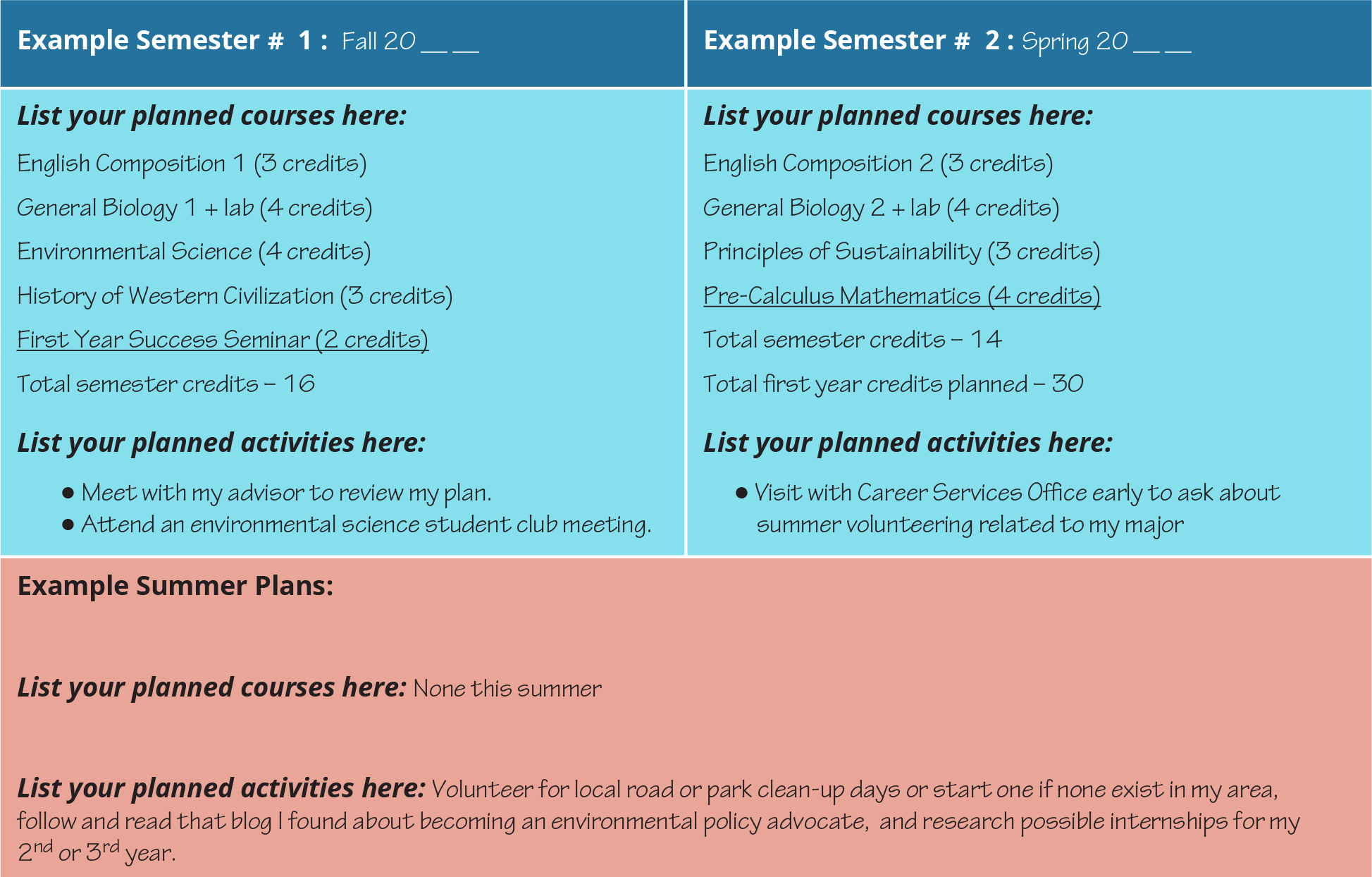
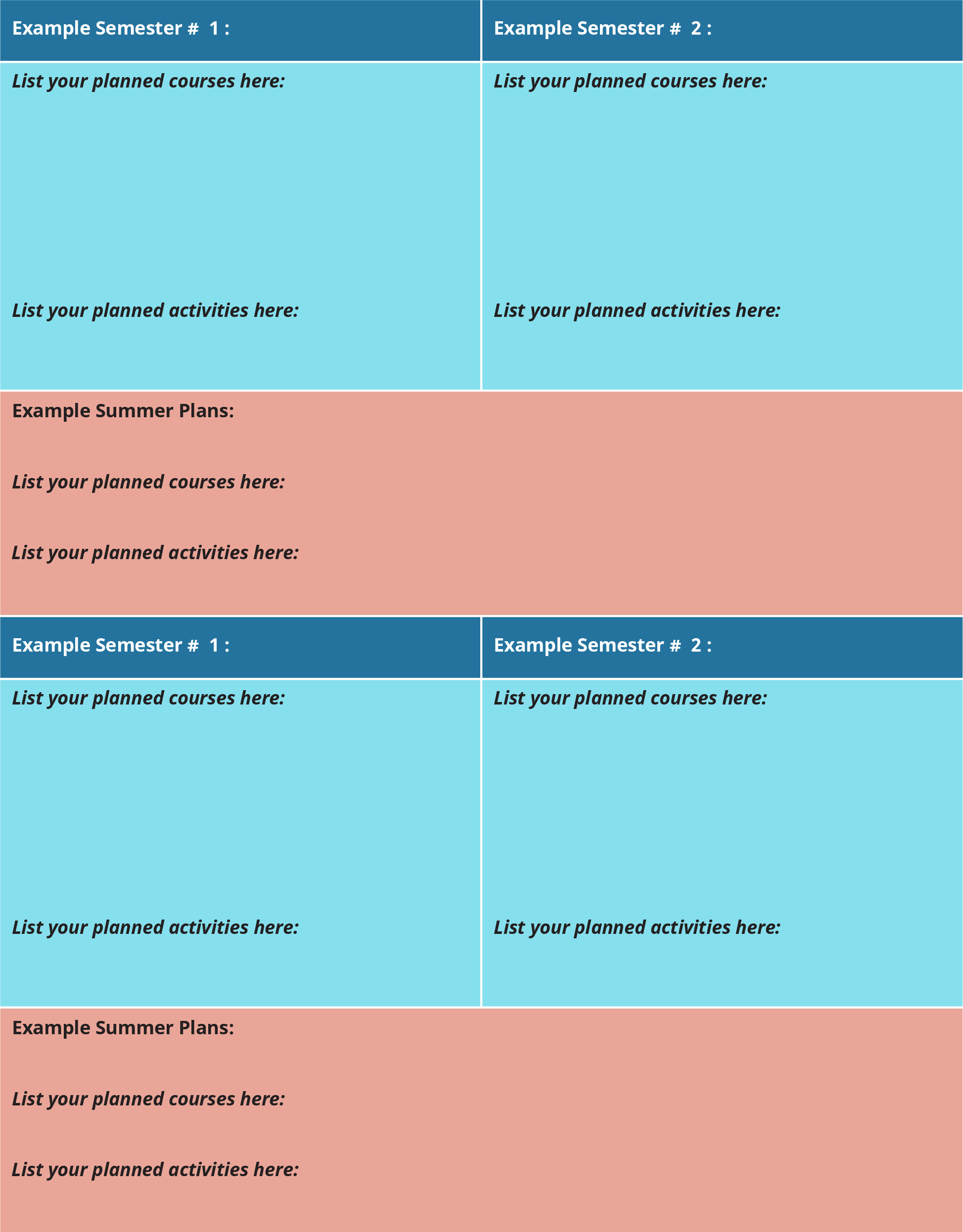
With the assistance of your instructor or academic advisor, find the curriculum map for your major or for an example major that you might be considering if you’re still exploring. Use the information in the curriculum map to draft an academic plan for your undergraduate degree. This plan should include both a semester-by-semester sequence of courses and a list of related activities to help you progress toward your career or graduate school goals. Keep in mind any personal circumstances that may impact your plan (such as whether you’ll need to attend part-time or full-time). You may use the grid provided or utilize your college’s student planning software if available. For your reference, you will find the start of an example grid from a dedicated environmental science student below.
Note: If your college offers courses using the quarter system rather than semesters, you may need to draft your own grid. You can find example planning grids for quarter systems online.
Planning for After Graduation
Students usually pursue a college degree with some additional end goal in mind, whether that goal is further study as a graduate student or entry into a desired career. As you develop a plan for your undergraduate studies, you can also plan pursuits outside of the classroom to prepare for these future goals. To begin planning for life after graduation, consider the experiences that would best complement your coursework. If you are not required to participate in fieldwork or internships, perhaps you could plan a summer internship to help you gain workplace experience and learn more about what you do and do not want to do. It is also valuable to gain leadership experience through participation in student clubs and organizations. Plan to find a club that matches your interests. Set a goal to attend regularly your first year and then run for a club leadership role in your second or third year.

Even before you begin an internship or career search in earnest, sites like Internships.com can be helpful simply to explore the possibilities and get ideas. Often, a dedicated career-oriented website will provide more filtered and specific information than a general search engine.
Consult with services or offices at your college that can assist with you with making your future plans and incorporating experiences into your academic plan that will prepare you to enter your career. These services are often accessible both to current students as well as to graduates, providing assistance with résumé writing and job searches. Chapter 12: Planning for Your Future provides further insight into career planning and college career services.
Alumni associations help graduates connect with other former students of all ages so that they can begin to build and strengthen their professional networks, leading to further job opportunities. And don’t discount the role of your professors in helping you build your network as well! In addition to providing valuable letters of recommendation for both graduate school and job applications, professors often have well-established professional networks and may be willing to help connect dedicated students with additional opportunities. You can plan these experiences to be distributed across your academic semesters and during the summer.
| Exploring Options |
|
| Gain Experience |
|
| Document Experiences |
|
This Draft an Academic Plan activity provides you an opportunity to consider and plan experiences alongside your coursework that could help you better prepare to meet your career goals. Also, the chapter on Planning Your Career goes into these topics in more depth.
4.4 Managing Change and the Unexpected
| Estimated completion time: 18 minutes. |
Questions to Consider:
- What happens if things don’t go according to plan?
- How can I make adjustments to my plan if things change?
- Is it OK to ask for planning help, and from whom?
Though we’ve discussed planning in a great degree of detail, the good news is that you don’t have to have it all figured out in order to be successful. Recall the upside-down puzzle analogy from earlier in this chapter. You can still put a puzzle together picture-side down by fitting together the pieces with trial and error. Similarly, you can absolutely be successful in your academic and career life even if you don’t have it all figured out. It will be especially important to keep this in mind as circumstances change or things don’t go according to your original plan.
Consider Elena’s and Ray’s stories as examples.
Elena had always intended to go to college. It was her goal to become a nurse like her grandmother. She decided that the best path would be to complete her BSN degree at a state university nearby. She researched the program, planned her bachelor’s degree semester by semester, and was very excited to work with real patients while completing her clinicals! During her second year, Elena’s grandmother fell ill and needed more regular care. Elena made the difficult decision to stop-out of her program to help care for her grandmother. She spoke with her academic advisor, who told her about the policies for readmission. Because the nursing program was limited to a certain number of students, it would be challenging to reenter her program whenever she was ready to return.
At first Elena felt discouraged, but then her advisor assisted her in mapping a plan to take some prerequisite courses part-time at a community college near her home while she cared for her grandmother. She could then transfer those credits back to the university so they would count toward her degree there, or she could finish an associate’s degree and then return to a bachelor’s degree program whenever she was able. Although things weren’t following her original plans, she would be able to continue working toward her goals while also tending to one of her greatest values—her family. Elena’s plans changed, but her values and long-term goals didn’t have to change.
Ray’s parents wanted him to go to college to increase his chances of getting a good job. He wasn’t really sure what he wanted to study, so his dad suggested he choose business. During Ray’s first semester he took an introduction to business course that was required of all business majors in their first semester. He did well in the course, but it wasn’t his favorite topic. Conversely, he loved the history course on early Western civilization that he was taking to meet a general education requirement. He wasn’t necessarily ready to change his major from business to history, so he met with an academic advisor to see if there were any classes he could take during his second semester that would count toward either major. Ray was still exploring and had yet to set specific goals. But Ray did know that he wanted to finish college within a reasonable amount of time, so he made flexible plans that would allow him to change his mind and change his major if necessary.
Expecting Change
After you’ve devoted time to planning, it can be frustrating when circumstances unexpectedly change. Change can be the result of internal or external factors. Internal factors are those that you have control over. They may include indecision, or changing your mind about a situation after receiving new information or recognizing that something is not a good fit for your values and goals. Though change resulting from internal factors can be stressful, it is often easier to accept and to navigate because you know why the change must occur. You can plan for a change and make even better decisions for your path when the reason for change is, simply put—you! Ray’s story demonstrates how internal factors contribute to his need or desire to change plans.
External factors that necessitate change are often harder to plan for and accept. Some external factors are very personal. These may include financial concerns, your health or the health of a loved one, or other family circumstances, such as in Elena’s example. Other external factors may be more related to the requirements of a major or college. For example, perhaps you are not accepted into the college or degree program that you had always hoped to attend or study. Or you may not perform well enough in a class to continue your studies without repeating that course during a semester when you had originally planned to move on to other courses. Change caused by external factors can be frustrating. Because external factors are often unexpected, when you encounter them you’ll often have to spend more time changing your plans or even revising your goals before you’ll feel as though you’re back on track.
Managing Change
It is important to recognize that change, whether internal or external, is inevitable. You can probably think of an example of a time when you had to change your plans due to unforeseen circumstances. Perhaps it’s a situation as simple as canceling a date with friends because of an obligation to babysit a sibling. Even though this simple example would not have had long-term consequences, you can probably recall a feeling of disappointment. It’s okay to feel disappointed; however, you’ll also want to recognize that you can manage your response to changing circumstances. You can ask yourself the following questions:
- What can I control in this situation?
- Do I need to reconsider my values?
- Do I need to reconsider my goals?
- Do I need to change my plans as a result of this new information or these new circumstances?
- What resources, tools, or people are available to assist me in revising my plans?
When encountering change, it helps to remember that decision-making and planning are continuous processes. In other words, active individuals are always engaged in decision-making, setting new plans, and revising old plans. This continuous process is not always the result of major life-changing circumstances either. Oftentimes, we need to make changes simply because we’ve learned some new information that causes a shift in our plans. Planning, like learning, is an ongoing lifetime process.
Asking for Help
“Be strong enough to stand alone, be yourself enough to stand apart, but be wise enough to stand together when the time comes.”
— Mark Amend, American Author
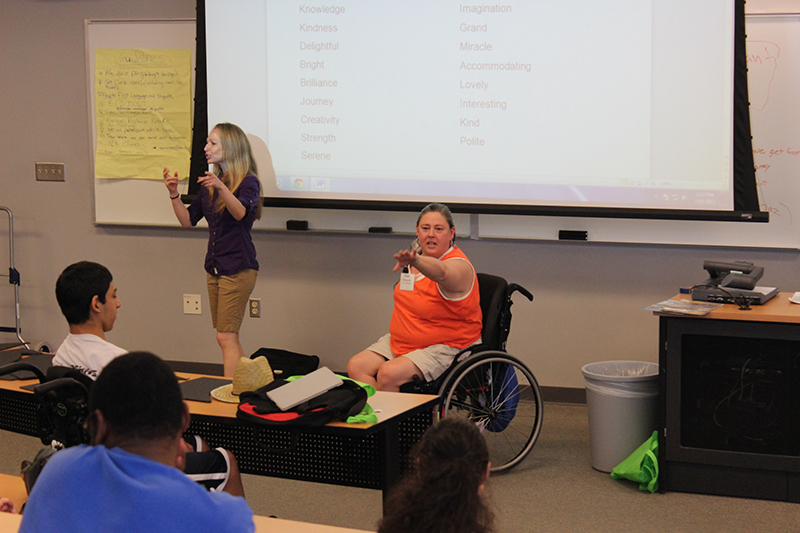
Throughout this chapter we have made mention of individuals who can help you plan your path, but noted that your path is ultimately your own. Some students make the mistake of taking too much advice when planning and making decisions. They may forgo their values and goals for others’ values and goals for them. Or they may mistakenly trust advice that comes from well-meaning but ill-informed sources.
In other cases, students grapple with unfamiliar college paperwork and technology with little assistance as they proudly tackle perhaps newfound roles as adult decision makers. It’s important to know that seeking help is a strength, not a weakness, particularly when that help comes from well-informed individuals who have your best interests in mind. When you share your goals and include others in your planning, you develop both a support network and a system of personal accountability. Being held accountable for your goals means that others are also tracking your progress and are interested in seeing you succeed. When you are working toward a goal and sticking to a plan, it’s important to have unconditional cheerleaders in your life as well as folks who keep pushing you to stay on track, especially if they see you stray. It’s important to know who in your life can play these roles.
For those facing personal and emotional challenges including depression and anxiety, specific guidance is covered in Chapter 11.
Asking for Help: Anton’s Story
Anton is in his first semester at State University. His high school guidance counselor, who he was required to meet with in his junior and senior years, was very helpful in preparing his college applications and in discussing what he could expect through the admissions process. When he was accepted to State University, she celebrated with him as well! Now that he’s arrived at college, though, he’s found it to be different from his high school. There are so many more options available to him and more freedom to plan his own time. About halfway through the semester, Anton falls behind in his information technology course, the introductory class for his major. He had been so excited to study more about computers and systems networking, but he’s finding it harder and harder to understand the content and he feels discouraged.
After learning that he’s headed for a D grade in the course, Anton is not certain what to do both about the class and about his major. In high school he would have spoken with his guidance counselor, who he knew by name and ran into in the hallway frequently. But he’s not yet well-connected to resources at his college. When his mom texts him from back home to share a story about his younger sister, he considers confiding in her about the course but doesn’t want her to worry about his focus or dedication. Anton is the first person from his family to attend college, so he feels a particular pressure to succeed and isn’t even certain if his mom would know how to help. He ends the text thread with a generic thumbs-up emoji and heads to the college fitness center to let off some steam.
At the fitness center he sees another student from his class, Noura, who mentions that she just came from meeting with an academic advisor. After talking a bit more about Noura’s interaction with her advisor, Anton learns that advising is both free and available on a walk-in basis. In fact, he finds out that at State University he even has an advisor who is assigned to him, similar to his high school counselor. Anton heads over to the advising center after class the next morning. He’s a bit hesitant to share about his concerns about his grade, but he feels more confident after speaking with Noura about her experiences. When he meets his advisor, Anton also finds out that the information he shares is confidential to his personal academic records. After introductions and sharing this privacy information, Anton’s advisor starts by asking him how everything is going this term. The casual conversation develops from there into a detailed plan for how Anton can seek some additional help in his course, including language he can use in an email to his instructor, the hours and location of the computer science tutoring lab, and “intel” on where the computer science students hang out so he can drop by to discuss their experiences in classes further along in the major. When Anton leaves his advisor’s office, he’s still considering a change to his major but decides to focus on improving his grade first and then making more decisions from there. Anton makes arrangements to meet with his advisor again before registering for the next semester and plans to follow up with him about his course via email after he speaks with his instructor. The whole experience was more casual and friendly than he could have imagined. He looks forward to running into Noura again to thank her (after he texts his mom back, of course!).
Mentors
When making academic decisions and career plans, it is also useful to have a mentor who has had similar goals. A mentor is an experienced individual who helps to guide a mentee, the less experienced person seeking advice. A good mentor for a student who is engaged in academic and career planning is someone who is knowledgeable about the student’s desired career field and is perhaps more advanced in their career than an entry-level position. This is a person who can model the type of values and behaviors that are essential to a successful career. Your college or university may be able to connect you with a mentor through an organized mentorship program or through the alumni association. If your college does not have an organized mentor program, you may be able to find your own by reaching out to family friends who work in your field of interest, searching online for a local professional association or organization related to your field (as some associations have mentorship programs as well), or speaking to the professors who teach the courses in your major.
Activity
Your Support Call List
When you start a new job, go to a new school, or even fill out paperwork at a new doctor’s office, you’re often asked to provide contact information for someone who can assist in making decisions and look out for your best interests in the event of an emergency. Academic decision-making and planning doesn’t involve the same level of urgency, but it’s useful to have in mind the people in your life or the offices and individuals available to you at your college who motivate and support your plans, or can assist you in setting them. Prepare your support call (or text, email, or DM) list now so that all you have to do is pick up your phone to get the support you need. Keep in mind that one person can fulfill more than one role.
| Who knows your interests? Knows what you love or what you hate to do sometimes even before you do? Who can list your strengths and weaknesses without bias? This is the person who can support you when you are deciding on a degree program or major: | Name of individual(s) or office: | |
| Who knows the college or university degree and program details, policies, procedures, and technological systems? This is the person who can support you when you are drafting your plan: | Name of individual(s) or office: | |
| Who knows the career and graduate school opportunities available to someone in your major or program? This is the person who can support you in planning for activities beyond your courses: | Name of individual(s) or office: | |
| Who is your biggest cheerleader who you can contact when you’re feeling discouraged or unmotivated? This is the person who can support you when plans need to change: | Name of individual(s) or office: | |
| Who has successfully navigated all of this college planning in the past and is now working in a career that interests you as well? This is the person who can become your mentor: | Name of individual or office: |
Analysis Question
Consider, are you someone who panics if there is a change in plans, or are you relatively flexible? What techniques will you employ to help you manage change if you encounter it?
This chapter focuses on the importance of decision-making and planning, stressors that can sometimes feel overwhelming. If you are feeling less excited about the possibilities of planning and more overwhelmed, it’s important that you take a break from this process. If you talk to others who are already working in their career fields, even those who work at your college, you’ll probably find many individuals who were undecided in their path. Take some comfort in their stories and in knowing that you can absolutely find success even if you don’t yet have a plan. Take a break and engage in those self-care activities that bring you some peace of mind. You can also reference Chapter 11, which provides further details regarding these concerns. If you are ever feeling anxious, stressed, depressed, or overwhelmed, please find the resources available at your college to assist you.
Student Profile
“I graduated with my bachelor’s degree in elementary education about 10 years ago and was lucky to get a job at the same school where I completed my student teaching requirement. I absolutely love my students and am very happy as a teacher. Recently, though, I’ve had the opportunity to mentor some new teachers at my school. After I got over the shock of not being the new teacher myself anymore (am I that old?!), I realized how much I enjoyed helping new teachers get established in their classroom as well. I’ve been thinking about maybe going to back school to get a master’s degree in education so that I can someday become an administrator or maybe a principal at a school. I guess I should start researching programs that will help me meet my goal, because I know I won’t get started until I have a plan in place. I’ll need a program that can allow me to continue working full-time while going back to school. It’s totally exciting, but I’m also overwhelmed.”
—Amara, Brookdale Community College
Analysis Question
Some jobs require a graduate degree as a minimum entry requirement, but in other career fields, a graduate degree can help an individual advance to a management position or to a higher-level job with a higher salary. If you were in Amara’s position, what would you factor into your consideration when deciding whether to go back to college for a master’s degree? If you were Amara’s friend or advisor, what questions would you ask her to help her find a fitting program and create an academic plan?
Summary
This chapter began by describing the personal guideposts for our planning: our values and our goals. After a discussion of the relationship between short- and long-term goals and the importance of tracking the progress of our goals, the chapter dove into the specifics of academic plans. Sections on degree types and the special considerations and requirements of certain programs should help you understand the type of opportunities that may be available to you and the types of questions you should research and ask. The section on planning your semesters provides you with the types of resources, people, and tools that you should look for when developing your academic plan. It also provides you an example planning grid to begin to draft a plan for your undergraduate studies. Keep in mind that you may need to make changes to your plan as you follow it. You can refer back to the section on managing change to consider how you might respond. Finally, the chapter concludes with a section on asking for help. Recall that others can both help you plan and hold you accountable to your plan, but only you set your values, so stick to them!
Career Connection
This article discusses the challenges that business leaders face in making decisions under pressure and the impact of stress in making poorer decisions. Read the article and consider times when you’ve had to make consequential decisions. Can you relate to the pitfalls of making decisions under stress rather than taking the time to think things through and develop a plan?
Rethinking
Revisit the questions you answered at the beginning of the chapter. After reviewing this chapter, were you as ready to plan as you thought you were? Are you more prepared now? Rate your readiness again, ranking questions on a scale of 1–4, 1 meaning “least like me” and 4 meaning “most like me.”
- I have reflected on and can identify my personal values.
- I have set both short- and long-term academic goals.
- I am familiar with the requirements I must complete and options I must select to obtain a college degree.
- I am familiar with the resources, tools, and individuals who can assist me in developing an effective plan for success.
Where do you go from here?
Planning and decision-making are continuous processes, but if you’re reading this text you presumably have a specific educational end goal in mind—you want to graduate with a degree! After you’ve decided on a degree and major path, you’re already well-prepared to begin your academic planning. Use the resources discussed in this chapter and available at your college or university to draft your plan, and then review it with others who can provide feedback. If you’re undecided about your degree and major, you will still have some work ahead of you before you can craft a more detailed academic plan. Here are some steps you can take to help you find a major that’s right for you:
- Consider your interests and skills. Your academic advisor and/or your college’s career services office can connect you with an academic and career path through discussion about your interests and skills. These offices and individuals often provide interest and skills tests that offer a starting point for your discussion. There are also free assessments available on the internet, such as the this one, that can help identify your interests and skills and match them with careers and related majors. (Refer to the Get Connected section earlier in this chapter for additional online resources.)
- Consider the future. Imagine yourself in job. What types of tasks or work environments are attractive to you? Is there anything you would absolutely hate to do that you can already rule out? Also consider the future of work. The Bureau of Labor Statistics’ Occupational Outlook Handbook identifies some career fields as having a bright outlook with expected job growth in the future. Ideally, you’ll want to study for a career that’s growing, not declining.
- Consider your preferred lifestyle. Although we all like to have a balanced life, perhaps it’s less important to you to follow your interests and more important to follow the bottom line. If your preferred lifestyle will require that you make a high salary, you’ll want to research those jobs that are highest paying and take note of the degrees and majors that prepare you for those fields.