第 71 节 · SECTION 71
`Rc<T>`, the Reference Counted Smart Pointer
Rc<T>, the Reference-Counted Smart Pointer
In the majority of cases, ownership is clear: You know exactly which variable owns a given value. However, there are cases when a single value might have multiple owners. For example, in graph data structures, multiple edges might point to the same node, and that node is conceptually owned by all of the edges that point to it. A node shouldn’t be cleaned up unless it doesn’t have any edges pointing to it and so has no owners.
You have to enable multiple ownership explicitly by using the Rust type
Rc<T>, which is an abbreviation for reference counting. The Rc<T> type
keeps track of the number of references to a value to determine whether or not
the value is still in use. If there are zero references to a value, the value
can be cleaned up without any references becoming invalid.
Imagine Rc<T> as a TV in a family room. When one person enters to watch TV,
they turn it on. Others can come into the room and watch the TV. When the last
person leaves the room, they turn off the TV because it’s no longer being used.
If someone turns off the TV while others are still watching it, there would be
an uproar from the remaining TV watchers!
We use the Rc<T> type when we want to allocate some data on the heap for
multiple parts of our program to read and we can’t determine at compile time
which part will finish using the data last. If we knew which part would finish
last, we could just make that part the data’s owner, and the normal ownership
rules enforced at compile time would take effect.
Note that Rc<T> is only for use in single-threaded scenarios. When we discuss
concurrency in Chapter 16, we’ll cover how to do reference counting in
multithreaded programs.
Sharing Data
Let’s return to our cons list example in Listing 15-5. Recall that we defined
it using Box<T>. This time, we’ll create two lists that both share ownership
of a third list. Conceptually, this looks similar to Figure 15-3.
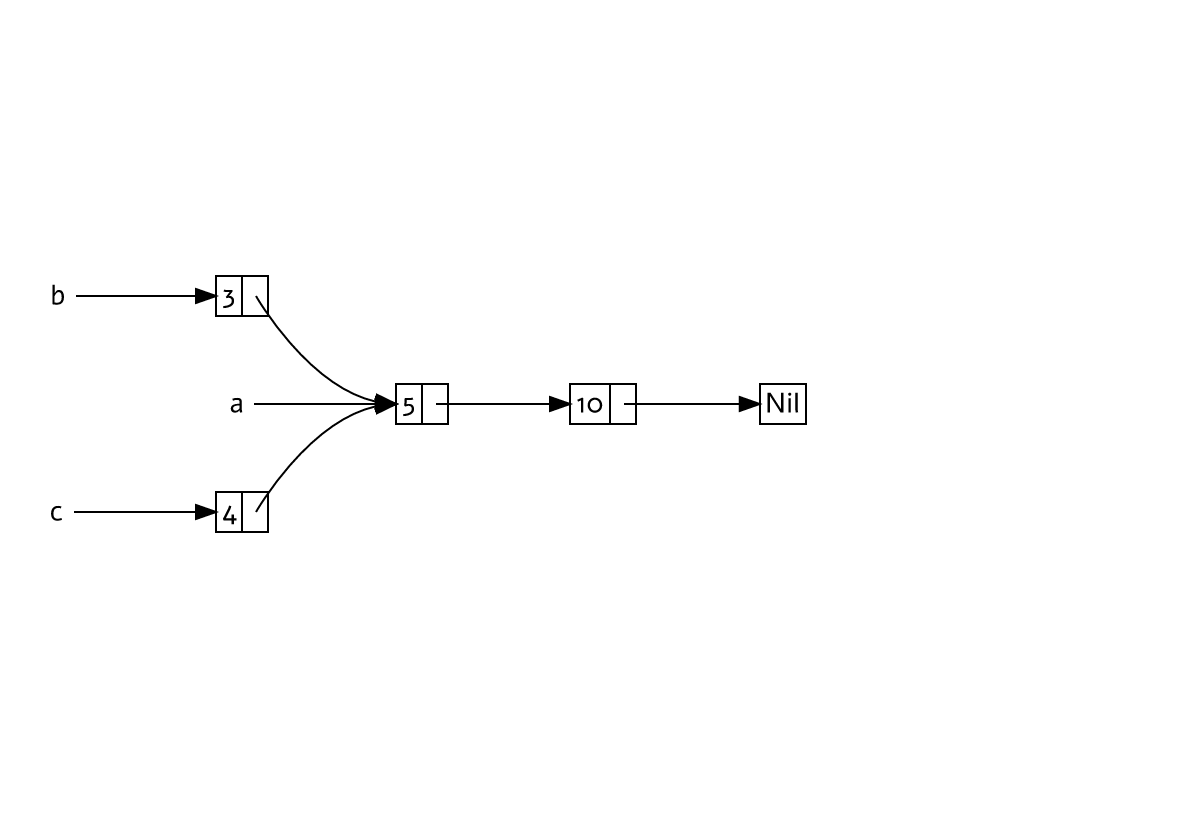
Figure 15-3: Two lists, b and c, sharing ownership of
a third list, a
We’ll create list a that contains 5 and then 10. Then, we’ll make two
more lists: b that starts with 3 and c that starts with 4. Both the b
and c lists will then continue on to the first a list containing 5 and
10. In other words, both lists will share the first list containing 5 and
10.
Trying to implement this scenario using our definition of List with Box<T>
won’t work, as shown in Listing 15-17.
Listing 15-17: Demonstrating that we’re not allowed to have two lists using Box<T> that try to share ownership of a third list
Filename: src/main.rs
enum List {
    Cons(i32, Box<List>),
    Nil,
}

use crate::List::{Cons, Nil};

fn main() {
    let a = Cons(5, Box::new(Cons(10, Box::new(Nil))));
    let b = Cons(3, Box::new(a));
    let c = Cons(4, Box::new(a));
}
When we compile this code, we get this error:
$ cargo run
   Compiling cons-list v0.1.0 (file:///projects/cons-list)
error[E0382]: use of moved value: `a`
  --> src/main.rs:11:30
   |
 9 |     let a = Cons(5, Box::new(Cons(10, Box::new(Nil))));
   |         - move occurs because `a` has type `List`, which does not implement the `Copy` trait
10 |     let b = Cons(3, Box::new(a));
   |                              - value moved here
11 |     let c = Cons(4, Box::new(a));
   |                              ^ value used here after move
   |
note: if `List` implemented `Clone`, you could clone the value
  --> src/main.rs:1:1
   |
 1 | enum List {
   | ^^^^^^^^^ consider implementing `Clone` for this type
...
10 |     let b = Cons(3, Box::new(a));
   |                              - you could clone this value

For more information about this error, try `rustc --explain E0382`.
error: could not compile `cons-list` (bin "cons-list") due to 1 previous error
The Cons variants own the data they hold, so when we create the b list, a
is moved into b and b owns a. Then, when we try to use a again when
creating c, we’re not allowed to because a has been moved.
We could change the definition of Cons to hold references instead, but then
we would have to specify lifetime parameters. By specifying lifetime
parameters, we would be specifying that every element in the list will live at
least as long as the entire list. This is the case for the elements and lists
in Listing 15-17, but not in every scenario.
Instead, we’ll change our definition of List to use Rc<T> in place of
Box<T>, as shown in Listing 15-18. Each Cons variant will now hold a value
and an Rc<T> pointing to a List. When we create b, instead of taking
ownership of a, we’ll clone the Rc<List> that a is holding, thereby
increasing the number of references from one to two and letting a and b
share ownership of the data in that Rc<List>. We’ll also clone a when
creating c, increasing the number of references from two to three. Every time
we call Rc::clone, the reference count to the data within the Rc<List> will
increase, and the data won’t be cleaned up unless there are zero references to
it.
Listing 15-18: A definition of List that uses Rc<T>
Filename: src/main.rs
enum List {
    Cons(i32, Rc<List>),
    Nil,
}

use crate::List::{Cons, Nil};
use std::rc::Rc;

fn main() {
    let a = Rc::new(Cons(5, Rc::new(Cons(10, Rc::new(Nil)))));
    let b = Cons(3, Rc::clone(&a));
    let c = Cons(4, Rc::clone(&a));
}
We need to add a use statement to bring Rc<T> into scope because it’s not
in the prelude. In main, we create the list holding 5 and 10 and store it
in a new Rc<List> in a. Then, when we create b and c, we call the
Rc::clone function and pass a reference to the Rc<List> in a as an
argument.
We could have called a.clone() rather than Rc::clone(&a), but Rust’s
convention is to use Rc::clone in this case. The implementation of
Rc::clone doesn’t make a deep copy of all the data like most types’
implementations of clone do. The call to Rc::clone only increments the
reference count, which doesn’t take much time. Deep copies of data can take a
lot of time. By using Rc::clone for reference counting, we can visually
distinguish between the deep-copy kinds of clones and the kinds of clones that
increase the reference count. When looking for performance problems in the
code, we only need to consider the deep-copy clones and can disregard calls to
Rc::clone.
Cloning to Increase the Reference Count
Let’s change our working example in Listing 15-18 so that we can see the
reference counts changing as we create and drop references to the Rc<List> in
a.
In Listing 15-19, we’ll change main so that it has an inner scope around list
c; then, we can see how the reference count changes when c goes out of
scope.
Listing 15-19: Printing the reference count Filename: src/main.rs
// --snip--

fn main() {
    let a = Rc::new(Cons(5, Rc::new(Cons(10, Rc::new(Nil)))));
    println!("count after creating a = {}", Rc::strong_count(&a));
    let b = Cons(3, Rc::clone(&a));
    println!("count after creating b = {}", Rc::strong_count(&a));
    {
        let c = Cons(4, Rc::clone(&a));
        println!("count after creating c = {}", Rc::strong_count(&a));
    }
    println!("count after c goes out of scope = {}", Rc::strong_count(&a));
}
At each point in the program where the reference count changes, we print the
reference count, which we get by calling the Rc::strong_count function. This
function is named strong_count rather than count because the Rc<T> type
also has a weak_count; we’ll see what weak_count is used for in “Preventing
Reference Cycles Using Weak<T>”.
This code prints the following:
$ cargo run
   Compiling cons-list v0.1.0 (file:///projects/cons-list)
    Finished `dev` profile [unoptimized + debuginfo] target(s) in 0.45s
     Running `target/debug/cons-list`
count after creating a = 1
count after creating b = 2
count after creating c = 3
count after c goes out of scope = 2
We can see that the Rc<List> in a has an initial reference count of 1;
then, each time we call clone, the count goes up by 1. When c goes out of
scope, the count goes down by 1. We don’t have to call a function to decrease
the reference count like we have to call Rc::clone to increase the reference
count: The implementation of the Drop trait decreases the reference count
automatically when an Rc<T> value goes out of scope.
What we can’t see in this example is that when b and then a go out of scope
at the end of main, the count is 0, and the Rc<List> is cleaned up
completely. Using Rc<T> allows a single value to have multiple owners, and
the count ensures that the value remains valid as long as any of the owners
still exist.
Via immutable references, Rc<T> allows you to share data between multiple
parts of your program for reading only. If Rc<T> allowed you to have multiple
mutable references too, you might violate one of the borrowing rules discussed
in Chapter 4: Multiple mutable borrows to the same place can cause data races
and inconsistencies. But being able to mutate data is very useful! In the next
section, we’ll discuss the interior mutability pattern and the RefCell<T>
type that you can use in conjunction with an Rc<T> to work with this
immutability restriction.